


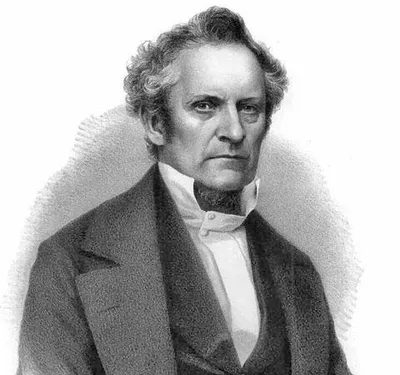
Julius Plückerer is not your typical one-trick pony. Born in 1801 in Elberfeld, Germany, he spent his life moving between two worlds that most people kept strictly separate. First is the abstract and rigorous realm of pure mathematics. Then there’s the messy, experimental side of physics. He didn’t just frequent these areas; He conquered both.
His journey begins in the auditoriums of Heidelberg, Bonn, Berlin and Paris. In 1829, he received a professorship at the University of Bonn. This is where things get interesting. He published Analytisch-geometrische Entwicklungen. This is more than just a book. It’s a blueprint for a new way of looking at the universe.
Traditional geometry focused on points. Plückerer flipped the script. He uses lines as basic building blocks. This is not just an adjustment. This is a revolution. He discovered the dual principle of projective geometry. This idea is simple but effective. If the statement about the points is true, then the corresponding statement about the line is also true. Just replace the elements. This is a mathematical mirror.
In 1834 he moved to Halle for a short stay. Two years later he returned to Bonn. At that time he rejected the “algebraic curve theory”. Here he introduced what we now call Plückerer formulas These equations connect the singularities of the algebraic curve to the those of their duals. Basically, these map breaks and infinities in the functional landscape. He also promoted linear functions as an alternative to standard coordinate systems. His 1846 work System der Geometrie des Raumes refined all this into an integrated system.
But then things changed. Major Pivot.
Mathematician Jakob Steiner was leading an synthetic school in Berlin at the time. This is mainstream. Plückerer felt like an outsider. Or maybe he’s just bored. For some reason he gave up geometry. He turned to physics.
This twist changes everything. In 1847, he began to study crystals in magnetic fields. The results are fundamental. These will help you understand magnetism better. But his most famous work is not magnetism. It’s in the light.
He collaborated with physicist Johann W. Hittorf. They observed cathode rays together. They study magnetic deflection. They thoroughly researched spectroscopy. They were years ahead. Plückerer laid the foundation long before Robert Bunsen and Gustav Kirchhoff made their famous statements about spectral lines. He showed that spectral lines could identify chemical substances.
In 1862 he did an important thing. Even the same element can show different spectra depending on the temperature. This is not just a small detail. This is an important insight into how matter interacts with energy. Hittorf remembers that Plücker was the first to identify three lines in the hydrogen spectrum. This line was identified in solar radiation only a few months after Plücker’s death in 1868.
Why is this important today?
Let’s think about the screen. Think of the light from a street lamp. All of this depends on how the atoms emit light. Plücker’s research on cathode rays and spectroscopy served as a bridge. He doesn’t just measure light. He traces its origins. He showed that electricity and light are connected in a way that was no one had fully mapped before.
After Steiner’s death in 1863, Plücker continued his mathematical studies. But it’s not old math. This is a new area. line geometry. He considered straight lines to be the main elements of space. His 1868 Neue Geometrie des Raumes was a groundbreaking sketch.
He never finished the second part. His young student Felix Klein intervened. Klein had the talent to finish this painting. Without him, Plückere’s final ideas about the geometry of space might have remained fragmented.
Plücker died in Bonn in 1868. His legacy cannot be easily categorized. He was a geometer and later a physicist. A theorist turned experimenter. He shows that the boundaries between disciplines are often artificial. The real discovery happens when you cross them.
We still use his formula. We still rely on his spectral vision. The spectral lines of hydrogen he discovered are still used to identify stars. It is a kind of silent immortality. Not everyone has Plückerer’s name. But his work can be seen everywhere.
The question is whether he understands how important his turn is. Or maybe he’s just letting his curiosity get the best of him. Probably the latter. He’s not looking for fame. He is looking for the truth. He observed this in both numbers and light.

