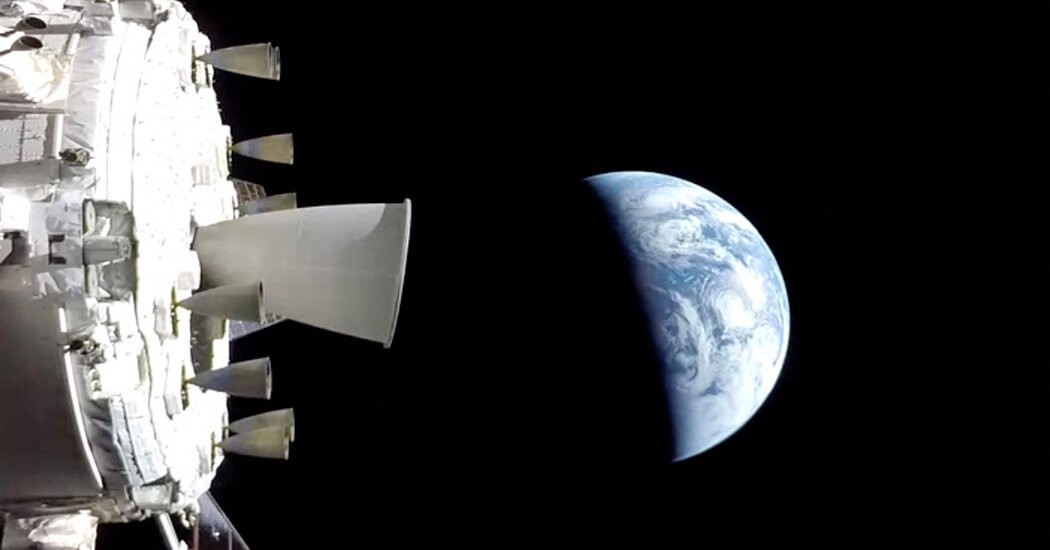
After 10 days in deep space and a record-breaking journey around the Moon, the Artemis II crew is preparing for their final, most critical phase: returning to Earth. The mission, which marks the first crewed foray into deep space in over five decades, is now entering its high-stakes splashdown sequence.
The Final Countdown: What to Expect
The return of the Orion spacecraft is a precision-timed operation. The transition from orbital flight to atmospheric re-entry involves several rapid stages:
- 7:33 p.m. ET: The crew module (the capsule containing the astronauts) will detach from the service module, which provides power and propulsion.
- 7:37 p.m. ET: The capsule will fire its thrusters to orient itself for the descent trajectory.
- 7:53 p.m. ET: The capsule will hit the upper layers of Earth’s atmosphere at a staggering 24,000 mph.
- 8:07 p.m. ET: Following a period of deceleration via atmospheric friction and parachute deployment, the capsule is expected to splash down in the Pacific Ocean, west of San Diego.
Note for observers: While the re-entry may produce a sonic boom detectable in parts of Southern California, the spacecraft itself will likely not be visible to the naked eye, as it will descend over the ocean during daylight hours.
A Mission of Firsts and Records
Artemis II has been defined by its historic milestones and its role as a “test bed” for the future of lunar exploration. The crew—comprising Reid Wiseman, Victor Glover, Christina Koch, and Jeremy Hansen —has achieved several significant feats:
- Breaking Records: The crew surpassed the distance record previously held by Apollo 13, traveling 252,756 miles from Earth.
- New Perspectives: The astronauts captured high-resolution imagery of the Moon’s far side—areas that remained in shadow during the Apollo era—providing unprecedented geological data.
- Breaking Barriers: The crew includes the first Black man (Glover), the first woman (Koch), and the first Canadian (Hansen) to travel around the Moon.
Testing the Limits: Successes and Setbacks
While the mission has been a triumph of navigation and observation, it has also served as a rigorous stress test for NASA’s hardware. The crew dealt with several real-world challenges, including communication glitches and mechanical issues with the spacecraft’s toilet, highlighting the necessity of specialized IT and plumbing support in long-duration spaceflight.
More critically, the mission has tested the core life-support and propulsion systems required to sustain humans in deep space. However, the mission has not been without controversy.
The Heat Shield Debate
A significant point of tension remains the Orion heat shield. NASA has acknowledged flaws in the shield’s design, though the agency maintains that the trajectory was carefully planned to mitigate these risks and ensure safety. Despite NASA’s confidence, some veteran astronauts and engineers have voiced concerns, suggesting that the risks posed by the shield’s imperfections should have precluded the launch.
Looking Ahead
The success of Artemis II is not measured merely by the safe return of its crew, but by the data gathered during its 695,000-mile journey. By testing new spacesuits, emergency life-support systems, and docking capabilities, NASA is building the foundation for much more ambitious goals: landing humans back on the lunar surface and, eventually, venturing toward Mars.
Conclusion: As the Orion capsule prepares to descend through the atmosphere, Artemis II stands as a successful, if challenging, bridge between the era of Apollo and the future of permanent human presence in deep space.