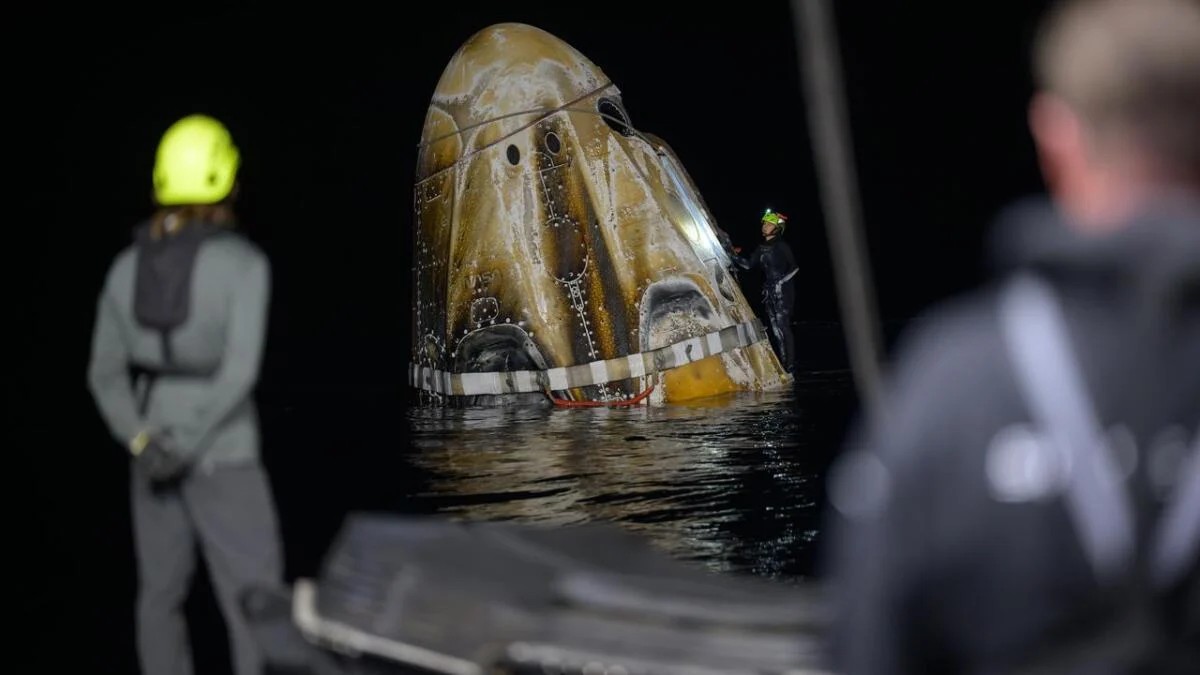
Colonel Mike Fincke, a veteran NASA astronaut, has publicly confirmed that he was the crewmember who experienced a medical issue in space last month, forcing an unprecedented early return of his SpaceX Crew-11 mission from the International Space Station (ISS). The incident marks NASA’s first controlled medical evacuation from the ISS in its 25 years of continuous habitation.
The Incident and Response
On January 7th, just one day before a scheduled spacewalk, Fincke experienced a health event that required immediate attention from his crewmates. While he did not disclose the specific diagnosis, Fincke stated he is now “doing very well” and undergoing standard post-mission rehabilitation. The rapid response of his team, guided by NASA flight surgeons, stabilized his condition quickly.
The decision to bring the crew home a month ahead of schedule—on January 15th—underscores the inherent challenges of providing advanced medical care 250 miles above Earth. The incident highlights that even with extensive preparation, complex health problems are difficult to manage without access to terrestrial facilities.
Temporary Staffing Gap at the ISS
The early departure left Chris Williams, an American astronaut who arrived via a Russian Soyuz spacecraft in November 2025, as the sole U.S. presence on the ISS for a month until the arrival of Crew-12 on February 14th. This temporary staffing gap illustrates the logistical dependencies of international space operations.
Fincke’s Career and Medical Care
Fincke, 58, is a highly experienced astronaut with over 549 days in space across four missions: Expedition 9 (2004), Expedition 18 (2009), STS-134 (2011), and Expedition 74 (2025). He has logged nine spacewalks totaling nearly 49 hours.
NASA initially withheld the astronaut’s identity due to medical privacy, but the agency confirmed the event was not work-related. Fincke’s statement revealed that the evacuation facilitated access to advanced medical imaging unavailable on the ISS, with his post-landing care provided at Scripps Memorial Hospital La Jolla in California.
Space Medicine Realities
Astronauts routinely deal with minor medical issues in orbit—from toothaches to infections—often managed with telemedicine and onboard supplies. More severe cases, like a previously treated blood clot, require resupply missions to deliver necessary medications.
“Spaceflight is an incredible privilege,” Fincke said, “and sometimes it reminds us just how human we are.”
This incident serves as a stark reminder that even in the advanced realm of space exploration, human physiology remains vulnerable, and emergency terrestrial support can be critical. The controlled evacuation, as opposed to an immediate deorbit, prioritized safety and landing conditions over speed.
The event underscores the delicate balance between pushing the boundaries of space exploration and ensuring the well-being of those who venture beyond Earth.