Astronomers have released the most comprehensive radio map of the sky to date, revealing 13.7 million previously unseen celestial objects. This breakthrough, made possible by the LOFAR Two-metre Sky Survey (LoTSS-DR3), provides a new window into the universe by detecting radio waves invisible to the human eye.
The Scale of Discovery
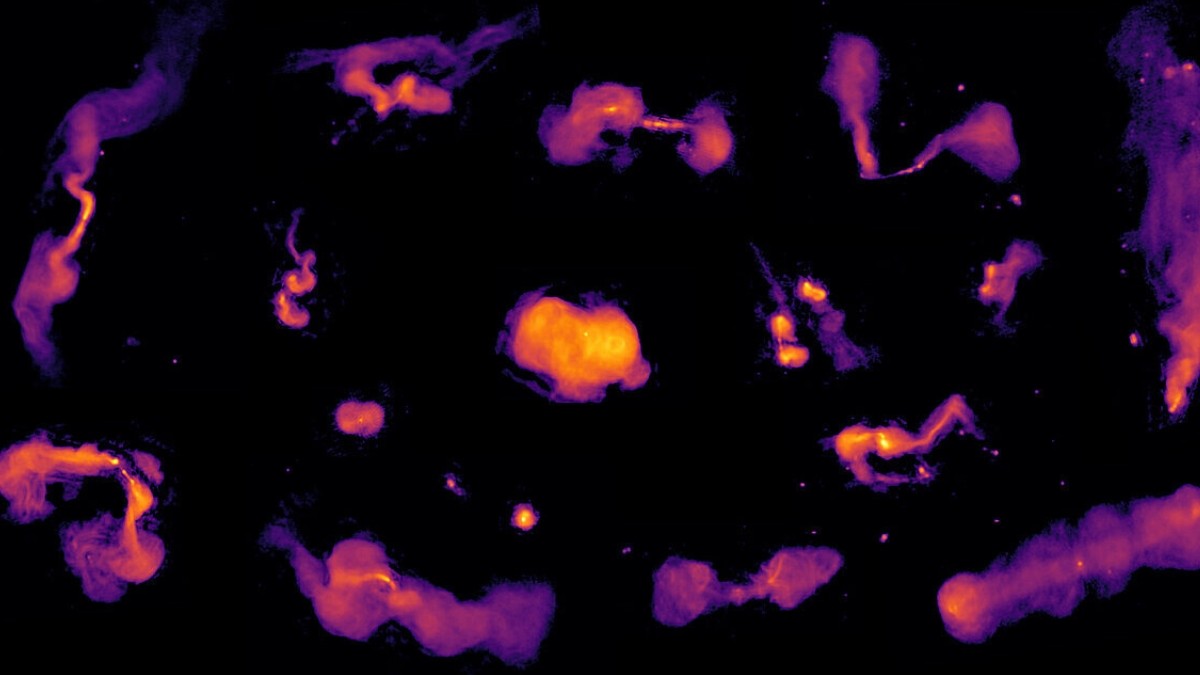
The survey covers 88% of the northern sky, compiled from over 13,000 hours of data gathered over years. This isn’t just a larger map; it’s a fundamentally different way of seeing the cosmos. Radio astronomy reveals phenomena obscured to optical telescopes, such as the extreme distortions of galaxies shaped by supermassive black hole jets.
The sheer volume of data—18.6 petabytes—required the use of supercomputers at the Jülich Supercomputing Centre in Germany, consuming over 20 million core hours of processing time. This demonstrates how modern astronomy is increasingly reliant on big data and advanced computational infrastructure.
How LOFAR Works: A Distributed Telescope
The Low Frequency Array (LOFAR) isn’t a single dish but an interferometer: a network of over 20,000 antennas spread across 52 stations in the Netherlands and other European countries. Spanning over 1,000 kilometers, this array functions as a single, continent-sized telescope. The system digitizes and combines 13 terabytes of raw data per second—equivalent to over 300 DVDs—to create each image.
This approach allows LOFAR to detect low-frequency radio waves, which penetrate dense dust clouds and reveal hidden structures within galaxies, as well as the evolution of black holes and the birth of stars. The result is a ghostly, unfamiliar view of the universe, with familiar sights like the Andromeda Galaxy appearing as a cosmic eye peering into its future collision with the Milky Way.
Implications and Future Prospects
The release of this data is not just an end point but a starting point. Previous LOFAR releases have already led to discoveries like the identification of 25,000 supermassive black holes in a single image. The open availability of LoTSS-DR3 will spur further research, as astronomers leverage this unprecedented dataset.
This work also serves as a vital stepping stone towards the Square Kilometre Array Observatory (SKAO), an even more ambitious project to build the world’s largest radio telescope arrays in South Africa and Australia. LOFAR has proven the feasibility of large-scale, data-intensive radio astronomy, paving the way for future explorations of the cosmos.
The implications of this discovery are clear: our understanding of the universe is expanding thanks to new technologies and collaborative efforts. The hidden universe is becoming visible, one radio wave at a time.