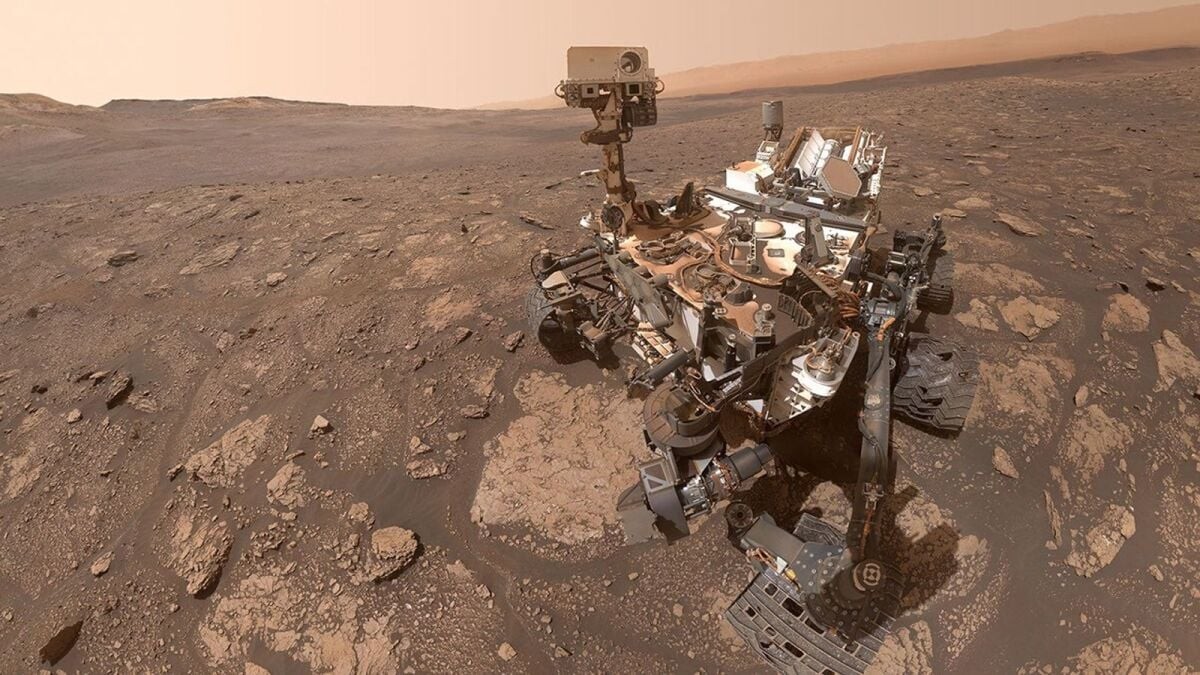
For years, NASA’s Curiosity rover has been picking up “breadcrumbs” of organic matter on Mars—small, simple carbon-based molecules that hinted at a chemically active past. However, a groundbreaking new analysis suggests these fragments are not just isolated traces, but parts of a much larger, more complex chemical puzzle.
By utilizing a specialized chemical process on a rock sample collected six years ago, scientists have identified 21 different organic molecules, marking the largest and most diverse set of organic compounds ever detected on the Red Planet.
The Breakthrough: From Fragments to Complexity
The discovery, published in Nature Communications, stems from a sophisticated experiment conducted in the Gale Crater. Using a solvent called tetramethylammonium hydroxide (TMAH), the rover’s onboard laboratory was able to break down rock samples more effectively, revealing a wealth of detail that previous missions had missed.
Among the findings are several key indicators of chemical complexity:
– Seven entirely new molecules never before seen on Mars.
– Nitrogen heterocycles : Ring-shaped structures containing nitrogen. This is particularly significant because nitrogen is a fundamental building block of DNA and RNA on Earth.
– Naphthalene and benzothiophene : Compounds that typically suggest the breakdown of much larger, more intricate carbon structures.
“Our discovery not only expands the catalog of known molecules, but tells us that some of the building blocks for life as we know it on Earth were also present on Mars in the ancient past.” — Amy Williams, Lead Author, University of Florida
Why This Matters for the Search for Life
While these findings do not prove that life ever existed on Mars, they fundamentally change our understanding of the planet’s history.
To support life, a planet needs more than just the right ingredients; it needs an environment stable enough to preserve them. The presence of these complex molecules suggests that ancient Mars possessed a “gentle” enough chemistry to protect organic matter from being destroyed by harsh radiation and extreme climate shifts.
The role of clay is central to this preservation. The sample was taken from a clay-rich area nicknamed “Mary Anning.” On Earth, clay minerals are known for their ability to trap and shield organic material from degradation. The fact that these molecules survived for billions of years suggests that Mars’ geological history may have provided the perfect “vault” for biological signatures.
A High-Stakes Scientific Experiment
This discovery was the result of a high-stakes, precision mission. Curiosity carried only two small containers of the necessary chemical solvent for its entire multi-year mission. After the first use in 2020, NASA scientists spent years refining the process, redesigning the experiment into a three-stage procedure to more closely mimic advanced Earth-based laboratories.
The successful use of this final supply of TMAH has provided a roadmap for how future missions might hunt for even more elusive traces of ancient microorganisms.
Looking Ahead
The rock analyzed today formed roughly 3.5 billion years ago, during a period when the Gale Crater was a water-rich environment. If Mars ever hosted life, or even the precursors to it, the chemical traces would likely be found in exactly this kind of preserved, clay-rich sediment.
Conclusion: The detection of complex, nitrogen-rich organic molecules proves that Mars once possessed a sophisticated chemical landscape capable of preserving the fundamental building blocks of life. This discovery shifts the focus from merely finding “ingredients” to searching for the preserved remains of a complex, ancient world.