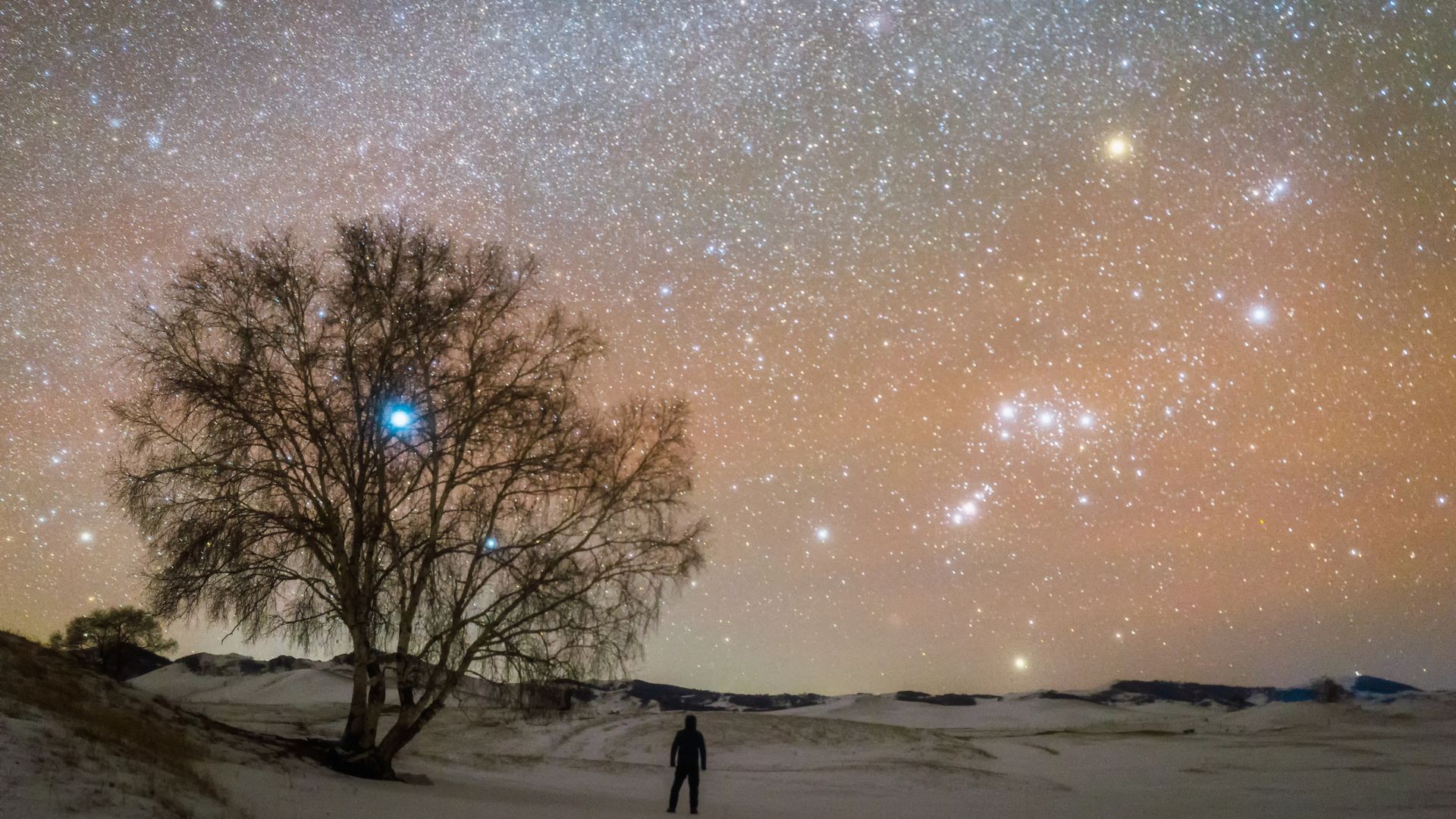
If you look up at the night sky on a winter evening and then again during the height of summer, you will notice something striking: the stars have changed. Familiar patterns like Orion may vanish entirely, replaced by new shapes and clusters.
This phenomenon isn’t because the stars are moving away; rather, it is a result of our own planet’s complex dance through space.
The Mechanics of Visibility
The primary reason constellations appear and disappear is the combination of Earth’s rotation and its orbit around the Sun. To understand this, we must consider two main factors:
- Nighttime Orientation: Night occurs when our side of the Earth faces away from the Sun. At that moment, we are looking into a specific direction in space. The stars we see are simply the ones located in that particular direction.
- The Annual Orbit: As Earth revolves around the Sun over the course of a year, our “viewing window” into the universe shifts. In the summer, the Earth is positioned such that certain constellations are behind the Sun from our perspective. Because the Sun’s light drowns them out, they become invisible to us until Earth moves further along its orbit.
For example, Orion’s Belt is a winter staple in the Northern Hemisphere. By summer, Earth has moved to the opposite side of the Sun, placing Orion in a part of space that is obscured by daylight.
The Exceptions: Circumpolar Constellations
Not all stars are seasonal travelers. Some constellations remain visible throughout the entire year, regardless of the season. These are known as circumpolar constellations.
Because these patterns are located near the celestial poles, they never “set” below the horizon from certain vantage points. Instead, they appear to slowly circle the pole as the Earth rotates.
– In the Northern Hemisphere: Polaris (the North Star) and the Big Dipper (part of Ursa Major) are permanent fixtures.
– In the Southern Hemisphere: The Southern Cross serves as a year-round guide.
It is important to note that visibility is also determined by your latitude. Stargazers in the Northern Hemisphere see different portions of the sky than those in the Southern Hemisphere, particularly regarding stars located near the equator.
The Long-Term Shift: Earth’s “Wobble”
While seasonal changes happen yearly, the night sky is also changing on a much grander, millennial scale. Earth does not spin perfectly straight; it undergoes a slight “wobble” known as precession.
This wobble means that the positions of stars and the timing of the zodiac constellations are constantly, albeit slowly, shifting. This has profound implications for celestial navigation:
1. The North Star is not permanent: Thousands of years ago, the star Thuban served as the North Star. In 5,000 years, a completely different star will take its place.
2. Scientific Timing: Astronomers must time their observations carefully. For instance, to study the supermassive black hole at the center of our galaxy, researchers must wait for the specific time of year when the constellation Sagittarius is visible and not blocked by the Sun’s glare.
“Sometimes what initially seems a little bit confusing can become clearer when we shift our perspective a little bit.” — Michael Brown, Monash University
Conclusion
The shifting patterns of the stars are a direct reflection of Earth’s movement through the solar system. By understanding our planet’s rotation, orbit, and axial wobble, we can better navigate the cosmos and time our observations of the universe’s most profound mysteries.