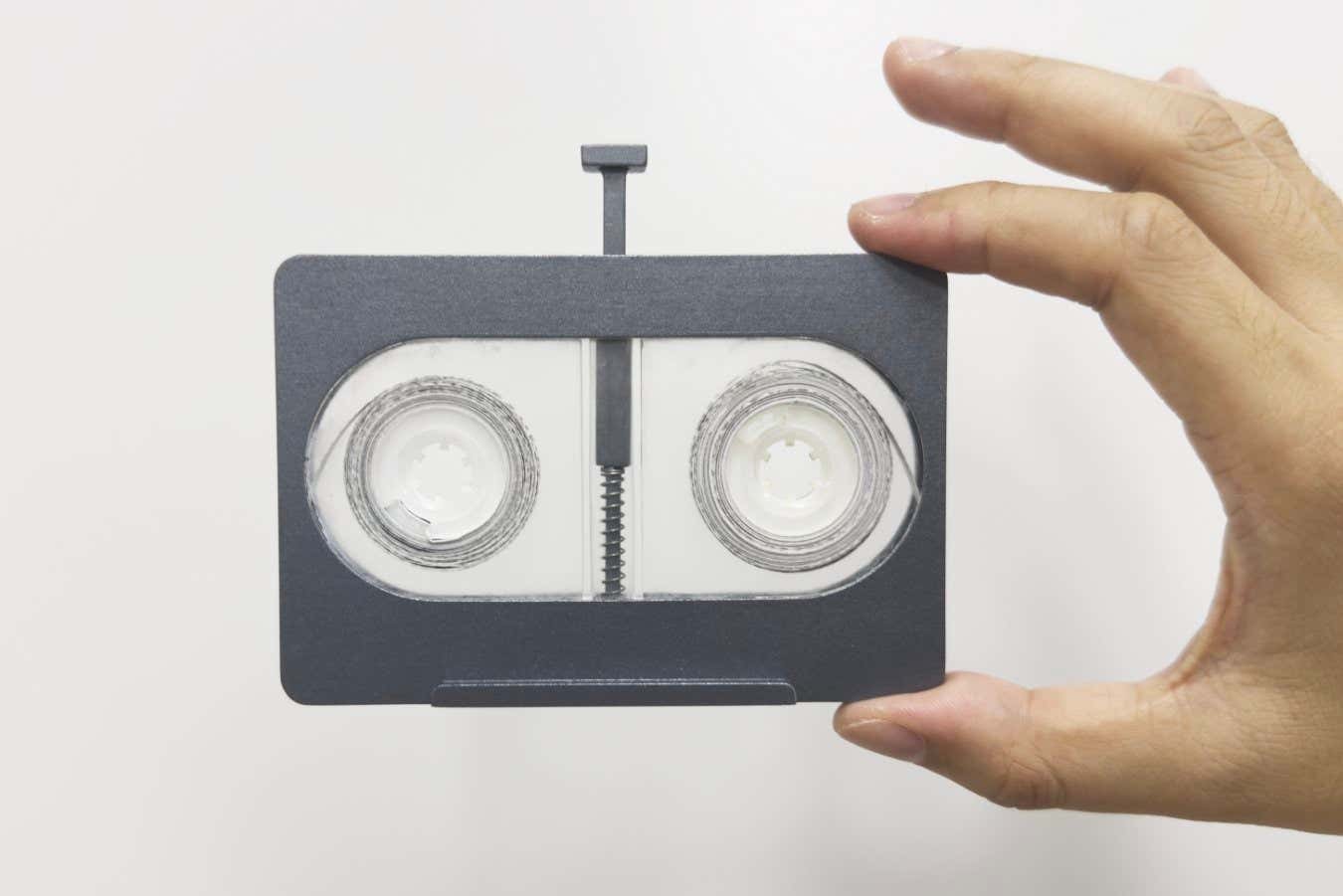
Researchers have revived the cassette tape format using synthetic DNA as a storage medium, achieving an unprecedented data density that dwarfs conventional digital methods. The innovation, developed at the Southern University of Science and Technology in Guangdong, China, allows for storing the entirety of recorded music on just 100 meters of tape. This isn’t just nostalgia; it’s a leap forward in long-term data preservation.
The Science Behind the Breakthrough
Traditional cassette tapes rely on magnetic particles to encode information. The new method replaces this with DNA molecules, where the order of the four nucleotide bases (Adenine, Thymine, Cytosine, and Guanine) represents digital data as binary code. This allows for storing approximately 36 petabytes —equivalent to 36,000 terabyte hard drives—on a single tape.
The key advantage of DNA is its stability and density; DNA can last for centuries under proper conditions, unlike magnetic or flash storage which degrades over time.
Beyond Capacity: The Unexpected Impact
The project’s lead researcher, Xingyu Jiang, noted that the response has been far broader than anticipated. “Many people wrote to us saying the work inspired them to think about data, biology and technology in new ways.” The cassette’s revival isn’t just a scientific feat; it’s a cultural moment sparking creativity across disciplines.
The Path to Commercialization
The team is now focused on developing a functional read-write “head” to interact with the DNA tape. The current prototype involves chemically processing the DNA in a reaction chamber, but the goal is a streamlined, commercially viable device. Jiang estimates the DNA cassette tape could be available within five years.
“For us, the DNA cassette tape project was always about more than just storage capacity. It’s about reimagining how information can live in physical, even biological, forms,” says Jiang.
The reemergence of the cassette tape as a DNA-based storage solution highlights the potential of biological mediums to address the growing demands for long-term, high-density data archiving. This technology offers a compelling alternative to traditional methods, promising a future where data isn’t just stored, but preserved.