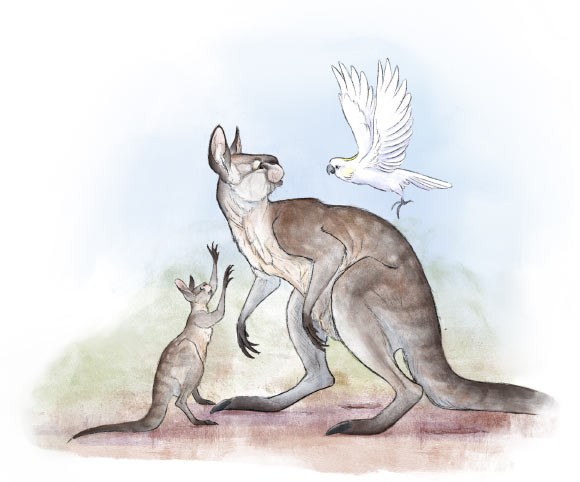
Recent paleontological research overturns long-held assumptions about the locomotion of extinct giant kangaroos. A team from the University of Bristol, University of Manchester, and University of Melbourne has demonstrated that these Ice Age megafauna – some weighing up to 250 kg (over twice the size of modern red kangaroos) – were physically capable of hopping. The study challenges previous estimates that suggested hopping would be mechanically impossible for animals exceeding 150 kg.
Rethinking Size Limits in Kangaroo Evolution
For years, scientists believed that as kangaroos grew larger during the Pleistocene epoch (2.6 million to 11,700 years ago), they would have had to abandon hopping in favor of more sustainable gaits. The logic was simple: larger body mass should have put unsustainable stress on their hindlimbs. However, the new research suggests that these ancient kangaroos were not merely scaled-up versions of modern species; they possessed distinct anatomical adaptations that allowed them to overcome these limitations.
The team analyzed hindlimb bones from 94 modern kangaroos and wallabies, as well as 40 fossil specimens from the extinct Protemnodon genus. By calculating the weight-bearing capacity of the fourth metatarsal (a critical bone for hopping) and assessing heel bone structure, researchers determined that giant kangaroos had the robust bones and tendon support necessary to withstand hopping stresses.
How Giant Kangaroos Hopped
The study revealed that the metatarsals of giant kangaroos were strong enough to handle the physical stress of hopping, and their heel bones were large enough to accommodate the thick tendons needed for powerful, elastic movement. While likely not as efficient as the hopping of smaller species, this adaptation suggests that these giants could indeed use hopping as a means of locomotion.
Researchers propose that giant kangaroos probably didn’t rely on hopping for all movement, given its inefficiency over long distances. Instead, they likely used short bursts of hopping to evade predators like the extinct marsupial lion Thylacoleo, or to quickly navigate rough terrain. Thicker tendons would have provided greater safety at the cost of reduced energy return.
Broader Implications for Australian Megafauna
This research highlights the ecological diversity of prehistoric Australia. Some large kangaroos likely grazed like their modern counterparts, while others were browsers – filling a niche not seen in today’s megafauna. The findings suggest that kangaroos occupied a wider range of habitats and behaviors than previously understood.
“Our findings contribute to the notion that kangaroos had a broader ecological diversity in prehistoric Australia than we find today,” said Dr. Robert Nudds, a researcher at the University of Manchester.
The study, published in Scientific Reports, reinforces the idea that extinct kangaroos were not simply oversized versions of modern species, but uniquely adapted animals that thrived in a different ecological context.
This research shifts our understanding of how kangaroos evolved and interacted with their environment, demonstrating that physical limits are not always absolute in the face of natural selection.