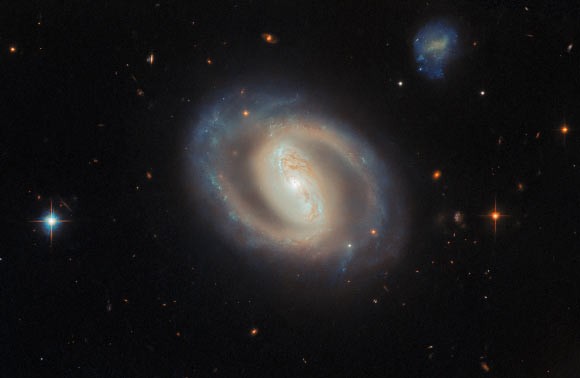
The Hubble Space Telescope has delivered a striking new image of IC 486, a barred spiral galaxy 380 million light-years away in the constellation Gemini. This captivating view reveals intricate details of the galaxy’s structure, including its active galactic nucleus powered by a supermassive black hole.
Discovery and Key Characteristics
Originally discovered in 1891 by Austrian astronomer Rudolf Spitaler, IC 486 (also known by designations LEDA 22445, IRAS 07572+2645, or UGC 4155) presents a classic barred spiral morphology. A prominent bar-shaped structure dominates its center, with spiral arms extending outward in a smooth, ring-like pattern. This arrangement is common in many galaxies, indicating a specific formation process influenced by gravitational interactions and stellar evolution.
Stellar Populations and Dust Distribution
Hubble’s observations highlight subtle color variations within IC 486. The galaxy’s central region glows with the light of older stars, while scattered bluish areas in the surrounding disk mark zones of recent star formation. Wisps of dust weave throughout the structure, obscuring light and tracing regions dense in molecular gas – the nurseries where new stars emerge. This dynamic interplay between stellar populations and interstellar dust is crucial to understanding galactic evolution.
An Active Galactic Nucleus
A bright, white glow at the galaxy’s center confirms the presence of an active galactic nucleus (AGN). This luminosity is fueled by a supermassive black hole exceeding 100 million times the mass of our Sun.
Every large galaxy hosts a supermassive black hole, but not all are actively feeding. In galaxies like IC 486, the black hole aggressively pulls in gas and dust, forming a superheated accretion disk. The intense friction within this disk generates extreme radiation, including X-rays, that can outshine the entire galaxy. This makes IC 486 an “active galaxy,” demonstrating the powerful forces at play in the universe.
Galactic Evolution
Though appearing serene, IC 486 is a dynamic system undergoing constant change. Over millions of years, stars will be born, live out their lifecycles, and eventually fade, continuously reshaping the galaxy’s structure. The processes observed within IC 486 are representative of the ongoing evolution of galaxies across the universe.
IC 486 serves as a vivid example of how gravity, stellar populations, and supermassive black holes work in tandem to sculpt the cosmos. The galaxy’s structure, stellar birth, and energetic nucleus all contribute to the ongoing story of galactic life in the Universe.
The Hubble telescope’s image provides valuable insight into the complex dynamics of this distant galaxy, furthering our understanding of galactic evolution and the role of supermassive black holes in shaping the cosmos.