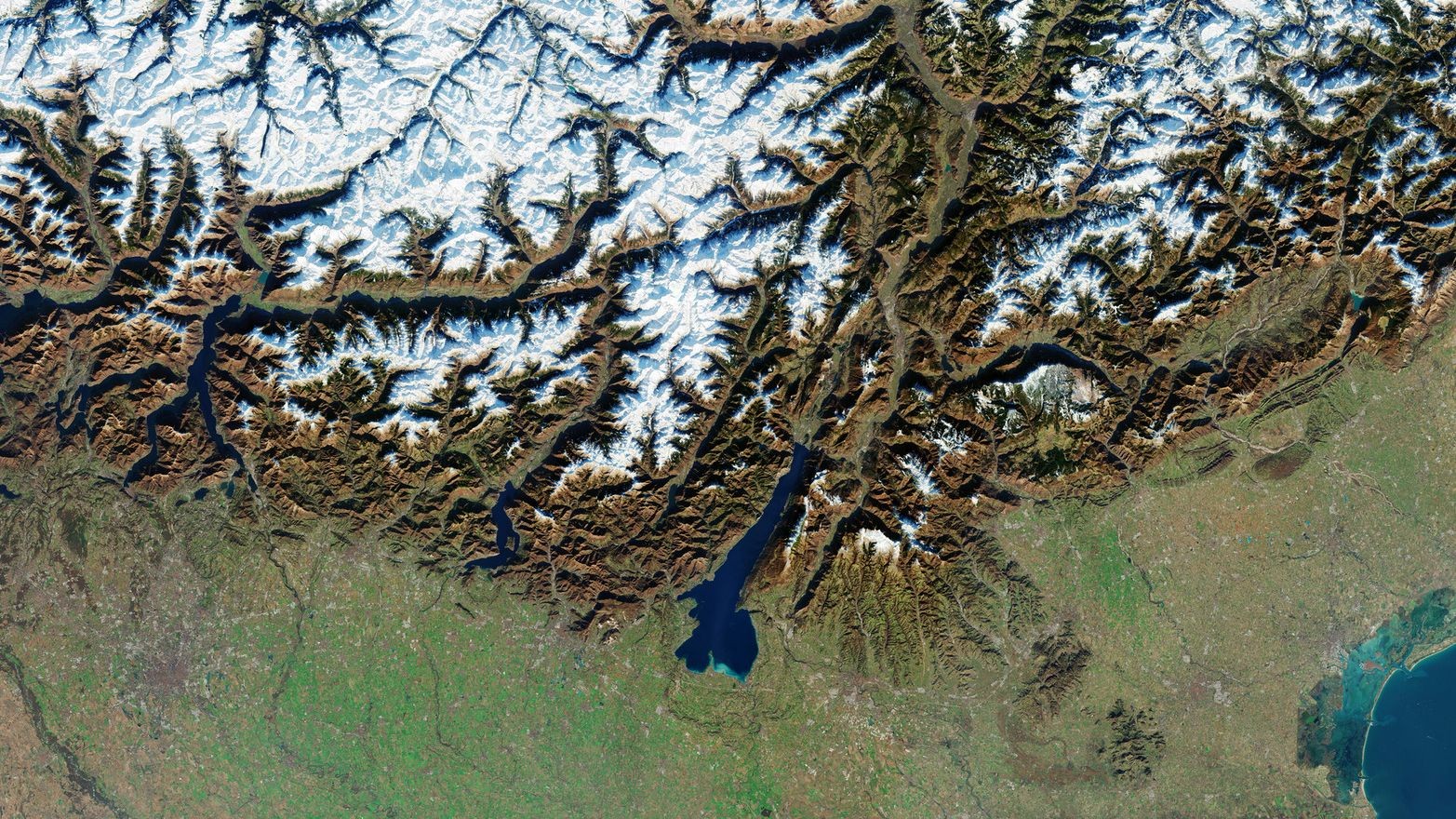
Spectacular satellite imagery released by the European Space Agency (ESA) offers a unique perspective on Italy’s preparations for the 2026 Milano-Cortina Winter Olympics, which officially opened on February 6th. The images, captured by ESA’s Copernicus Sentinel-2 mission, showcase the stunning alpine landscapes and key host cities from a vantage point 786 kilometers above Earth.
A Bird’s-Eye View of the Olympic Region
The Sentinel-2 satellites provide high-resolution visuals of the diverse Italian terrain. Snowy valleys and dramatic mountain peaks define the Olympic venues, with Cortina d’Ampezzo—the “Pearl of the Dolomites”—clearly visible nestled among the northern alpine regions. This region will host events like alpine skiing, curling, and bobsleigh.
To the south, the images reveal the urban centers of Milano and Verona, alongside the expansive Lake Garda and the coastal lagoon of Venice. This juxtaposition highlights the scale of the event, extending from major metropolitan areas to remote mountainous settings.
The Role of Satellite Technology
The Copernicus-2 mission relies on three satellites—Sentinel-2A, Sentinel-2B, and Sentinel-2C—equipped with multispectral imaging instruments. These instruments achieve a spatial resolution of up to 10 meters, allowing for detailed monitoring of land and coastal areas.
These satellites don’t just capture pretty pictures. They are vital for tracking environmental changes, monitoring agricultural health, and assisting in disaster response by mapping flood zones, wildfires, and earthquake damage.
The Italian IRIDE Hawk constellation contributed to the imagery, further demonstrating the country’s investment in Earth observation technology.
Why This Matters
The use of satellite technology in event preparation and disaster management is becoming increasingly common. High-resolution Earth observation provides real-time data for logistical planning, security monitoring, and emergency response. The 2026 Olympics serves as a test case for integrating advanced remote sensing into large-scale international events.
The event will bring thousands of athletes to the region, and this satellite imagery is part of a broader trend toward using space-based data for optimizing infrastructure and ensuring safety. The images serve as a reminder that modern events are not just about sports, but about technological advancement and global cooperation.
The ESA’s Sentinel-2 mission continues to provide invaluable data for both scientific research and practical applications, bridging the gap between space exploration and real-world impact.