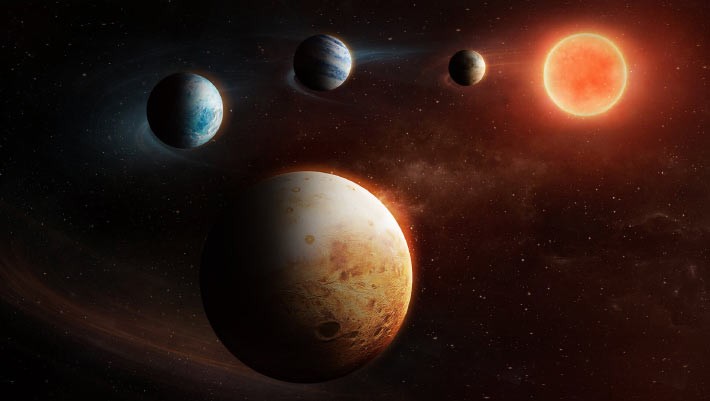
Astronomers using the European Space Agency’s (ESA) CHEOPS satellite have discovered a unique four-planet system around the red dwarf star LHS 1903, located 116.3 light-years away. What makes this system stand out is its outermost planet: a small, rocky world where gas giants are expected. This finding challenges existing theories about how planets form, suggesting they can emerge even in gas-poor environments previously thought inhospitable to rocky planet creation.
A System Turned Inside Out
The star, also known as TOI-1730 or G 107-55, is a cool, dim M-dwarf – smaller and fainter than our Sun. The planets orbit in an unusual order: a rocky planet (LHS 1903b) closest to the star, followed by two gas giants (LHS 1903c and LHS 1903d), and then another rocky planet (LHS 1903e) at the system’s outer edge. This arrangement is unexpected because rocky planets typically form closer to stars where radiation strips away their atmospheres, while gas giants accumulate further out in cooler, gas-rich regions.
Challenging Existing Models
Current planet formation models predict that gas giants dominate the outer regions of planetary systems. The discovery of a rocky planet where a gas giant should be raises fundamental questions about planetary evolution. The research team, led by Dr. Thomas Wilson at the University of Warwick, ruled out several explanations, including atmospheric stripping by collisions or planetary migration. Instead, their simulations suggest that the planets formed sequentially, with the outer rocky planet arising after the system had depleted its gas supply.
“It seems that we have found first evidence for a planet which formed in what we call a gas-depleted environment,” Dr. Wilson stated.
This implies that rocky planet formation is not strictly limited to the inner regions of planetary systems and can occur even when gas is scarce.
Implications for Exoplanet Research
The discovery has significant implications for our understanding of planet formation. It suggests that the conditions required for rocky planet creation may be more widespread than previously thought, potentially increasing the likelihood of finding habitable worlds in unexpected places. ESA’s CHEOPS project scientist, Dr. Maximilian Günther, emphasized that the finding is precisely the kind of puzzle the satellite was designed to solve.
The findings were published in the journal Science on February 12, 2026, under the title: “Gas-depleted planet formation occurred in the four-planet system around the red dwarf LHS 1903.” (DOI: 10.1126/science.adl2348).
This discovery highlights that planet formation is still a poorly understood process, and that our current models may need revision to account for the diversity of planetary systems observed beyond our own.