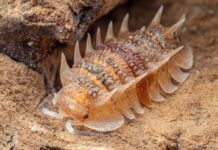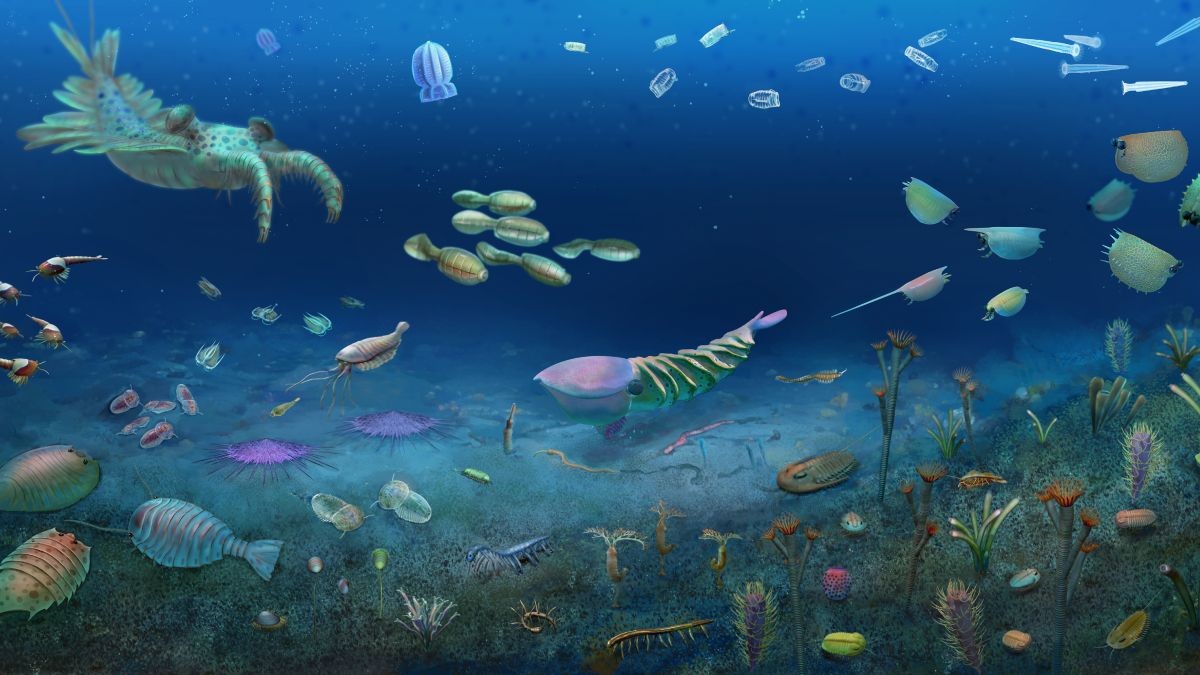
A recently unearthed fossil site in Hunan, South China, is reshaping our understanding of how life rebounded after a major extinction event roughly 513 million years ago. The discovery, named the Huayuan biota, represents an unprecedented snapshot of an ecosystem in recovery, preserved in extraordinary detail—including soft tissues and internal structures. Nearly 60% of the species found are previously unknown to science.
The Sinsk Extinction and Its Aftermath
Around 513.5 million years ago, the Sinsk extinction event dramatically reshaped Earth’s Cambrian landscape, cutting short the Cambrian explosion of life. While the extinction itself is known, what happened immediately after remained largely a mystery. The Huayuan biota fills this gap, offering a direct window into the ecosystem’s recovery.
The site contains 153 animal species across 16 major groups, totaling over 8,600 specimens. Its richness and preservation rival those of the famed Burgess Shale in Canada, classifying it as a rare “Burgess Shale-type” (BST) Lagerstätte—a fossil bed where even the most delicate soft tissues are fossilized. This level of detail is critical because it shows not just what lived, but how they lived.
A Deep-Water Refuge
Paleontologists have long known that life recovered from the Sinsk extinction within a few million years. But the Huayuan biota suggests where this recovery took place: deeper waters. Other Cambrian Lagerstätten, like the Burgess Shale and China’s Qingjiang and Chengjiang biotas, revealed that shallow-water species were hit hardest. Huayuan’s fossils demonstrate that certain ecosystems, particularly those in deeper environments, served as safe havens.
The preservation quality at Huayuan is remarkable. Fossils include not only external structures but also internal organs, nervous systems, and even cellular details. Researchers have identified gut structures and optic tissues, providing unprecedented glimpses into ancient physiology.
Key Discoveries and Global Connections
The biota features a diverse range of animals, including arthropods (trilobites), predators (radiodonts), and invertebrates (sponges, comb jellies). Many appear to have been preserved in their natural habitat, allowing for inferences about behavior—some species were found grouped together, suggesting they lived in schools.
One particularly significant finding is the world’s oldest known pelagic tunicate, a filter-feeding organism crucial to modern ocean carbon cycles. Its presence suggests that key elements of today’s marine ecosystems were already evolving shortly after the extinction.
Strikingly, the Huayuan biota shares species with the Burgess Shale, despite being separated by thousands of kilometers and millions of years. Animals once thought unique to the Canadian site, such as Helmetia and Surusicaris, have been found in Huayuan, confirming broader ecological patterns.
“The extraordinary biodiversity of the Huayuan biota provides a unique window into the Sinsk event by revealing the post-extinction recovery or radiation in the outer shelf environment,” researchers state. “It indicates that the deep-water environment might have played a crucial role for structuring the global marine animal diversification and distribution since the early Cambrian.”
This discovery underscores life’s remarkable resilience and the importance of deep-water ecosystems in shaping early animal evolution. The Huayuan biota will remain a focal point for paleontological research for years to come.