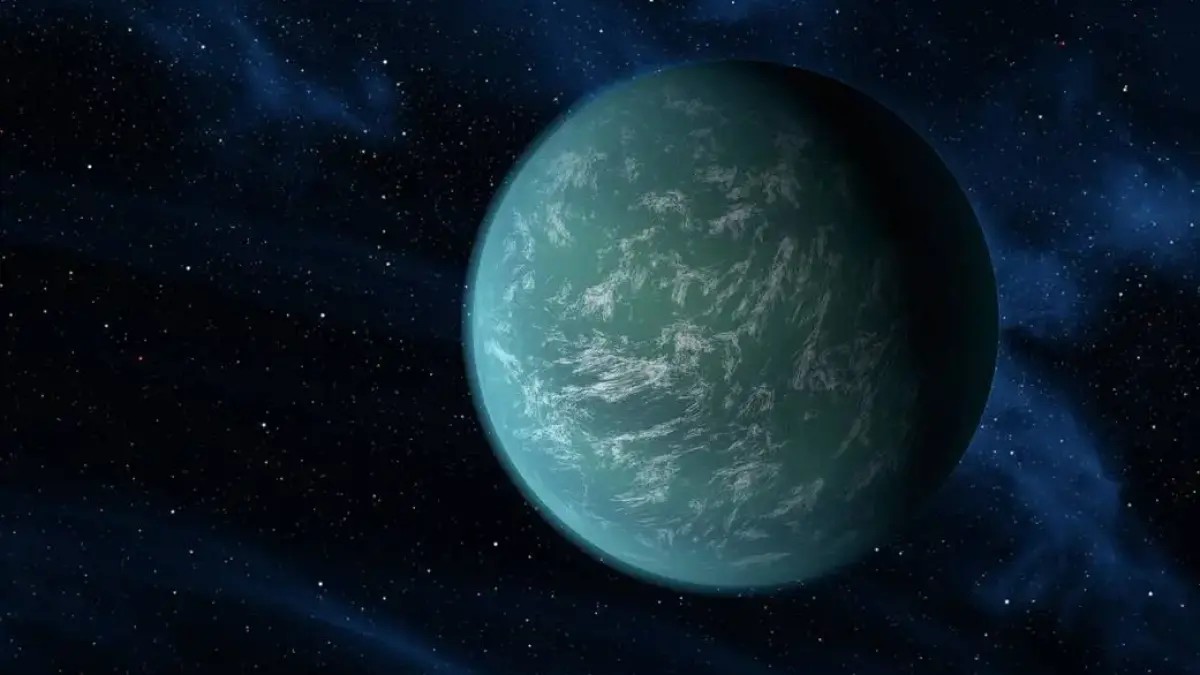
Apple TV’s new series, Pluribus, centers around a mysterious radio signal originating from a distant exoplanet: Kepler-22b. But this isn’t pure science fiction; Kepler-22b is a real planet discovered by NASA in 2009, and its existence raises fundamental questions about life beyond Earth. While the show imagines a sentient ocean world broadcasting across the cosmos, the reality of Kepler-22b is far more uncertain—and that’s precisely what makes it fascinating.
How Was Kepler-22b Discovered?
The Kepler Space Telescope didn’t take a photograph of Kepler-22b. Instead, astronomers detected it using the transit method. This involves observing the subtle dimming of a star as a planet passes in front of it. These “cosmic blinks” allowed scientists to confirm the planet’s existence and orbit. The discovery, led by William Borucki, was a landmark moment, proving that Earth-sized planets in habitable zones are not just theoretical possibilities.
Is Kepler-22b Truly “Earth-Like”?
Early headlines dubbed Kepler-22b a “new Earth” or an “Earth twin,” but the comparison is misleading. The planet is roughly twice Earth’s size, classifying it as a “super-Earth.” This term simply means it’s larger than our planet but smaller than Neptune. Crucially, scientists still don’t know what Kepler-22b is made of. It could be rocky, water-covered, or even a gas giant with no solid surface. All possibilities fit the current data.
The Habitable Zone: Hope and Uncertainty
Kepler-22b resides within its star’s habitable zone—the region where temperatures could allow liquid water to exist. However, the presence of liquid water isn’t guaranteed. The planet’s atmosphere, if it has one, would determine its surface temperature. A dense atmosphere like Venus’ could create a scorching environment, while a thin one like Mars’ would leave it frigid.
“Fortune smiled upon us with the detection of this planet,” said William Borucki. “The first transit was captured just three days after we declared the spacecraft operationally ready.”
The Impossibility of Travel
Pluribus depicts a direct exchange between Earth and Kepler-22b. In reality, the planet is 640 light-years away—an insurmountable distance with current technology. Even at the fastest speeds achieved by spacecraft like Voyager 1, a journey would take over 11 million years. The sheer scale of interstellar space underscores the futility of immediate contact. The show’s premise acknowledges this impossibility, with one character stating bluntly: “We’ll probably never learn the first thing about them. They’re too far away.”
Kepler-22b remains a tantalizing enigma. Its discovery was a milestone, proving that Earth-like planets exist beyond our solar system. But whether it harbors life, or even resembles Earth in any meaningful way, remains an unanswered question. The planet’s true nature, like the radio signal in Pluribus, remains shrouded in mystery.