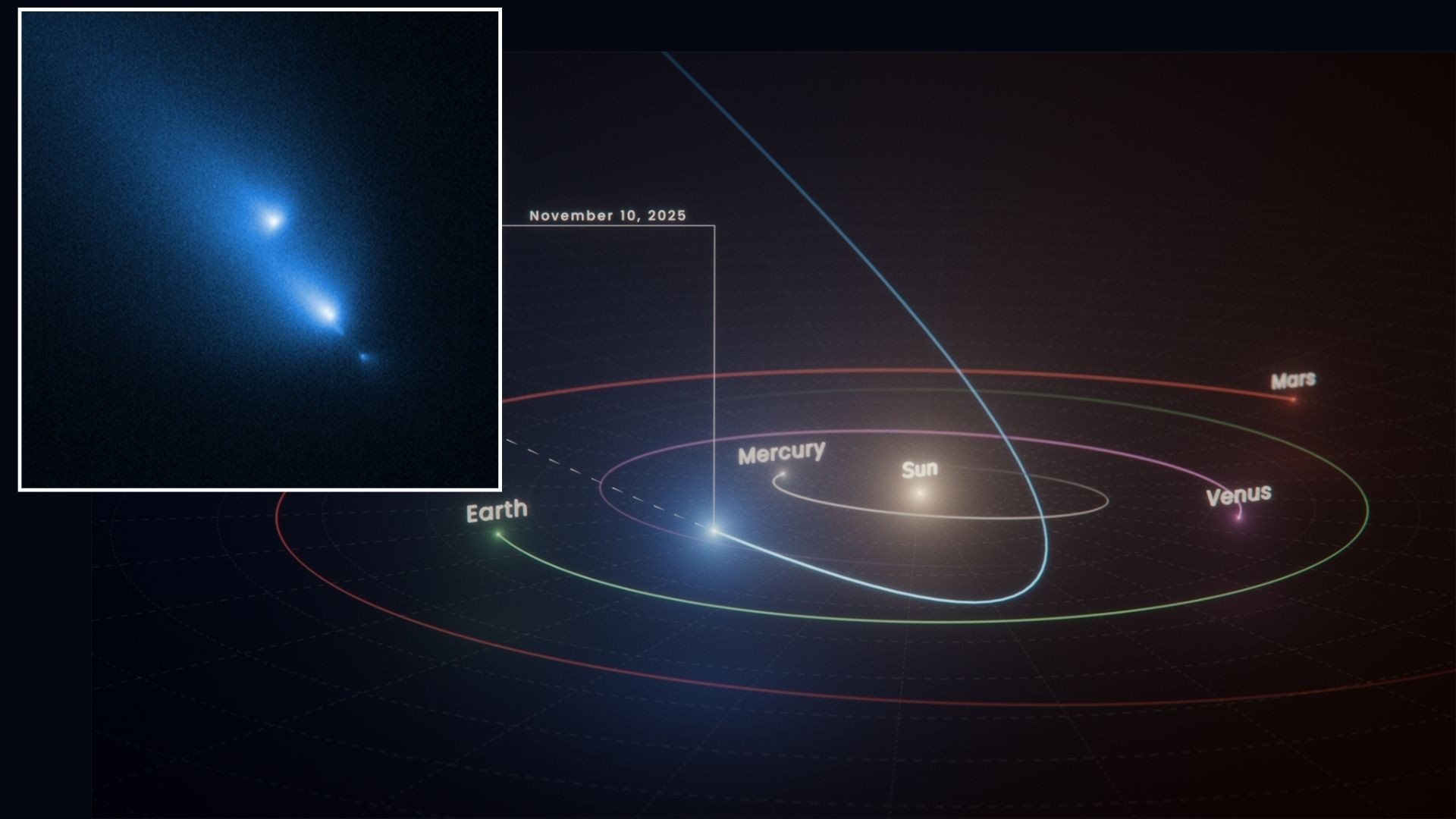
NASA’s Hubble Space Telescope has witnessed an unusual cosmic event: the breakup of comet C/2025 K1 (ATLAS) in near real time. The observation provides valuable, unexpected insight into the fragile structure of these icy relics from the solar system’s early history.
Unexpected Discovery
The fragmentation wasn’t planned; astronomers were forced to switch targets after technical issues prevented observation of their original comet. As luck would have it, the replacement target, comet K1, was undergoing a rapid disintegration when Hubble began tracking it.
“Sometimes the best science happens by accident,” stated Auburn University physics professor John Noonan. The timing was exceptionally rare, with Hubble capturing the event only days after the breakup began, a timescale far shorter than typical observations.
Why Comets Break Apart
Comets are essentially “dirty snowballs” – mixtures of ice, dust, and rock. As they approach the sun, solar heating causes ices to vaporize, creating a coma (the glowing atmosphere) and tail. This process also weakens the comet’s structure, making it susceptible to fragmentation under gravitational stress.
K1, a long-period comet originating from the distant Oort Cloud, was approximately 5 miles (8 kilometers) in diameter before breaking apart. The fragmentation likely began around a week before Hubble’s observations, coinciding with the comet’s closest approach to the sun. The telescope detected at least four major fragments, with one splitting again during the three-day observation period from November 8-10, 2025.
A Mystery in Brightness
The breakup revealed an unexpected anomaly: ground-based observers didn’t immediately see a surge in brightness following the fragmentation. This is unusual, as exposing fresh ice should increase reflectivity. Scientists now suspect that brightness depends more on dust than ice, with a delay needed for a dust layer to form before significant brightening occurs.
What This Means
This observation offers a rare chance to study the physics behind cometary disintegration at a granular level. The brief window before fragments fade will help determine the timescales involved in dust formation and ejection, revealing how these ancient bodies evolve as they interact with the sun.
“Never before has Hubble caught a fragmenting comet this close to when it actually fell apart,” Noonan said. “We may be seeing the timescale it takes to form a substantial dust layer that can then be ejected by the gas.”
Comets like K1 are remnants of the early solar system, preserving materials unchanged for billions of years. Their breakup provides critical data about the composition and dynamics of the outer solar system, even as they vanish from view. The event underscores how unpredictable and revealing space phenomena can be, even when discovered by chance.