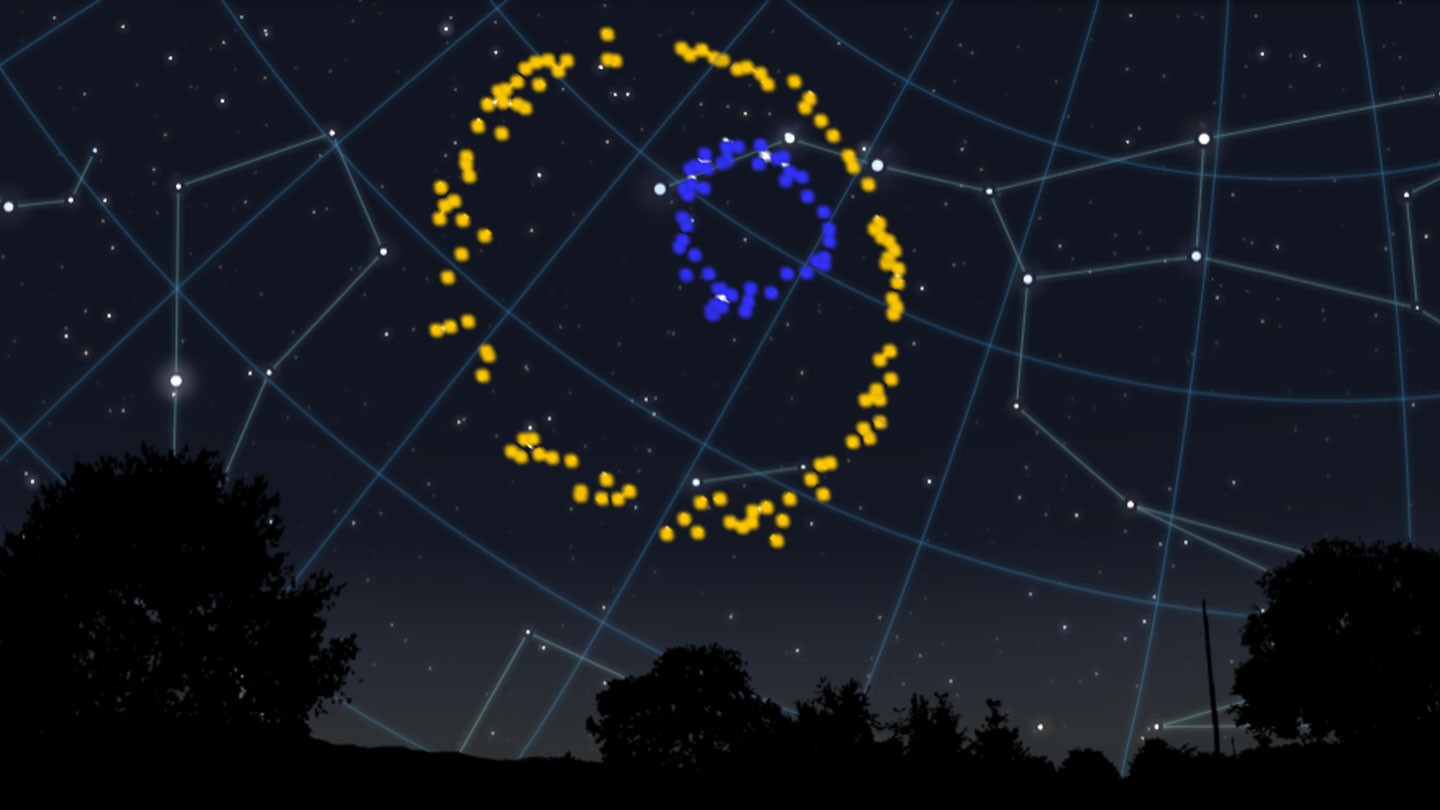
A newly discovered, extraordinarily large cosmic structure—a ring of dense matter spanning 3.3 billion light-years —is prompting scientists to re-evaluate a cornerstone principle of cosmology: the idea that the universe appears uniform in all directions when viewed on a vast scale. This finding, reported by cosmologist Alexia Lopez, raises fundamental questions about our understanding of the cosmos.
The Cosmological Principle Under Scrutiny
The cosmological principle, second only to Einstein’s theory of general relativity as a foundational assumption in physics, asserts that matter is evenly distributed across the universe at large volumes. If this principle is incorrect, “all hell would break loose,” as put by mathematical physicist Eoin ÓColgáin. The existence of such immense structures contradicts this assumption and threatens to destabilize current cosmological models.
The recently observed ring isn’t an isolated anomaly. It appears to be an extension of a previously identified “giant arc,” which itself encircles another large formation dubbed the “big ring.” The combined presence of these structures intensifies the challenge to the cosmological principle; explaining their co-existence under current assumptions is increasingly difficult.
How the Discovery Was Made
Lopez and her team detected these structures by analyzing light from distant quasars—supermassive black holes at the centers of galaxies. As light travels through space, intervening matter alters its spectrum, allowing astronomers to map the distribution of galaxies. The team noticed that galaxies within the arc and ring all appear to be at roughly the same cosmic distance, suggesting they formed around the same time in the universe’s history. Statistical tests suggest that the ring is unlikely to have emerged by chance, bolstering the claim that it is not merely a visual coincidence.
Debate Among Researchers
While Lopez argues that the scale and configuration of these structures pose a significant challenge to existing models, other scientists remain skeptical. Some argue that even large-scale structures do not necessarily invalidate the cosmological principle, while others maintain that current simulations can accommodate such formations. Theoretical astrophysicist Till Sawala, for example, claims that computer simulations can replicate similar structures without abandoning the cosmological principle. However, Lopez counters that the simulations used in Sawala’s work do not accurately reflect the scale of the observed ring.
The Path Forward: More Data Needed
Astrophysicist Subir Sarkar agrees with Lopez, stating that these rings “change the game altogether.” He emphasizes that while the work has not yet appeared in a peer-reviewed journal, upcoming sky surveys—such as those using the Dark Energy Spectroscopic Instrument and the Vera C. Rubin Observatory—will either confirm the existence of additional large-scale structures or disprove the finding.
“We don’t need to keep arguing until the end of time about whether this structure is real or accidental or whatever,” Sarkar says. “We should just get more data, and more things should show up.”
The discovery of this massive ring underscores the limits of our current cosmological models and highlights the need for more comprehensive observational data. Whether it represents an anomaly or a fundamental flaw in our understanding, it forces us to confront the possibility that the universe may not be as uniform as previously believed.