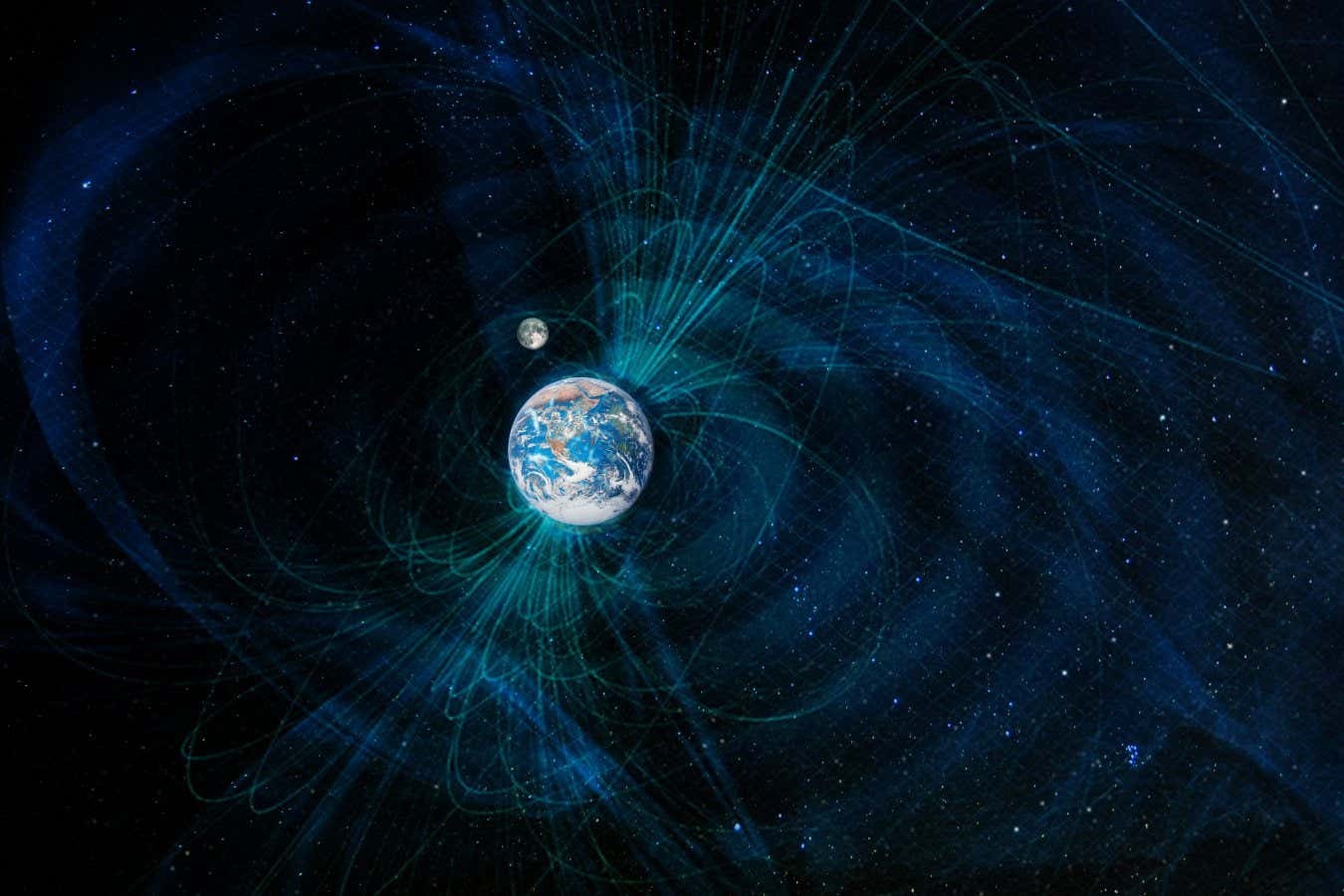
For decades, scientists have puzzled over two massive, continent-sized regions of unusually hot rock deep within Earth—one beneath Africa, the other under the Pacific Ocean. Now, research suggests these mysterious blobs aren’t just anomalies; they’ve actively shaped our planet’s magnetic field, making it slightly irregular for millions of years.
The Mystery Beneath Our Feet
These structures, extending nearly 1,000 kilometers from the outer core into the mantle, slow down seismic waves, indicating they’re fundamentally different from surrounding material. Determining exactly how they differ has been difficult because of their depth, but new evidence ties them directly to the behavior of Earth’s magnetic field.
How Heat Drives Magnetism
Earth’s magnetic field is generated by the chaotic movement of molten iron within the core. This field is crucial, shielding us from harmful solar radiation. The strength and shape of this field depend on how heat flows from the core to the mantle. By analyzing ancient volcanic rocks, researchers reconstructed how Earth’s magnetic field has changed over tens of millions of years.
Simulations Confirm the Connection
Researchers ran simulations of heat flow through the core, both with and without these massive blobs. The results were clear: the model including the blobs accurately matched historical magnetic field data. According to Andrew Biggin at the University of Liverpool, “These simulations can reproduce key features of the magnetic field, but only when accounting for the uneven distribution of heat flowing out of the core.”
In other words, these regions have been significantly hotter for hundreds of millions of years, slowing heat transfer between the core and mantle. This differential heating is critical to stabilizing Earth’s magnetic field.
A Wonky Magnetic Past
Most geologists assumed Earth’s magnetic field was symmetrical over long periods. However, the new data reveals that the ancient field was systematically asymmetrical, with consistent deviations persisting for millions of years. These irregularities align with the presence and influence of the deep heat blobs. This discovery could also change how scientists interpret the movement of ancient rocks, providing a deeper understanding of Earth’s internal structure.
Challenges and Future Research
While the findings are compelling, verifying them directly remains a challenge. Detecting temperature differences in Earth’s core requires analyzing seismic waves through vast layers of mantle material—a notoriously difficult task. Despite skepticism from some geologists, the research suggests that similar temperature variations may exist in the upper outer core, potentially detectable with more advanced techniques.
If confirmed, these findings could redefine our understanding of how Earth’s deep structures evolve and interact over geological timescales.