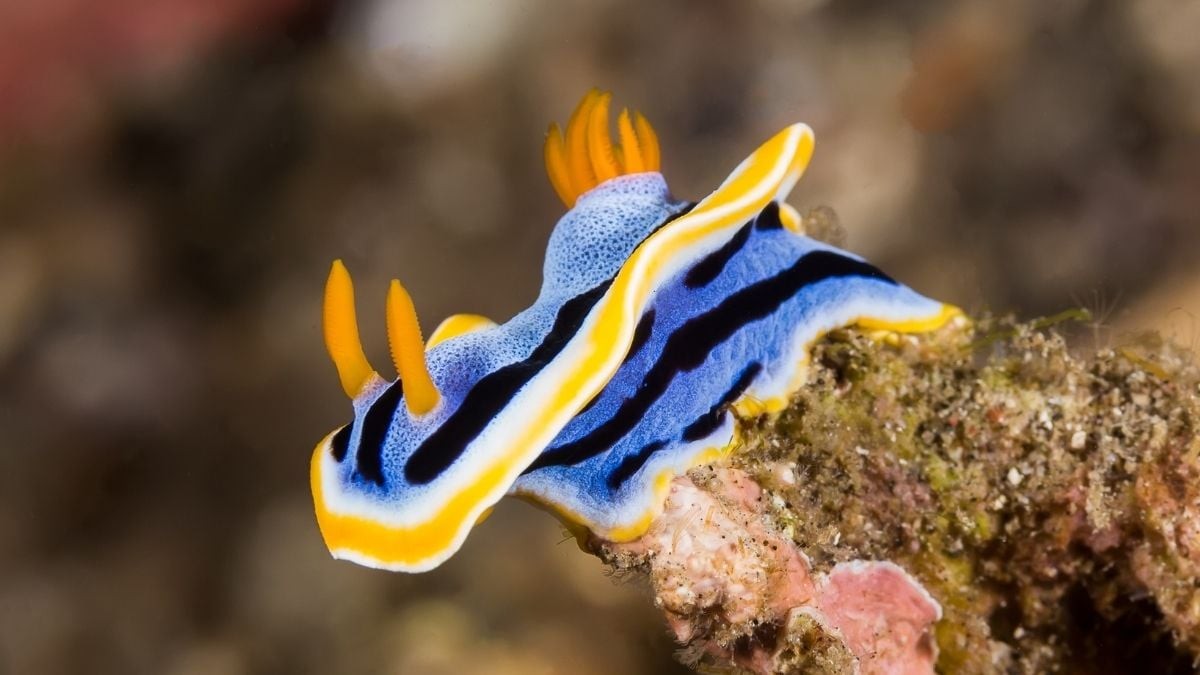
Nudibranchs, commonly known as sea slugs, have long been admired for their striking colors. Recent research reveals these vibrant hues aren’t created by pigments, but by microscopic crystals acting like natural “pixels” in their skin. This discovery challenges previous assumptions about how these marine creatures achieve such a dazzling diversity of patterns.
Structural Coloration: Beyond Pigments
For years, scientists believed nudibranch colors came from pigments – the same way a toucan’s beak gets its hues. However, researchers at the Max Planck Institute of Colloids and Interfaces found that structural color, an effect of light reflecting off microscopic structures, plays a crucial role. This means the colors aren’t about what the slug is made of, but how its skin is structured.
Structural coloration is common in nature: seen in insects, chameleons, and even oil slicks. It works differently than pigments; instead of absorbing light, it manipulates how light reflects. Many vibrant effects combine pigment with structural color. For instance, a peacock’s tail appears iridescent due to microscopic structures interfering with light, enhancing its brown base.
How Nudibranchs Do It: Guanine Nanocrystals
Nudibranchs use tiny nanocrystals of guanine molecules arranged in their skin. The arrangement, length, and angles of these crystals determine the color displayed. Surprisingly, these colors appear matte despite structural coloration usually causing iridescence (like a butterfly’s wing).
The key is randomness: the nanocrystals are stacked in layers within “pixels” across the slug’s surface. If perfectly ordered, they would shimmer, but the slight disarray flattens the color, creating bold, bright hues without the glitter. This allows nudibranchs to create a full spectrum of colors with only minor structural adjustments between species.
Implications and Future Applications
This discovery explains how nudibranchs evolved such a wide range of colors and patterns. It could also inspire new materials for human use. Physicist Silvia Vignolini notes that sustainable color technologies might be developed based on these natural principles.
“We often draw inspiration from nature when developing new materials and techniques. It might be possible to develop sustainable colors based on the same principles which are used by nudibranchs.”
The ability to create vivid, matte colors using simple structural adjustments is a remarkable evolutionary adaptation, and it may hold valuable lessons for materials science in the future.