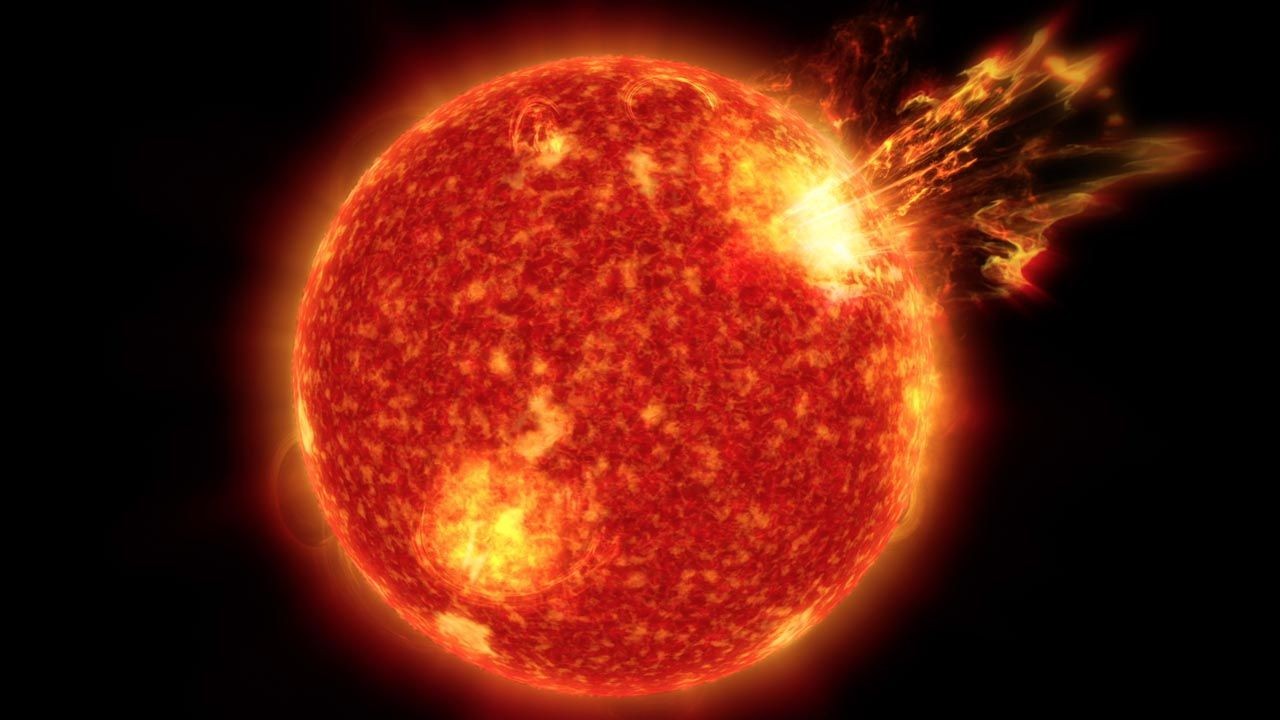
Astronomers have captured the earliest moments of a massive stellar eruption – a superflare – from the nearby star HD 22468, providing unprecedented insight into these powerful cosmic events. This observation marks the first time a hard X-ray triggered superflare has been witnessed on an RS CVn-type star, offering a critical “smoking gun” to test existing theories about how stars unleash enormous bursts of energy.
The Challenge of Catching Cosmic Fireworks
Observing stellar flares as they happen is notoriously difficult. The universe is full of fleeting events, and catching the initial energy release is like predicting where lightning will strike. Astronomers rely on global telescope networks to continuously scan the skies, hoping to witness these transient phenomena in real-time.
The HD 22468 Superflare: A Star’s Violent Burst
In November 2024, the SVOM/GRM telescope detected an immense superflare from HD 22468. Within moments, the star released energy equivalent to months of solar output. This isn’t just a larger version of our sun’s flares; superflares are thousands to millions of times more powerful, capable of sterilizing nearby planets with intense radiation.
Why This Matters: Understanding Stellar Violence
Superflares occur when twisted magnetic fields within a star’s corona suddenly snap and reconnect, releasing a huge amount of energy. RS CVn-type stars – close binary systems – are particularly prone to these outbursts due to their turbulent magnetic interactions.
“The hard X-ray trigger is crucial because it shows us the very beginning of the event,” explains the research published in The Astrophysical Journal. “This allows us to test models of how these flares initiate and develop.”
Decoding the Flare’s Physics
The observation revealed a clear sequence: the hard X-ray peak came first, followed by a longer-lasting soft X-ray and optical glow. Temperatures soared to between 10 million and 100 million Kelvin, driven by thermal processes and accelerated particles. This timing confirms that magnetic reconnection is likely the key mechanism behind these explosions.
Implications for Stellar Physics and Habitability
Detailed data from the flare allows astronomers to refine computer simulations, improving our understanding of how stars store and release energy. Better models will help predict stellar behavior, assess mass loss, and evaluate the habitability of planets orbiting active stars.
The study underscores the importance of continuous monitoring: “We just keep staring at stars for a long time, and sometimes, we get lucky,” notes the research team. This latest observation is a critical step toward a complete picture of stellar fireworks – and the conditions that allow them to happen in the universe.