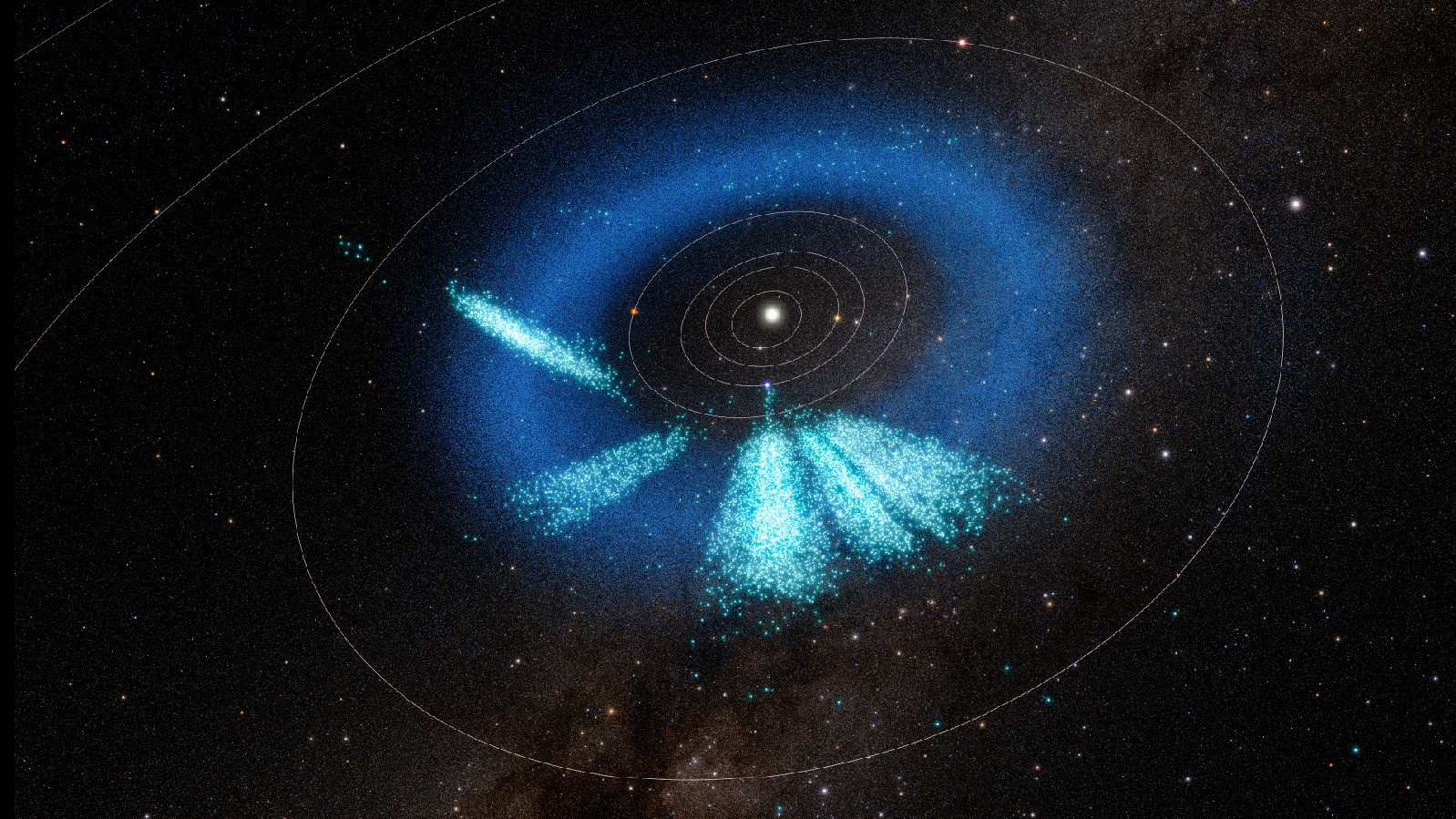
Early data from the Vera C. Rubin Observatory has already fundamentally altered our map of the solar system. Even before reaching full scientific operations, the facility has identified 11,000 previously unknown asteroids and provided precise measurements for tens of thousands more.
This breakthrough is not just a statistical milestone; it is a demonstration of a massive leap in astronomical capability. While traditional surveys often take years or even decades to catalog specific populations of space debris, the Rubin Observatory is performing these tasks in a matter of days.
The Power of the “Big Picture” Approach
The scale of this discovery is driven by the observatory’s unique hardware. Equipped with an 8.4-meter mirror and the largest camera ever built for astronomy, Rubin is designed to scan the entire southern sky repeatedly every few nights.
This “wide and deep” strategy allows astronomers to catch objects that are too faint or moving too quickly for conventional telescopes to track effectively. This capability is expected to transform our understanding of the solar system through its 10-year Legacy Survey of Space and Time.
Mapping the Solar System’s Diverse Populations
The preliminary data has revealed a diverse range of celestial bodies, spanning from the inner solar system to the frozen edges of our cosmic neighborhood:
-
The Main Asteroid Belt: The bulk of the 11,000 new finds are located between Mars and Jupiter,, helping to fill in the gaps of our current inventory of ~1.5 million known asteroids.
-
Near-Earth Objects (NEOs): The observatory identified 33 previously unknown NEOs (asteroids and or comets that pass close to Earth). While none of these specific objects pose a threat to our planet, their discovery is vital for long-term safety.
- Trans-Neptunian Objects (TNOs): Scientists detected approximately 380 icy bodies orbiting beyond Neptune. Finding these distant worlds is crucial for understanding the solar system’s history and could even provide clues regarding the existence of a theoretical “9th planet.”
Strengthening Planetary Defense
One of the most critical implications of the Rubin Observatory’s work lies in planetary defense. Currently, astronomers have only identified about 40% of the larger near-Earth objects that could potentially impact Earth.
By providing continuous, high-frequency monitoring, Rubin is projected to increase that detection rate to 70%.
“What used to take years or decades to discover, Rubin will unearth in months,” says Mario Juric, Rubin Solar System Lead Scientist.
By spotting these objects earlier and calculating their orbits with much higher precision, humanity gains a significantly larger window of warning. This capability shifts our approach from reactive observation to proactive monitoring, allowing for better preparation and a deeper understanding of how these objects move through our space.
The Computational Challenge
Detecting these objects is as much a feat of software engineering as it is of optics. To find the slow-moving TNOs or the fast-moving NEOs, researchers had to develop advanced algorithms capable of sifting through massive datasets. These systems must scan millions of light sources and test billions of potential motion paths to distinguish a moving asteroid from a static star.
Conclusion
The Rubin Observatory’s early successes signal a revolution in how we survey our cosmic backyard. By rapidly expanding our inventory of asteroids and near-Earth objects, the facility is providing the essential data needed to both understand our solar system’s origins and protect Earth from future impacts.