Recent CT scans of a decades-old specimen at the Yale Peabody Museum of Natural History have unveiled a previously unknown species of “proto-crocodile.” This discovery, involving a creature named Eosphorosuchus lacrimosa , provides a rare window into how early crocodile relatives began to specialize and dominate their environments over 210 million years ago.
A Predator Built for Power
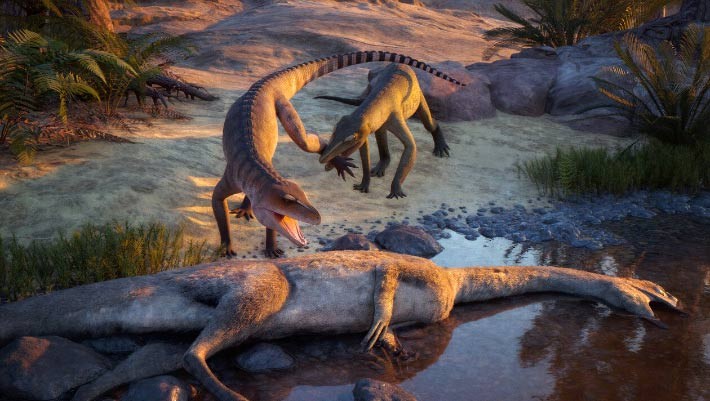
Living during the Late Triassic epoch in what is now New Mexico, Eosphorosuchus lacrimosa was far from the slow-moving aquatic reptiles we associate with crocodiles today. Instead, it was a fast-running, terrestrial predator.
Key anatomical features identified through advanced imaging include:
– Powerful Jaws: A short snout and a heavily reinforced skull, supported by well-developed jaw muscles designed for snapping shut on large prey.
– Agile Build: Large back legs paired with smaller, thinner arms, suggesting a gait more similar to a modern jackal or dog than a modern alligator.
– Diverse Anatomy: The specimen includes a nearly complete set of remains, including parts of the skull, lower jaw, vertebrae, limbs, and protective armor.
The “Dawn” of Ecological Competition
The significance of this find lies not just in the animal itself, but in its neighbors. The fossil was found alongside another small crocodylomorph, Hesperosuchus agilis.
This coexistence is a crucial piece of the evolutionary puzzle. It suggests that even as early as the Late Triassic, these reptile lineages were already partitioning ecological niches. Rather than competing for the exact same food sources, different species were evolving specialized feeding anatomies—such as the heavy-duty jaws of Eosphorosuchus —to occupy distinct roles within the same ecosystem.
“This represents the ‘dawn’ of functional diversification in the lineage that would give rise to modern crocodiles,” notes Miranda Margulis-Ohnuma, a researcher at Yale University.
A Tale of Two Dynasties
The Late Triassic was a pivotal era defined by a massive evolutionary race between two major groups:
1. The Crocodylomorph Line: Fast-running, low-slung, and heavily built predators.
2. The Dinosaur Line: At the time, these were relatively slim, delicate animals that often moved on two slender legs, much like modern herons.
The discovery of Eosphorosuchus proves that the “crocodile” side of this rivalry was already diversifying and refining its hunting strategies long before modern crocodiles appeared.
Unlocking Hidden History in Museums
Interestingly, this specimen was excavated in 1948 at Ghost Ranch, New Mexico. Despite being in a museum collection for 75 years, it had never been fully identified or analyzed. Its “re-discovery” via modern technology highlights the immense value of existing museum archives; many specimens sitting in storage may still hold the keys to understanding the history of life on Earth.
Conclusion
The identification of Eosphorosuchus lacrimosa reveals that early crocodile relatives were highly specialized hunters that occupied distinct ecological roles very early in their evolutionary history. This discovery underscores how biodiversity and niche specialization were already driving the complex ecosystems of the Triassic period.