
A fearsome predator lurking in the shadows of prehistoric Brazil has been brought back to light by paleontologists. The discovery, reported in the Journal of Systematic Palaeontology, reveals Tainrakuasuchus bellator, a new species of armored reptile that stalked its prey around 240 million years ago during the Triassic period.
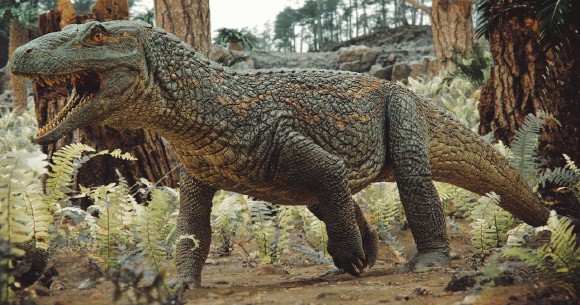
This ancient hunter wasn’t your average dinosaur; it belonged to Pseudosuchia, an early group of archosaurs that gave rise to modern crocodiles and alligators. Standing about 8 feet long and weighing in at a hefty 60 kg (Tainrakuasuchus bellator ) sported bony plates called osteoderms along its back, offering protection as it hunted in a landscape dominated by vast deserts and arid conditions.
Unlike the massive predators that also roamed this prehistoric ecosystem – some reaching up to 23 feet in length – this agile hunter relied on speed and precision. Its long neck likely granted it excellent agility, while its slender jaw packed sharp, recurved teeth perfect for gripping and preventing escape from unfortunate prey.
“This animal was an active predator,” explains Dr. Rodrigo Temp Müller of the Universidade Federal de Santa Maria, who led the research team. “But despite being relatively large, it wasn’t the largest hunter in its time.”
Distinguishing Tainrakuasuchus bellator from dinosaurs comes down to subtle anatomical differences, particularly in its pelvis structure and hip joint configuration. These unique features clearly place it within Pseudosuchia. Dr. Temp Müller emphasizes that this group was surprisingly diverse, encompassing both heavy-bodied hunters capable of tackling large prey and smaller, nimble predators specializing in faster targets.
The discovery sheds light on the complex interplay of predator niches during a pivotal moment in Earth’s history – right before the rise of dinosaurs. Tainrakuasuchus bellator, found in southern Brazil, reinforces a fascinating connection between South America and Africa during this era. Pangea, the supercontinent encompassing all landmasses, facilitated widespread dispersal of organisms across what are now separate continents.
“This connection between animals from South America and Africa can be understood in light of the Triassic period’s paleogeography,” Dr. Temp Müller notes. “The continents were still united, allowing free movement for organisms across regions that are now separated by oceans.”
Fossils of this remarkable predator hint at a thriving ecosystem teeming with diverse reptile communities adapted to various survival strategies – a testament to the rich evolutionary history unfolding even before dinosaurs dominated the scene.