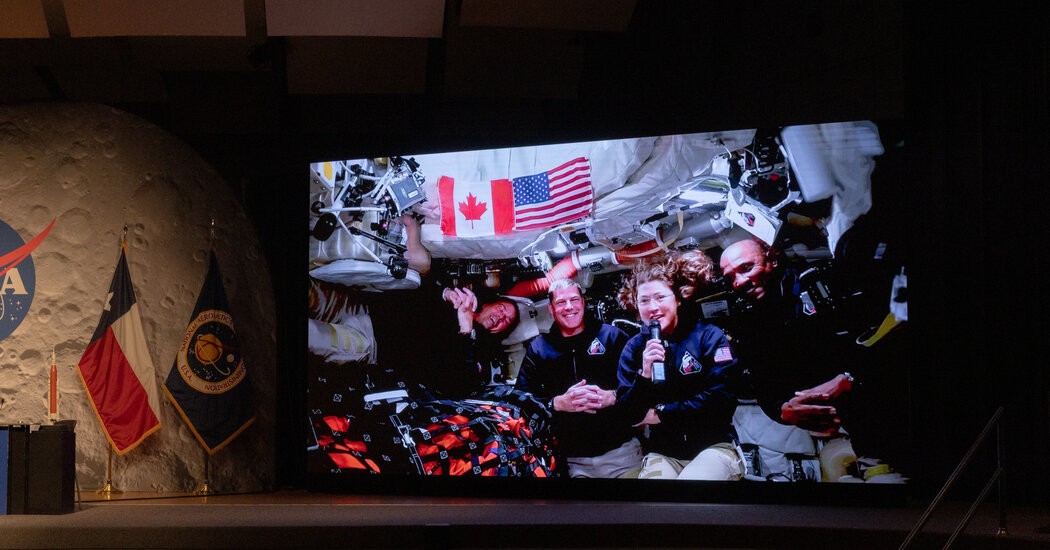
In a historic leap for human space exploration, the four astronauts aboard NASA’s Artemis II mission have officially traveled farther from Earth than any human being in history.
As of Monday afternoon, the crew—Reid Wiseman, Victor Glover, Christina Koch, and Jeremy Hansen—surpassed the long-standing record set by the Apollo 13 mission in 1970. The crew is currently navigating the Orion spacecraft toward a lunar flyby that will take them behind the Moon, offering a view of the lunar far side that has remained hidden from human eyes for decades.
Breaking the Apollo Record
At 1:56 p.m. ET on Monday, the crew crossed the 248,655-mile mark, eclipsing the distance achieved by the Apollo 13 crew over 55 years ago. The mission is expected to reach its peak distance of approximately 252,760 miles at 7:07 p.m. ET, as the spacecraft begins its loop around the Moon.
This milestone is not merely a numerical achievement; it represents the first time since 1972 that humans have ventured this deep into space. While the Artemis II mission is not a landing mission, it serves as a critical “test flight” for the life-support systems and technologies required for future lunar and Martian exploration.
The Lunar Far Side and the Radio Blackout
As the mission enters its next phase, the astronauts will encounter a period of isolation known as a radio blackout.
- The Blackout: Starting at 6:44 p.m. ET, the Moon will physically block radio signals between Earth and the Orion spacecraft. The crew will be out of contact with Mission Control for approximately 41 minutes.
- Safety Measures: NASA officials emphasize that this is a routine part of lunar flight. To ensure safety, the crew is utilizing a “free return” trajectory. This means that even if the spacecraft’s engines were to fail during the blackout, the gravitational pull of the Moon and Earth would naturally guide the capsule back home.
- Scientific Discovery: Once they emerge from the blackout, the crew will have observed the lunar far side—a region characterized by a thicker crust and a much higher density of impact craters compared to the side we see from Earth.
“The far side will look brighter than the near side because it has more impact craters… it may also look grayer,” noted Dr. Julie Stopar of the Lunar and Planetary Institute.
A Moment of Personal Tribute
Amidst the high-stakes technical maneuvers, the mission also provided a deeply human moment. During a communication link with Mission Control, the crew requested that a lunar crater be dedicated to the memory of Carroll Wiseman, the late wife of Mission Commander Reid Wiseman.
The dedication of “Carroll Crater” served as a poignant reminder of the personal sacrifices often made by those in the space program. The moment was met with a silent tribute from flight controllers in Houston, highlighting the tight-knit community that supports astronauts and their families.
What to Watch For
As the mission continues, several key events are expected:
1. Closest Approach: At 7:02 p.m. ET, the Orion will zip past the Moon at an altitude of just 4,070 miles.
2. The “Earthrise”: As the crew emerges from the far side, they may witness a view reminiscent of the iconic 1968 Apollo 8 photograph, seeing Earth rise over the lunar horizon.
3. Solar Eclipse: At 8:35 p.m. ET, the astronauts will experience a 53-minute solar eclipse, providing a unique vantage point to observe the sun’s corona.
Conclusion
The Artemis II mission marks a pivotal transition from the era of Apollo to a new age of deep-space exploration. By breaking distance records and testing the limits of human endurance, this crew is paving the way for the next generation of lunar explorers.