Paleontologists have uncovered the earliest direct evidence of large land predators actively hunting herbivores, dating back 280 million years to the Permian period. The discovery, detailed in the journal Scientific Reports, provides a unique look into the formative stages of predator-prey dynamics on land.
The Fossil Evidence
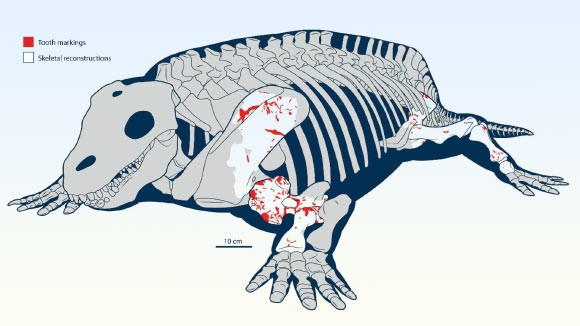
Researchers from the University of Toronto Mississauga analyzed the fossilized remains of three juvenile Diadectes, an early large plant-eating vertebrate. The bones bore numerous distinct tooth marks, offering irrefutable proof of predatory feeding behavior. Unlike the well-documented bite marks from the dinosaur-dominated Mesozoic Era, this is one of the first clear examples of such interactions from the Paleozoic Era when large terrestrial predators and herbivores first emerged.
What the Marks Reveal
The tooth marks weren’t random. Five types of damage were identified:
– Shallow scoring
– Deeper pitting
– Furrows carved into the bone shafts
– Conical punctures
– Tiny boreholes
These marks concentrated around joints, suggesting predators targeted cartilage-rich areas to strip muscle and connective tissue. Some furrows even indicate a “head-pulling” motion, where flesh was forcibly torn away.
Key Predators Involved
The team believes that predators like Varanops and Dimetrodon, early synapsids, were responsible for the attacks. These animals were apex predators in the Permian landscape. Even scavengers and small arthropods joined in after the initial predation, leaving their own marks on the carcasses. The presence of arthropod borings confirms that the bones were left exposed long enough for scavengers to feed on remaining tissue.
Why This Matters
This discovery reshapes our understanding of how early ecosystems functioned. For decades, paleontologists have speculated about predator-prey relationships in the Permian, but lacked solid physical evidence. The fossil record has always been sparser for this period. This find suggests that hierarchical food chains were established far earlier than previously thought, and that the basic dynamics between predators and prey existed even as terrestrial vertebrate life was first evolving into larger apex forms.
The evidence clearly shows that predator-prey relationships were already driving evolution in the Paleozoic Era, long before the dinosaurs. This new evidence pushes back the timeline of these interactions and demonstrates that the fundamental ecological rules were set much earlier in Earth’s history.