
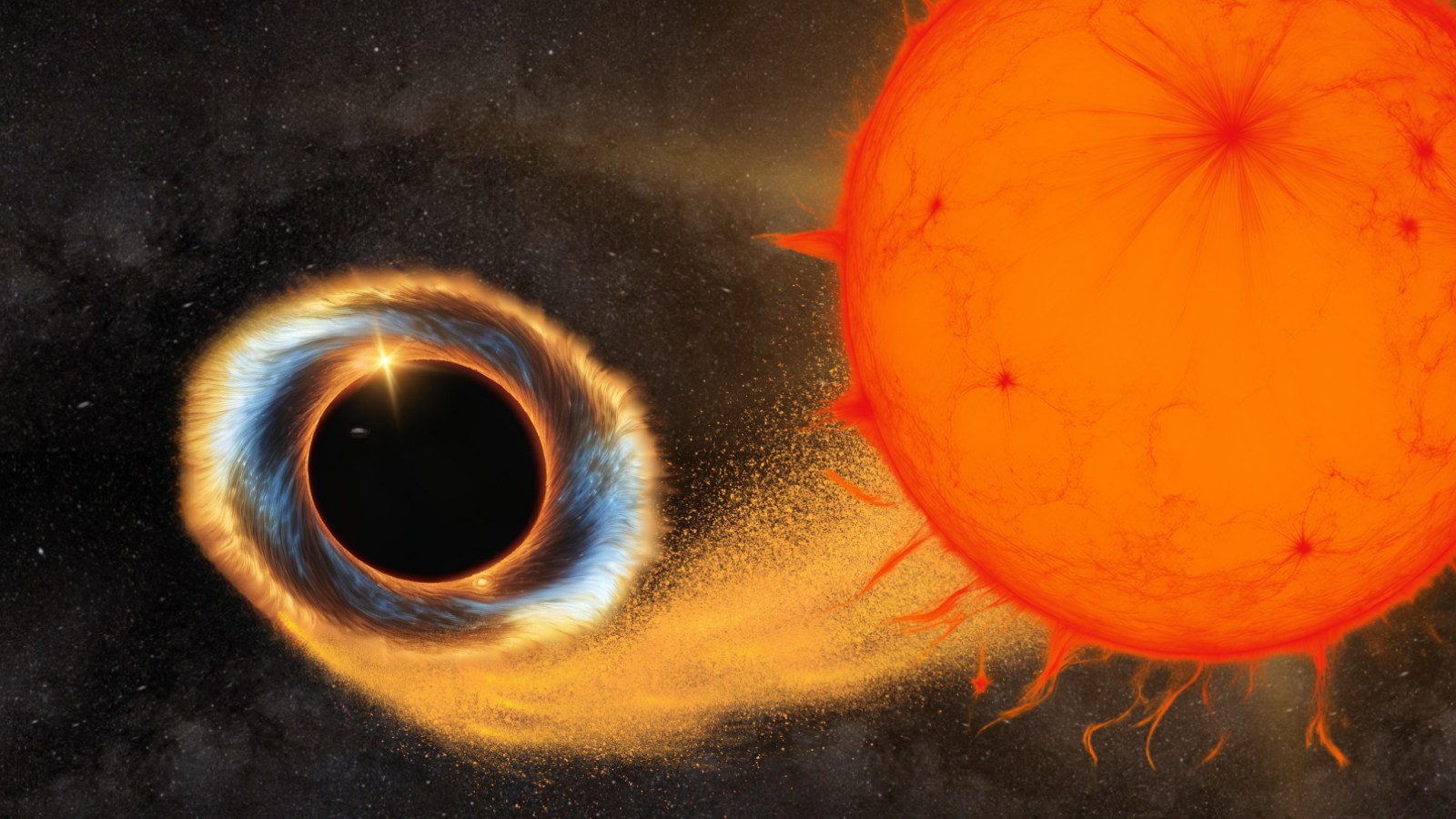
Astronomers have detected unusual “singing” from a red giant star locked in orbit with a black hole, using data from NASA’s Transiting Exoplanet Survey Satellite (TESS). This discovery, made in the Gaia BH2 system (approximately 3,800 light-years away), suggests the star has a violent history – potentially merging with another star in the past. The finding highlights how black hole systems can reshape stellar evolution in surprising ways.
Unveiling Stellar Interiors Through Starquakes
Just as earthquakes reveal Earth’s inner structure, scientists used starquakes detected by TESS to probe beneath the surface of the red giant. These oscillations, or vibrations, act as a cosmic seismograph, allowing researchers to understand the star’s internal composition and history.
The team, led by Daniel Hey of the University of Hawaii, found the red giant to be unusually rich in heavy elements (“alpha-rich”), a characteristic typically found in older stars. However, the starquakes revealed it is only about 5 billion years old — younger than expected for its chemical makeup. This discrepancy suggests the star didn’t form in isolation. The most plausible explanation is that it gained mass through a collision or merger with another star, or by consuming material during the black hole’s formation.
A Rapidly Spinning Past?
Adding to the mystery, the red giant spins much faster (once every 398 Earth days) than typical stars of its age. This rapid rotation further supports the theory of a past merger. Tidal interactions with its black hole companion could also contribute to the spin, but the speed suggests a more dramatic origin.
“If this rotation is real, it can’t be explained by the star’s birth spin alone,” notes Joel Ong, a NASA Hubble Fellow. “The star must have been spun up through tidal interactions with its companion, which further supports the idea that this system has a complex history.”
Another Enigma: The Metal-Poor Companion of Gaia BH3
The same team investigated another black hole system, Gaia BH3 (2,000 light-years from Earth), and found its companion star is notably lacking in heavy elements (“metal-poor”). Surprisingly, this star lacks the expected oscillations, a phenomenon that challenges existing models of stellar evolution.
This lack of observable vibrations could indicate unique internal properties or an unusual formation history. The team plans further observations using ESA’s Gaia spacecraft to confirm the starquake findings and refine their understanding of these peculiar systems.
These discoveries demonstrate that binary systems with black holes are far more dynamic than previously assumed. By studying these interactions, astronomers can unlock new insights into stellar evolution, galactic mergers, and the formation of black holes themselves. The ongoing research promises to reveal even more about the turbulent lives of these cosmic companions.