The red planet often appears to offer glimpses of the impossible, and the latest example is a striking pyramidal structure in the Candor Chasma region that resembles ancient Egyptian constructions. While some speculate about artificial origins, the reality is far more geological—and no less fascinating.
The Discovery and Initial Claims
The formation first gained attention in 2002 when independent researcher Wilmer Faust identified a peculiar feature in NASA’s Mars Global Surveyor imagery. More recently, filmmaker Brian Cory Dobbs shared cropped images on X, fueling claims of hidden structures on Mars. These images, though real NASA data, have been widely circulated without context.
What the Data Actually Shows
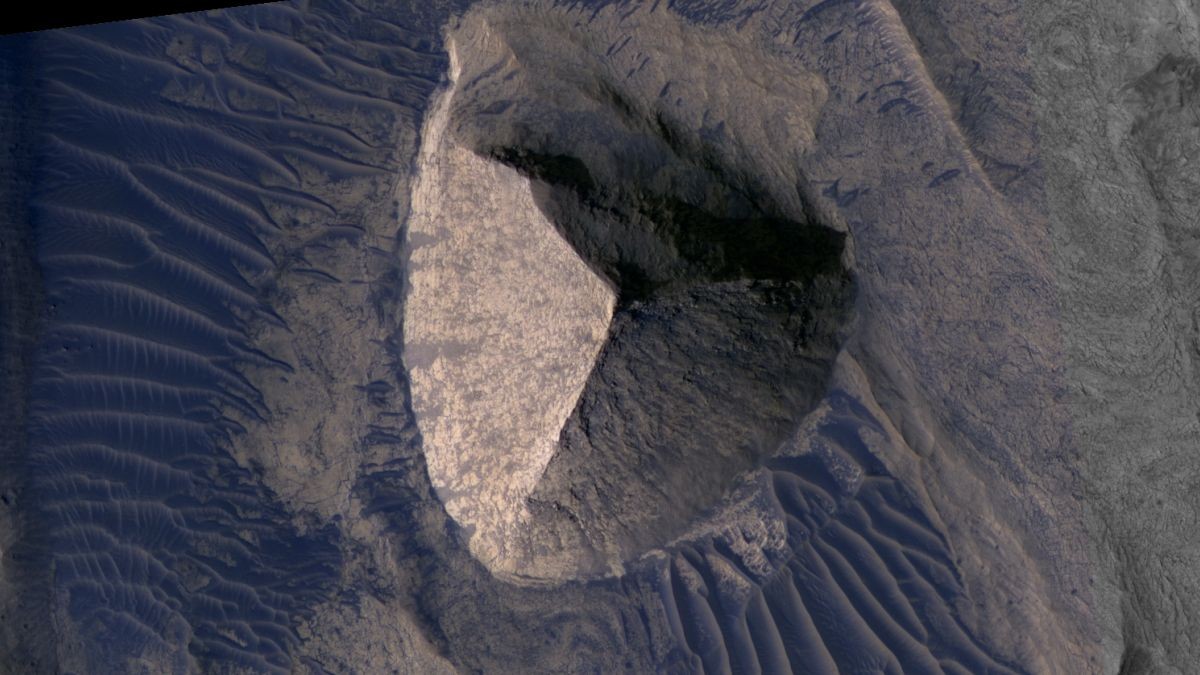
The so-called “Candor Tetrahedron” is a roughly triangular hill within the vast Candor Chasma canyon system. High-resolution images from the HiRISE camera on the Mars Reconnaissance Orbiter reveal that it is not an isolated anomaly but part of a broader landscape shaped by billions of years of erosion. The structure appears less remarkable when viewed in context with surrounding geological formations.
Geological Context: “Positive Relief Knobs”
The region is riddled with geological features called “positive relief knobs” — durable rock structures left behind as softer bedrock erodes away. These knobs can reach up to a kilometer in diameter and tens of meters in height. The “pyramid” measures 290 meters across and 145 meters tall, fitting comfortably within this natural formation process.
Natural Pyramids on Earth: A Parallel
Mars isn’t alone in producing pyramid-shaped landforms naturally. Mountains like Cerro Tusa in Colombia and those in China’s Guizhou province exhibit similar pyramidal shapes carved by erosion. The Martian structure’s uneven sides and lack of geometric perfection further suggest a natural origin.
The Role of Pareidolia
The human brain excels at pattern recognition, often finding meaning in random data. This phenomenon, known as pareidolia, leads us to perceive familiar shapes where none exist. Mars’ geology, however, is striking enough on its own without needing artificial embellishment.
In conclusion, the “pyramid” on Mars is a naturally formed rock structure sculpted by erosion, not evidence of an ancient civilization. The planet’s unique geology and weather have created landscapes that are both familiar and alien, challenging our perception and reminding us that the most extraordinary discoveries often lie in the mundane.