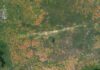
Recent analysis of decades-old radar data from NASA’s Magellan mission suggests the existence of a substantial underground tunnel carved by ancient volcanic activity on Venus. This finding, if verified, would represent just the second confirmed lava tube on Venus, joining similar discoveries on the Moon and Mars – and importantly, challenges the long-held notion of Venus as a geologically inert planet.
The Evidence: Radar Signatures and Surface Collapses
The discovery hinges on re-examining data collected between 1990 and 1992. NASA’s Magellan orbiter mapped the Venusian surface using radar, a necessity due to the planet’s perpetually dense cloud cover. These radar scans revealed chains of surface collapses – pits where the ground has given way – stretching for tens or even thousands of miles. Scientists have long suspected these formations might indicate underlying lava tubes, remnants of flowing magma that solidified over time.
The current study focuses on one such collapse near Nyx Mons, a major volcano on Venus. The radar signature from this site closely matches those previously observed in known lava tube collapses elsewhere in the solar system. The team estimates the structure could extend for dozens of kilometers underground, though only a portion of it has been definitively identified.
Why This Matters: Reassessing Venus’s Geology
The possibility of extensive lava tube networks beneath Venus has significant implications. These tubes could offer stable, shielded environments —potentially even habitable ones—protected from the planet’s extreme surface conditions: scorching temperatures and crushing atmospheric pressure.
More broadly, the discovery reinforces the idea that Venus is not the geologically “dead” world it was once considered. While the planet lacks Earth-style plate tectonics, evidence continues to accumulate showing ongoing (or recently active) volcanism. The very fact that these tubes exist suggests molten rock was once far more prevalent on Venus than previously thought.
Future Exploration: EnVision and Beyond
Confirming the full extent and stability of this potential lava tube requires further investigation. Luckily, upcoming missions are poised to deliver more detailed observations. The European Space Agency’s EnVision mission, equipped with the Subsurface Radar Sounder (SRS), is designed to penetrate hundreds of meters below Venus’s surface. SRS will be able to map these cavities even where no surface openings exist, offering an unprecedented view of the planet’s hidden geology.
This discovery is not an end point, but rather the beginning of what scientists anticipate will be a prolonged and fruitful period of research into the subsurface of Earth’s twin planet.