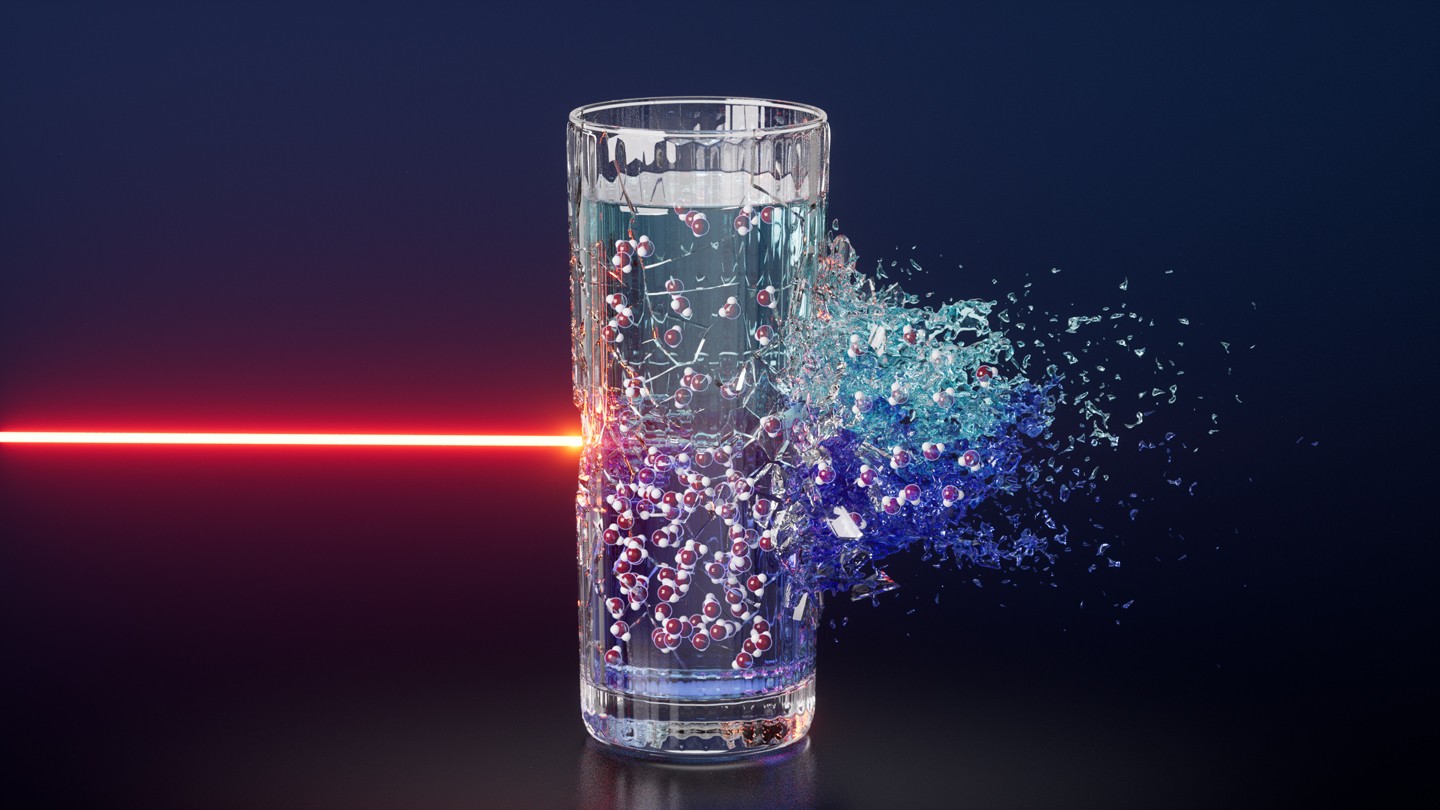
For decades, scientists suspected a hidden property within water – a second critical point at extremely low temperatures and immense pressure. Recent experiments have now confirmed this long-predicted phenomenon, shedding light on why water behaves so differently from other liquids. This discovery, detailed in the March 26 issue of Science, isn’t just academic curiosity; it explains several of water’s quirks that underpin its vital role in biology, climate, and countless industrial processes.
The Second Critical Point: A Phase Transition Revealed
Water already exhibits a well-known critical point at high temperatures (around 374°C and 218 times atmospheric pressure), where the distinction between liquid and gas disappears, creating a supercritical fluid. This new finding pinpoints a second critical point at approximately -63°C (210 kelvins) and pressure 1,000 times that at sea level. At this point, two distinct phases of supercooled water – high-density and low-density forms – merge into one, erasing their differences.
The experiments were challenging; supercooled water tends to freeze almost instantly under these conditions. Researchers led by Anders Nilsson of Stockholm University circumvented this by rapidly melting amorphous ice (a jumbled molecular structure) with infrared lasers and then probing the resulting liquid with X-ray lasers within nanoseconds. The snapshots taken revealed a clear transition from two distinct phases below the critical point, but no such transition at the critical point, confirming its existence.
Why Water is Weird: Density and Heat Capacity Anomalies
Water stands out among liquids because it doesn’t follow the usual rules. Most liquids become denser as they cool, but water reaches maximum density at 4°C before reversing course – colder water becomes less dense. Similarly, its heat capacity (how much energy it takes to heat it up) flips at a certain temperature. These anomalies have puzzled scientists for years.
The new critical point provides a potential explanation. These “flip-flopping” behaviors suggest the presence of underlying phase transitions, now confirmed by the experiments. The existence of two distinct liquid phases at low temperatures, merging at the critical point, likely drives these unusual properties.
A Relief for Theorists: Experimental Validation
For physicists like Nicolas Giovambattista of Brooklyn College, who have spent years simulating water’s behavior, seeing the experimental proof is a milestone. “It’s kind of inner peace,” he says. While the results are compelling, some questions remain: researchers assume the liquid reaches equilibrium quickly enough for accurate measurements. Given the speed of the experiment, this assumption needs further validation.
The confirmation of water’s second critical point is a significant step forward in understanding this essential substance. It not only resolves a long-standing scientific debate but also deepens our appreciation for the complex physics that govern water’s behavior, with far-reaching implications for fields ranging from materials science to climate modeling.