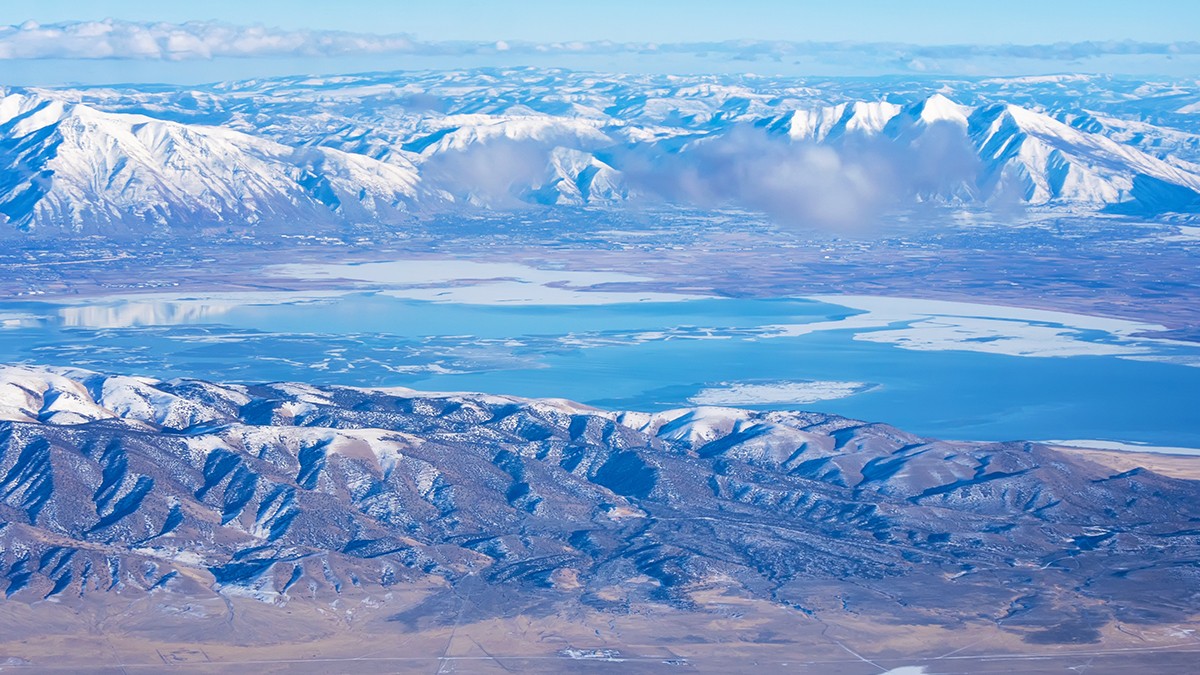
A massive reservoir of freshwater has been detected hidden beneath Utah’s Great Salt Lake, a finding that could have significant implications for water resource management and dust pollution mitigation in the region. The discovery, made by researchers at the University of Utah, confirms long-held suspicions while revealing the potential scale of the underground freshwater supply to be far larger than previously thought.
Airborne Survey Reveals Unexpected Depth
Using airborne electromagnetic (AEM) surveys, the team mapped the subsurface geology of Farmington Bay, an area along the southeastern edge of the lake. AEM technology detects electrical conductivity, allowing scientists to differentiate between saline and freshwater, as well as analyze rock composition. The survey revealed a dramatic drop in bedrock depth, creating a vast space filled with sediment saturated with freshwater.
The reservoir extends down between 3 and 4 kilometers (almost 2.5 miles) in the surveyed area, though a comprehensive assessment of the entire lake is still needed to confirm its full extent. Researchers estimate the reservoir spans approximately 2,500 square kilometers (950 square miles). This finding is remarkable because the Great Salt Lake is known for its high salinity, making the presence of such a large freshwater body unexpected.
The Importance of Subsurface Freshwater
The existence of subsurface freshwater has been hinted at by the emergence of reed-covered islands across the lake basin, but this study provides the first concrete assessment of the reservoir’s size. The data shows that the freshwater extends further into the center of Farmington Bay than anticipated, suggesting it may even underlie the entire lake.
This discovery matters because the Great Salt Lake is rapidly shrinking due to evaporation, exposing lakebed sediments that contain toxic metals. As these sediments dry, they become airborne, creating a public health hazard for surrounding communities. The freshwater reservoir could be used to dampen these dust hotspots, mitigating the spread of harmful pollutants. However, researchers caution that careful study is needed to avoid disrupting the freshwater system itself.
Next Steps and Broader Implications
Researchers are actively seeking funding to expand the AEM survey across the entire Great Salt Lake, aiming to map the full boundaries of the subsurface bedrock drop. This will provide a more accurate estimate of the freshwater volume stored beneath the lake.
“We need to survey the entire Great Salt Lake. Then we’ll know the top and the bottom,” states geophysicist Michael Zhdanov.
The techniques used in this study – combining magnetic readings to estimate rock depths with electrical conductivity readings to locate freshwater – can be applied to other similar saline lakes worldwide. The findings could aid in water resource planning and the investigation of hidden freshwater reserves in arid regions.
In conclusion, the discovery of this massive freshwater reservoir beneath the Great Salt Lake represents a significant step forward in understanding the region’s hydrology. While further research is needed, this finding offers a potential solution to dust pollution while opening new avenues for sustainable water management in the face of climate change and shrinking water bodies.