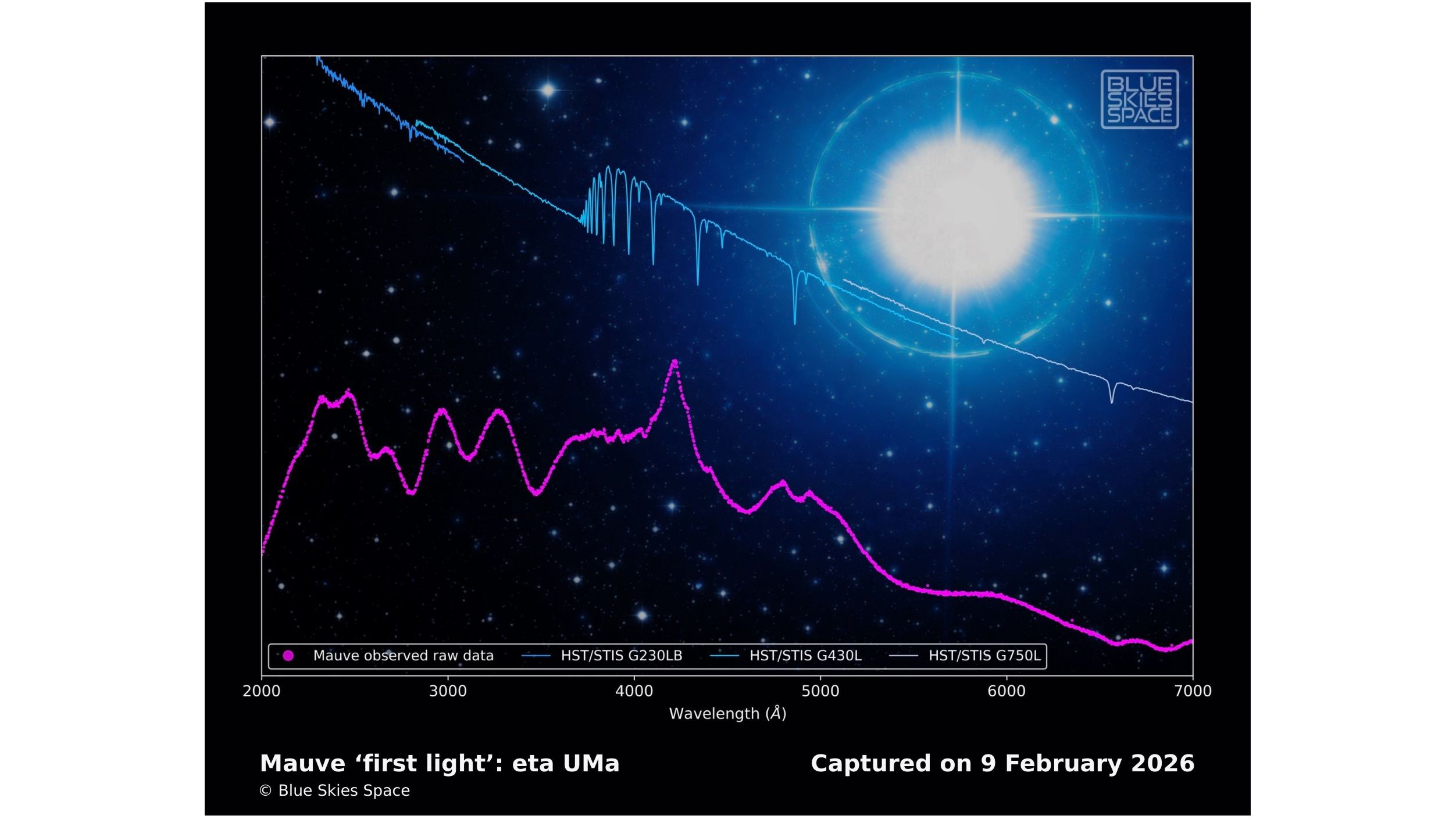
The first fully commercial space telescope, Mauve, has successfully captured its inaugural stellar observation, marking a pivotal shift in astronomical research. The satellite, launched last November via SpaceX, spotted the star eta Ursa Majoris – a bright, hot star 104 light-years away – using its specialized ultraviolet light sensors. This event signals the beginning of a new era where privately funded missions will supplement, and in some cases accelerate, traditional government-led space science.
The Rise of Commercial Space Astronomy
For decades, astronomy has been dominated by agencies like NASA and ESA. Now, London-based Blue Skies Space, a spin-out from University College London, is pioneering a customer-driven model. This approach allows for faster deployment and focused data acquisition, filling critical gaps in scientific understanding.
The team behind Mauve recognized a long-standing need: the last dedicated ultraviolet space observatory, the International Ultraviolet Explorer, went offline in 1996. Advancements in satellite technology made a small, privately funded solution viable. Ultraviolet observations are particularly important because they reveal stellar flares—powerful bursts of radiation that can dramatically affect the habitability of orbiting planets.
Why Stellar Flares Matter
Stellar flares release high-energy particles that can strip away planetary atmospheres. While Earth is protected by its magnetic field, planets like Mars have suffered significant atmospheric erosion from such events. By tracking flare activity in nearby stars, Mauve will help scientists identify potentially habitable exoplanets more effectively.
The telescope’s swift development – completed in just three years with contributions from companies across Europe – demonstrates the efficiency of a commercial approach. This contrasts sharply with the decades-long timelines often associated with large government-funded missions.
Future Missions and Global Collaboration
Research institutions worldwide, including teams from the U.S., Japan, and Europe, have already subscribed to Mauve’s data. Blue Skies Space plans to leverage revenue from this mission to fund Twinkle, a larger satellite designed to directly observe exoplanet atmospheres. The company is also exploring a lunar-orbiting constellation for radio astronomy in collaboration with the Italian Space Agency.
“There are plenty of opportunities for many satellites to do space science,” says Blue Skies Space CEO Marcell Tessenyi.
While acknowledging the vital role of government agencies in pushing technological boundaries, Tessenyi emphasizes that commercial astronomy will complement these efforts by efficiently reusing existing technologies and accelerating data provision. The Mauve mission is expected to deliver scientific data within weeks, representing a significant step towards democratizing access to space-based astronomy.