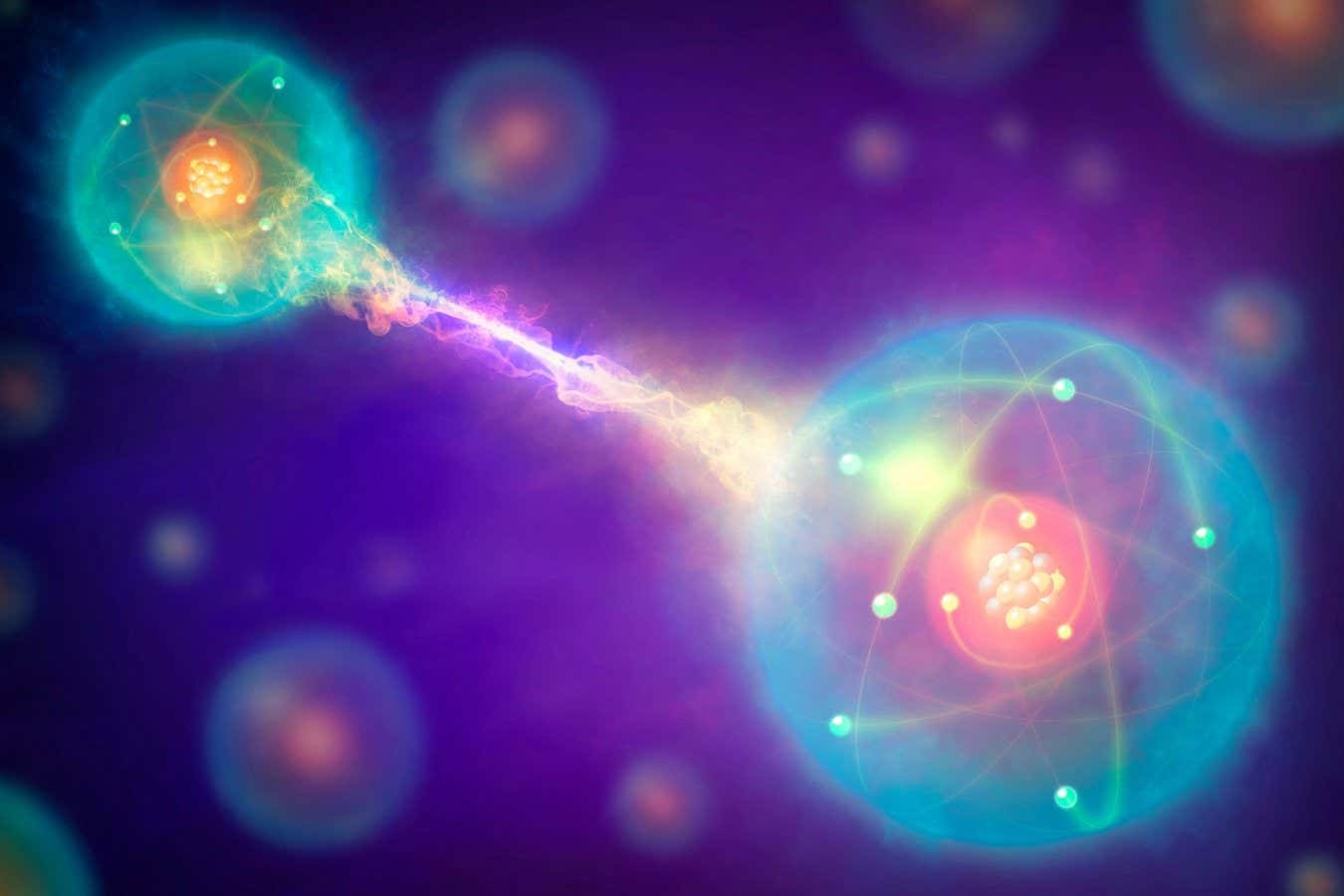
For years, scientists have struggled to peer into the “quantum innards” of solid objects to see if their particles are truly entangled. While we can manipulate individual particles in a controlled vacuum or a quantum computer, observing the collective entanglement within a physical piece of matter has remained an elusive goal.
Now, a research team led by Allen Scheie at Los Alamos National Laboratory has developed a groundbreaking method to measure this phenomenon, potentially opening a new chapter in both fundamental physics and the development of quantum technologies.
The Challenge of “Seeing” Entanglement
Quantum entanglement is a phenomenon where particles become so deeply linked that the state of one instantly influences the state of another, regardless of the distance between them. This “spooky action” is the backbone of future technologies like ultra-secure communication networks and powerful quantum computers.
To date, researchers have used Bell tests to confirm entanglement between specific particles, but these methods are difficult to scale to entire materials. Determining whether a solid substance—like a crystal or a metal—is permeated with entanglement has been nearly impossible because the complexity of the material often masks the quantum connections.
The Neutron Method: A New Way to Peek Inside
The breakthrough lies in using neutrons as messengers. Since the 1950s, physicists have known that by firing neutrons at a material and analyzing how they bounce off or pass through it, they can learn about the arrangement of particles inside.
Scheie and his team have refined this concept to calculate Quantum Fisher Information (QFI). Here is how the process works:
1. Neutron Bombardment: A sample of material is pelted with neutrons.
2. Detection: The properties of the exiting neutrons are collected by high-precision detectors.
3. Calculation: By analyzing the neutron data, researchers can calculate the QFI—a mathematical value that indicates the minimum number of particles within the material that must be entangled to produce that specific result.
Proven Accuracy and Versatility
The team tested their technique on various magnetic materials, including a well-known crystal composed of potassium, copper, and fluorine. To ensure the method was accurate, they compared their experimental results against computer simulations of the crystal’s quantum structure.
“It was a remarkably close agreement between the experimental and theoretical curves,” noted team member Pontus Laurell from the University of Missouri.
What makes this method particularly revolutionary is its resilience :
– No Model Required: Unlike previous attempts, this technique works even if scientists don’t have a perfect mathematical model of the material beforehand.
– Tolerance for Imperfection: It remains effective even when the material samples are not “perfect” crystals, which is a common reality in laboratory settings.
– Universal Application: The team has established a reliable, generally applicable way to measure entanglement that can be applied to a wide variety of new materials.
Why This Matters for the Future
This discovery is more than just a mathematical victory; it is a practical tool for the next generation of technology. As engineers hunt for the best materials to build quantum processors and sensors, they need a way to verify if those materials actually possess the quantum properties required for operation.
The researchers are now moving toward even more complex territory: measuring QFI during phase transitions. A phase transition is the quantum equivalent of water turning into ice. At these critical points, theoretical models often fail, and entanglement is expected to spike dramatically. By testing their method here, the team hopes to uncover entirely new quantum phenomena that have never been observed before.
Conclusion
By successfully using neutron scattering to measure Quantum Fisher Information, researchers have provided a reliable “thermometer” for entanglement in solids. This breakthrough provides the essential toolkit needed to explore new materials and accelerate the transition from theoretical quantum physics to functional quantum technology.