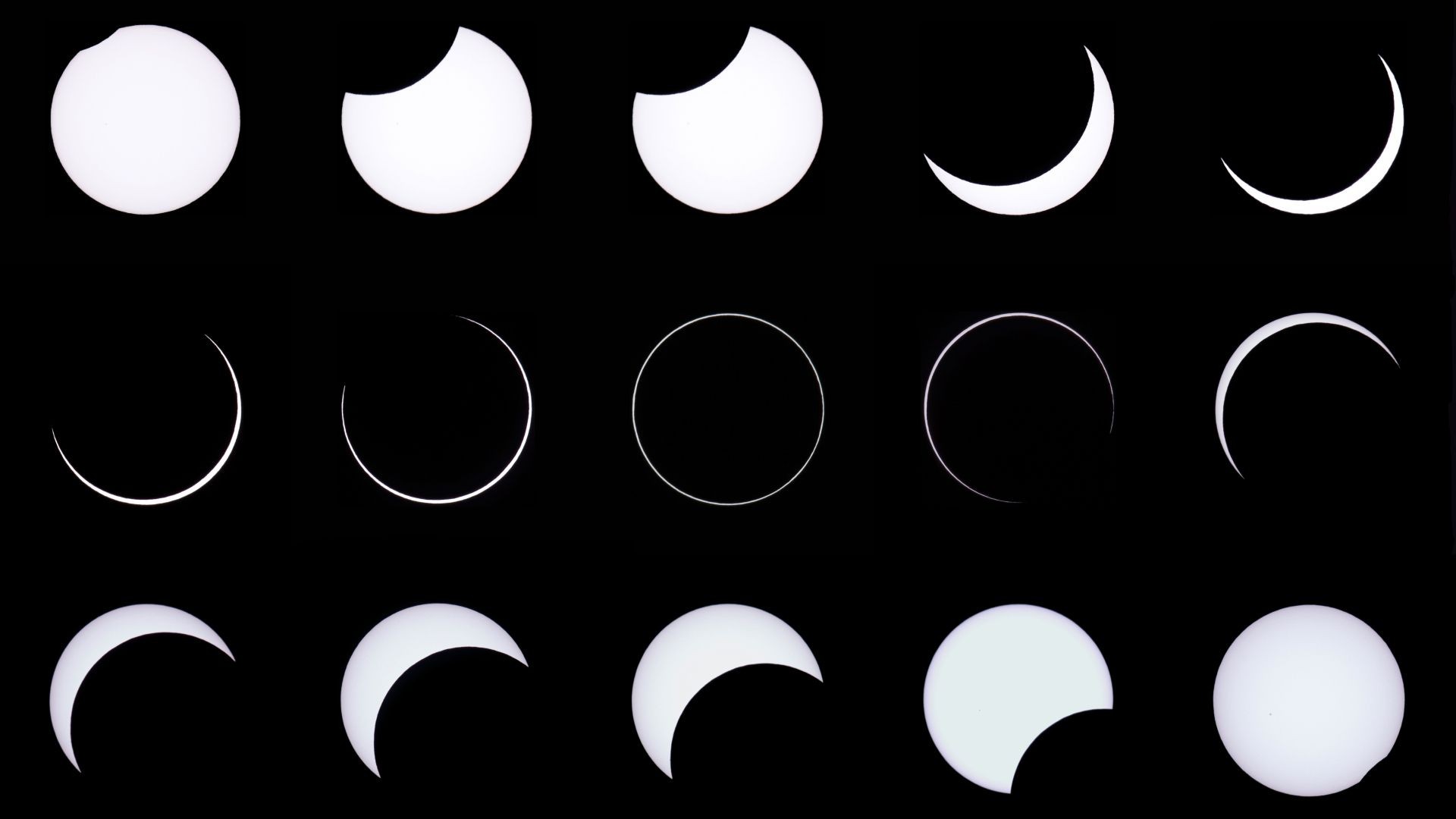
An annular solar eclipse – often called a ‘ring of fire’ – recently swept across Antarctica, creating a stunning celestial display visible to a small number of observers. The event occurred on February 17th as the moon passed between the Earth and sun, appearing smaller in the sky due to its distant position in its orbit.
How the Eclipse Worked
The eclipse began at 4:56 a.m. EST (0956 GMT) with the moon gradually obscuring the sun. Unlike a total solar eclipse, where the moon completely covers the sun, this was an annular eclipse. This means the moon was too far away to fully block the sun’s disk, leaving a brilliant ring of sunlight visible around the moon’s silhouette.
The peak of the eclipse – known as annularity – lasted just over two minutes and was observable along a narrow 383-mile (616 km) corridor in Antarctica. The Concordia research station, housing fewer than 100 people, was one of the few places where scientists and visitors could witness the event firsthand.
Global Visibility & What it Means
While full annularity was limited to Antarctica, a partial eclipse was visible to roughly 176 million people in southern South America and parts of Africa, including Madagascar. The eclipse concluded at 9:27 a.m. EST (1427 GMT) as the moon moved away from the sun’s disk.
This eclipse underscores the precision of celestial mechanics. Annular eclipses are rarer than total solar eclipses because they require a specific alignment of the Earth, moon, and sun. The fact that this one occurred over Antarctica highlights how much of our planet remains relatively unexplored by most people.
What’s Next?
Skywatchers won’t have to wait long for another spectacle. A total lunar eclipse, sometimes called a “blood moon,” is scheduled for March 3rd. Over 2.5 billion people, including those in North America, will have the chance to see the moon turn a deep red as it passes through Earth’s shadow.
For future solar eclipses, including a major one on August 12th, proper eye protection is essential. Safe eclipse glasses or viewers are crucial to avoid permanent eye damage.