NASA is preparing to send four astronauts on a groundbreaking mission to orbit the moon, marking humanity’s farthest journey from Earth since the Apollo 17 mission in 1972. The Artemis II flight, scheduled for later this year, will test critical systems for future lunar landings and represents a significant step toward establishing a sustained presence on the moon.
The Mission and Its Significance
This mission is not a return to landing on the moon, but a crucial test flight. The primary goal is to validate the Orion spacecraft’s life-support systems and other essential components in deep space. If successful, Artemis II will pave the way for crewed landings as early as 2027, reigniting human lunar exploration after a decades-long hiatus.
The Artemis program’s resurgence isn’t just about scientific discovery. It’s about resource exploration too. The moon holds potential for mining frozen water for future space missions and extracting helium-3, a rare isotope that could fuel fusion power plants. This makes the moon a key strategic asset for long-term space development.
The Hardware: SLS and Orion
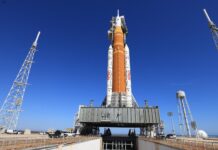
The mission will utilize NASA’s Space Launch System (SLS) rocket, a modern equivalent of the Saturn V used during the Apollo era. The SLS stands 322 feet tall, weighs 5.75 million pounds when fueled, and can lift 60,000 pounds to the moon. This rocket is a blend of proven technologies from the 1970s space shuttles, updated with modern engineering.
The Orion capsule will carry the astronauts to lunar orbit and back. The crew module will splash down in the Pacific Ocean near San Diego upon returning to Earth. Orion’s design includes a “free return” trajectory, meaning the spacecraft can return to Earth even with propulsion system failures, ensuring crew safety.
The Crew: History in the Making
The Artemis II crew includes three NASA astronauts – Commander Reid Wiseman, Pilot Victor Glover, and Mission Specialist Christina Koch – all veterans of the International Space Station. Joining them is Canadian astronaut Jeremy Hansen, making him the first non-NASA crew member on a lunar mission.
Victor Glover will become the first Black astronaut to travel around the moon, and Christina Koch the first woman. These milestones mark a new era of diversity in space exploration.
The Path Forward: Artemis III and Beyond
NASA initially planned to land astronauts on the moon by the end of 2028 with Artemis III. However, plans have shifted. Artemis III will now serve as a test flight in Earth orbit, practicing rendezvous maneuvers with SpaceX and Blue Origin’s lunar landers. If successful, Artemis IV and V could attempt landings as early as 2028, potentially meeting former President Trump’s goal of returning astronauts to the moon before the end of his second term.
The total cost of developing the SLS, Orion, and ground systems has exceeded $50 billion. Each SLS/Orion launch is estimated to cost around $4.1 billion. This highlights the immense financial commitment required for deep-space exploration.
The Artemis II mission is not merely a symbolic journey; it is a critical step toward establishing a sustainable human presence beyond Earth. The success of this mission will determine the pace and direction of lunar exploration for decades to come.