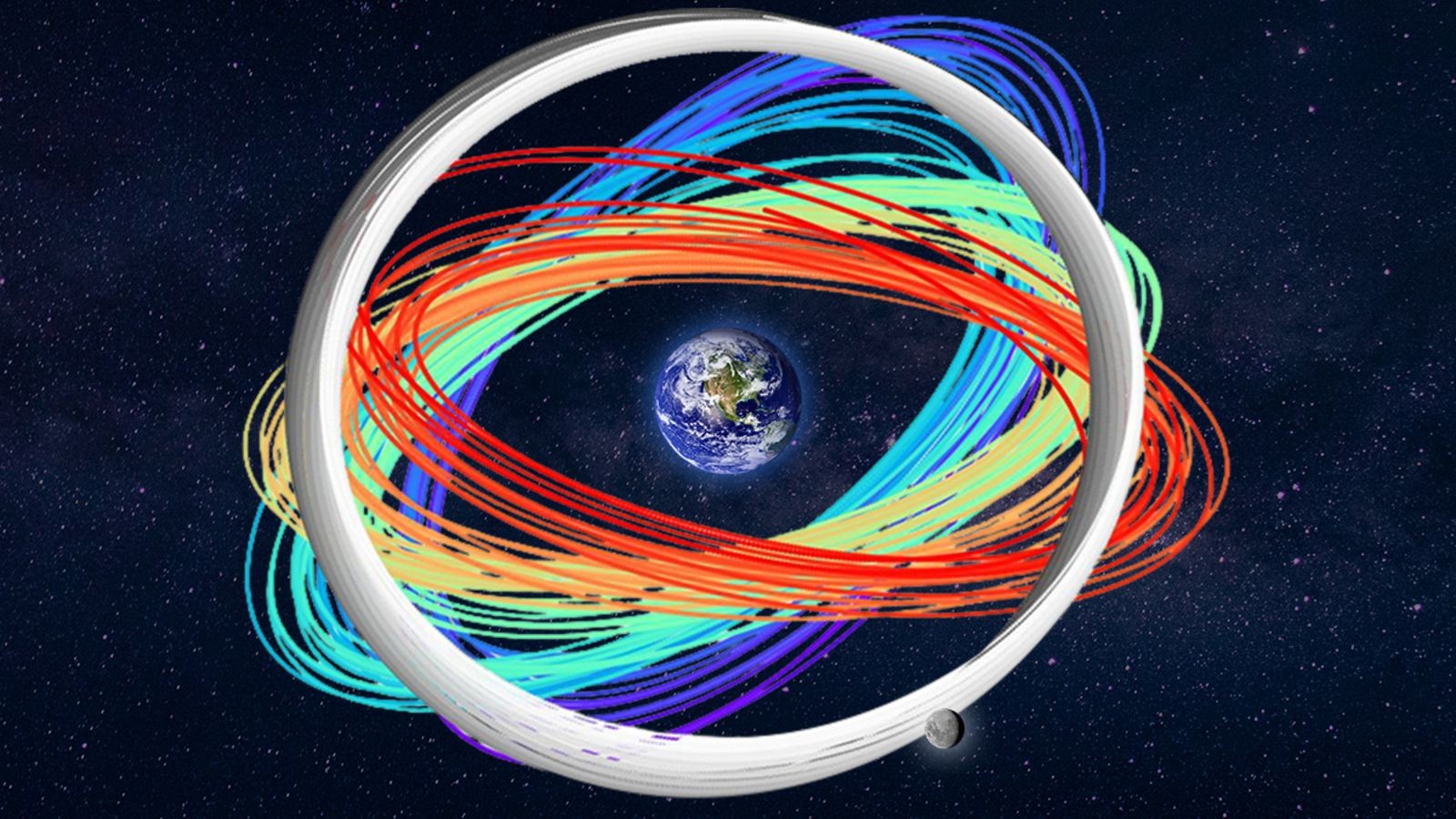
New supercomputer simulations demonstrate that maintaining stable satellite orbits between Earth and the Moon is far more challenging than previously understood. Of one million simulated spacecraft, fewer than 10% remained viable over a six-year period, highlighting significant hurdles for expanding orbital infrastructure beyond low Earth orbit (LEO).
The Cislunar Challenge: Beyond Low Earth Orbit
The rise of mega-constellations like SpaceX’s Starlink and China’s Thousand Sails has rapidly increased the number of satellites in LEO. As LEO approaches saturation – with estimates suggesting a maximum capacity of roughly 100,000 satellites before collision risks escalate – attention is turning towards cislunar space – the region between Earth and the Moon – as the next frontier for satellite deployment.
However, cislunar orbits are inherently unstable. Unlike LEO, where gravitational forces are relatively predictable, spacecraft in this region are pulled by Earth, the Moon, and the Sun in complex interactions. The lack of Earth’s magnetic shielding also exposes satellites to destabilizing solar radiation.
Supercomputer Modeling: A 1.6 Million CPU-Hour Task
To map cislunar orbital stability, researchers at Lawrence Livermore National Laboratory (LLNL) used the Quartz and Ruby supercomputers to simulate the trajectories of approximately one million objects. The simulations, requiring 1.6 million CPU hours (equivalent to 182 years on a single computer), were completed in just three days.
The results are stark: roughly 54% of simulated orbits remained stable for at least one year, but only 9.7% survived the full six-year simulation period. This underscores that long-term stability in cislunar space is significantly lower than previously anticipated.
Earth’s Imperfections: A Subtle Yet Critical Factor
One surprising finding was the impact of Earth’s uneven gravitational field. The simulations revealed that Earth’s mass distribution isn’t uniform; gravity varies subtly due to geographical features (lower gravity over Canada, for instance). This “blobbiness” subtly affects orbital trajectories, adding another layer of complexity.
Implications and Future Exploration
Despite the low survival rate, the simulations still identify approximately 97,000 potentially stable orbits in cislunar space. More importantly, the dataset provides invaluable insights into why certain orbits fail, allowing engineers to refine future designs. According to study lead Travis Yeager, “Learning which orbits didn’t work is just as valuable as knowing which ones did.”
The cislunar space will become a critical region for future infrastructure, including lunar colonies and expanded communication networks. Understanding orbital instability is the first step towards making this expansion viable.