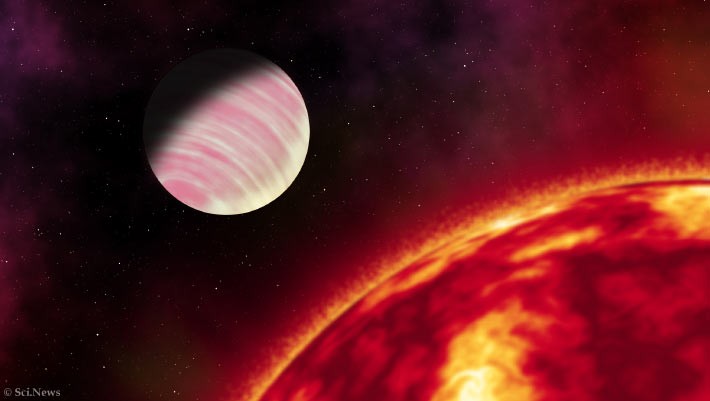
New observations from the James Webb Space Telescope (JWST) have revealed a planetary mystery 283 light-years away. Astronomers studying the gas giant TOI-5205b have discovered an atmosphere that defies standard planetary formation models, characterized by a surprising lack of heavy elements and a unique chemical signature.
A Planetary Outlier
TOI-5205b is a massive gas giant, nearly identical in size and mass to Jupiter. However, its environment is vastly different from our own solar system. It orbits a small, dim red dwarf star (an M4-type star) every 1.63 days, making it a “short-period” planet that sits extremely close to its host star.
Using the telescope’s Near-Infrared Spectrograph (NIRSpec), researchers analyzed three separate transits of the planet. The data revealed a chemical composition that contradicts existing theories:
- Low Metallicity: The atmosphere contains significantly fewer heavy elements relative to hydrogen than Jupiter does.
- Chemical Imbalance: The atmosphere is notably carbon-rich but oxygen-poor.
- Trace Gases: The observations also detected the presence of methane and hydrogen sulfide.
The Formation Paradox
The existence of TOI-5205b poses a significant challenge to the “core accretion” theory—the leading model for how planets form.
In traditional models, a massive planet forms when a solid core grows large enough to rapidly pull in surrounding gas. However, red dwarf stars like TOI-5205 typically have smaller protoplanetary disks with less dust and gas. This makes it mathematically difficult to build a core large enough to trigger the creation of a Jupiter-sized giant.
“These worlds are difficult to form through core accretion because the low disk masses… impede the efficient formation of massive planetary cores,” explains Dr. Caleb Cañas of NASA’s Goddard Space Flight Center.
Why the Atmosphere is So “Empty”
One of the most striking findings is the disconnect between the planet’s bulk composition and its atmosphere. While the planet’s mass and radius suggest a heavy, metal-rich interior, the atmosphere itself is surprisingly “light” in terms of heavy elements.
To explain this discrepancy, researchers, including Dr. Shubham Kanodia of Carnegie Science, suggest a process of internal migration :
- Heavy Element Migration: During the planet’s formation, heavy elements likely migrated toward the center of the planet.
- Lack of Mixing: The interior and the atmosphere appear to be chemically isolated, meaning the heavy elements trapped in the core are not mixing with the outer layers.
This discovery suggests that TOI-5205b may be an “extreme regime” planet, representing a type of world that current models of planetary evolution struggle to fully explain.
Conclusion
The study of TOI-5205b reveals that gas giants around red dwarf stars can possess atmospheres strikingly different from those in our solar system. These findings force astronomers to rethink how massive planets form around small stars and how their internal structures evolve over time.