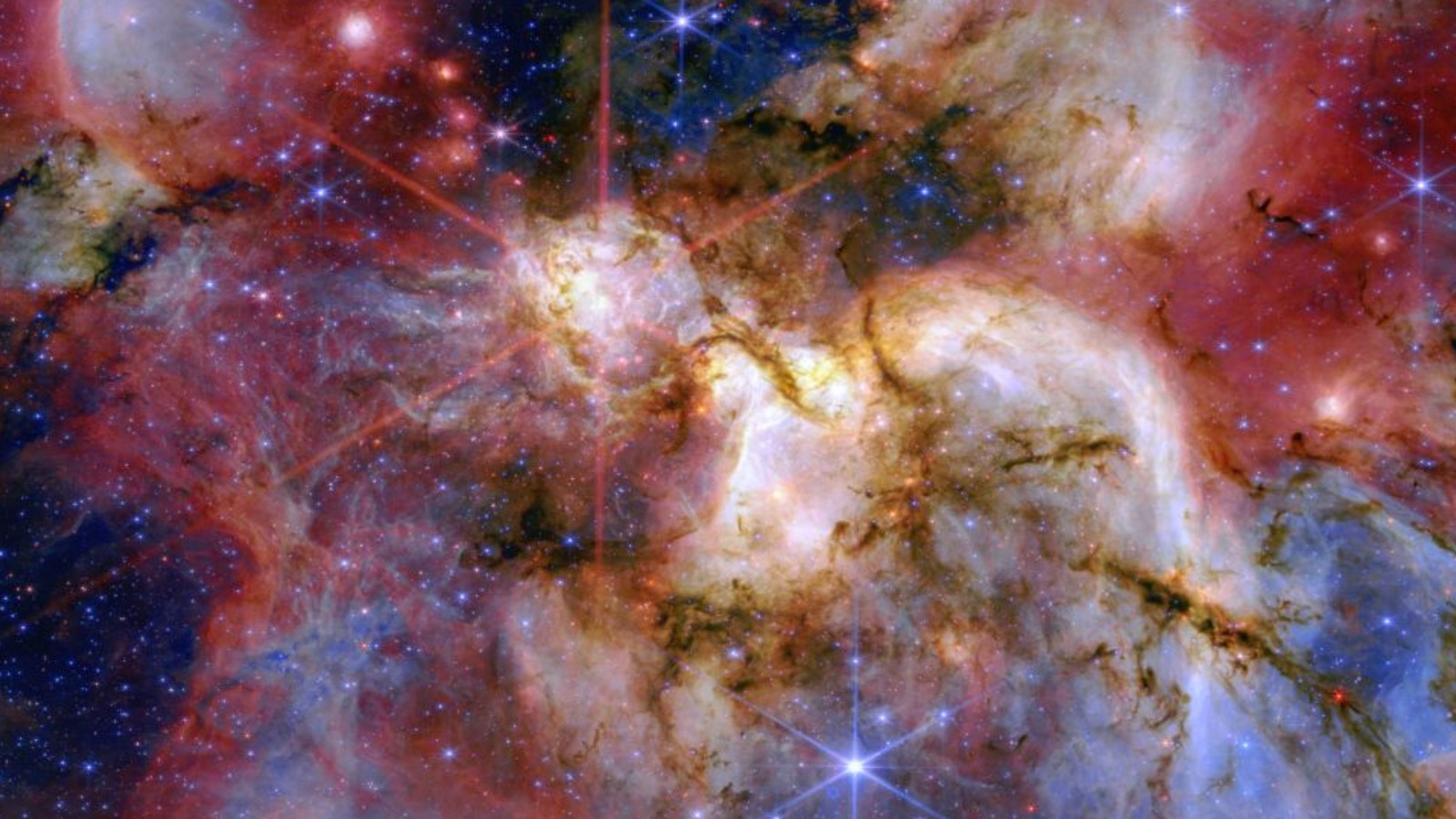
The James Webb Space Telescope (JWST) has delivered groundbreaking images of the W51 star-forming region, exposing previously unseen young stars buried deep within clouds of gas and dust. This marks a significant step forward in understanding how massive stars are born – a process that remains largely mysterious to astronomers.
Unveiling the Invisible
For decades, W51 has been observed by various telescopes, yet many of its infant stars remained hidden. The JWST’s unique ability to detect infrared light, which penetrates dense cosmic dust, has changed this. The new observations reveal these stellar nurseries with unprecedented clarity, showing lanes of gas and dust illuminated by the recently formed stars.
The stars within W51 are remarkably young, having emerged within the last million years. This is a blink of an eye in cosmic terms – our Sun, for comparison, is roughly 4.6 billion years old.
Why Infrared Matters
Traditional telescopes struggle to peer through the thick dust clouds surrounding these nascent stars. Visible light is scattered and absorbed, leaving them invisible. However, infrared radiation cuts through the dust, allowing the JWST to “see” the hidden stars forming within.
“With optical and ground-based infrared telescopes, we can’t see through the dust to see the young stars,” explains University of Florida researcher Adam Ginsburg. “Now we can.”
Implications for Stellar Formation
The images aren’t just visually striking; they hold crucial scientific value. High-mass star formation is less understood than the birth of smaller stars like our Sun. The JWST allows researchers to study these massive stellar infants directly, potentially unlocking the secrets of their formation mechanisms.
The telescope also revealed previously unseen structures within W51, including shockwaves, expanding gas bubbles, and dark dust filaments – all indicators of the turbulent environment in which these stars are born.
“Every time we look at these images, we learn something new and unexpected,” Ginsburg stated. The JWST’s advanced capabilities have essentially created a “new” view of W51, despite decades of prior observations.
These discoveries represent a major advance in astrophysics, offering a glimpse into the earliest stages of star formation and challenging existing theories. The JWST’s ability to see the unseen is revolutionizing our understanding of the cosmos.