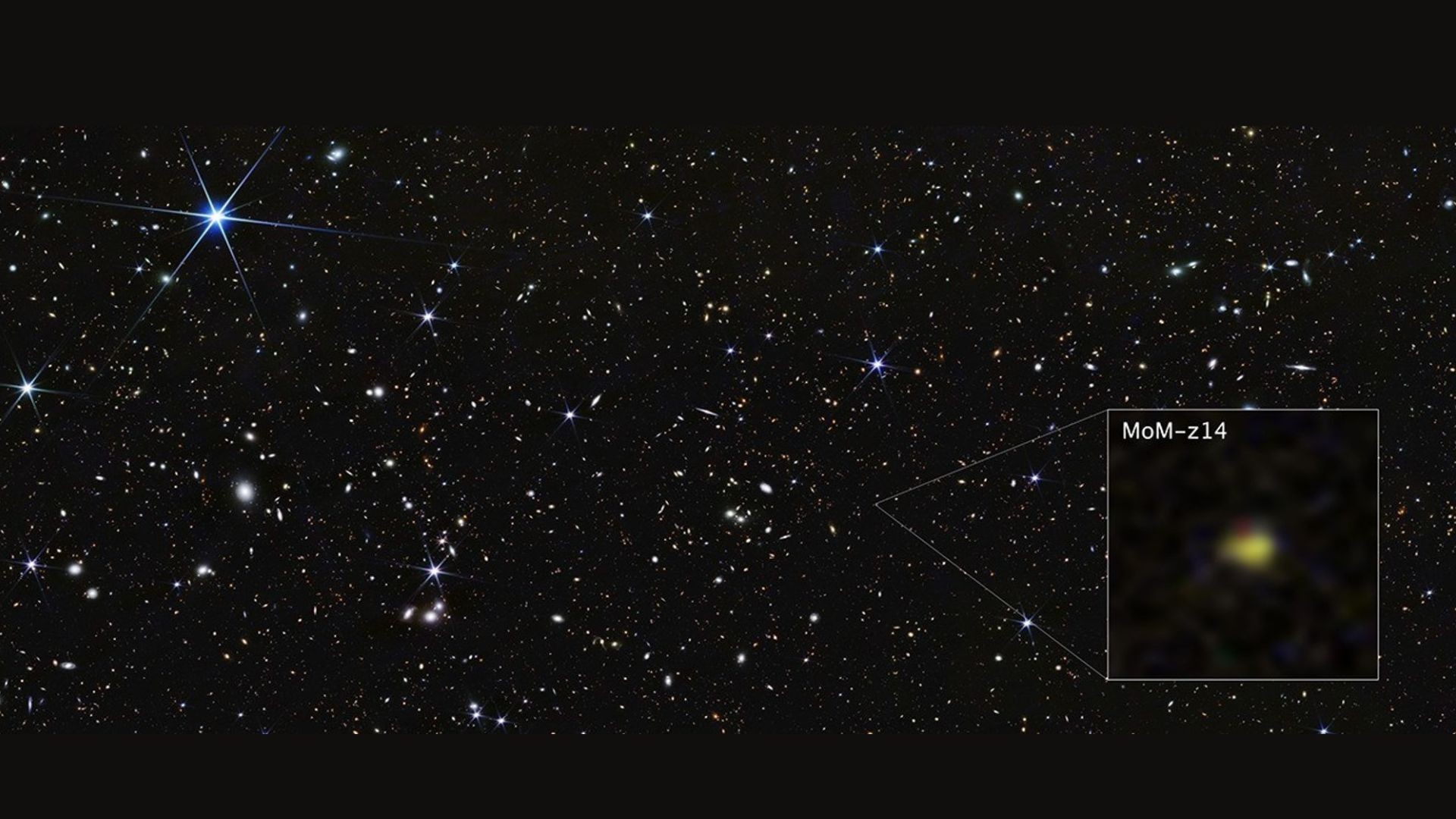
The James Webb Space Telescope (JWST) has identified the farthest galaxy ever observed, named MoM-z14, pushing the boundaries of our understanding of the early universe. The discovery, announced by NASA on January 28th, allows astronomers to study a period just 280 million years after the Big Bang – a time known as cosmic dawn when the first stars and galaxies emerged.
Unprecedented Distance and Brightness
MoM-z14’s light has traveled roughly 13.5 billion years to reach Earth, making it the most distant and one of the earliest galaxies confirmed to date. What sets this galaxy apart is its unexpected brightness and chemical composition, defying prior expectations about early galactic formations.
According to Rohan Naidu, lead author from MIT, “With Webb, we are able to see farther than humans ever have before, and it looks nothing like what we predicted, which is both challenging and exciting.” The galaxy is brighter, more compact, and shows higher levels of chemical enrichment than models anticipated for this early stage of the universe.
Challenging Existing Models
The presence of elevated nitrogen levels in MoM-z14 suggests that massive stars formed and evolved at a much faster rate than previously thought. It has also cleared away primordial hydrogen gas from its surrounding region, a surprising discovery given the early universe was mostly filled with neutral hydrogen.
These findings are adding fuel to the growing gap between theoretical predictions and actual observations. Jacob Shen, a co-author from MIT, stated, “There is a growing chasm between theory and observation related to the early universe, which presents compelling questions to be explored going forward.”
The JWST’s Unexpected Success
Before the JWST launched, scientists expected detecting bright galaxies at this distance would be nearly impossible. Models predicted early galaxies would be faint, small, and rare, requiring extensive observation time to confirm even a few sources. Instead, the telescope has consistently surpassed expectations, routinely capturing light from numerous young galaxies formed just a few hundred million years post-Big Bang.
Pieter van Dokkum of Yale University noted last year, “While we were hoping for some very early objects, I don’t think any of us expected to break the redshift record!” This continued success suggests that even more groundbreaking discoveries are on the horizon.
The JWST’s ability to reveal the early universe in such detail underscores how much remains unknown about the cosmos. Astronomers now face the challenge of refining existing theories to reconcile them with these new, unexpected observations.
The James Webb Space Telescope has not just extended our vision into the distant past but also forced us to reconsider how we understand the birth of galaxies and the evolution of the early universe.