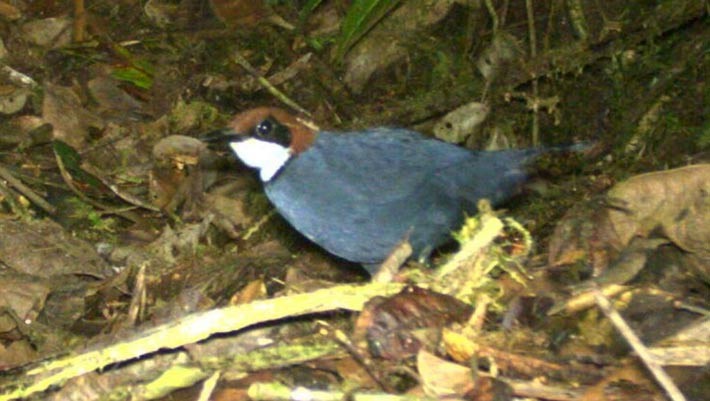
Ornithologists have confirmed the existence of a previously unknown bird species in the remote forested karst regions of Papua New Guinea. The discovery, made using automated camera traps, introduces a new member to the Ptilorrhoa genus – commonly known as jewel-babblers – a group unique to New Guinea and its surrounding islands.
Identifying a Hidden Species
Jewel-babblers are small, ground-dwelling insectivores characterized by their plump bodies, short wings, and distinctive markings: a black mask, a contrasting throat or cheek patch, and soft, often blue or chestnut-colored plumage. These birds are typically heard more often than seen due to their shy nature and preference for dense forest interiors.
Currently, four jewel-babbler species are recognized, each occupying different altitudes across New Guinea. The blue jewel-babbler thrives in lowlands, the chestnut-backed in the hills, and the spotted in montane forests. A fourth, the brown-headed jewel-babbler, has a fragmented distribution in northeast Papua New Guinea and on Yapen Island.
Camera Trap Breakthrough
The new species, dubbed the hooded jewel-babbler (Ptilorrhoa urrissia ), was first observed in 2017 through a long-term camera trap study on Iagifu Ridge in the Southern Highlands Province. Over 1,800 camera days, researchers captured 94 photographs and seven videos of the bird, confirming its distinction from known Ptilorrhoa forms. Despite dedicated searching, researchers failed to capture the bird physically until 2024.
Limited Population and Habitat
The hooded jewel-babbler appears to be a permanent resident of Iagifu Ridge, with consistent sightings over seven years. The total estimated population is exceptionally small, likely fewer than ten individuals. Observations suggest a social structure of pairs or small family groups, similar to other jewel-babblers.
Researchers believe the species may occupy isolated, low-elevation mountain habitats fragmented across southern Papua New Guinea, potentially between Mt Bosavi and Mt Karimui. The birds appear less vocal than other jewel-babblers, exhibiting behavior closer to the montane species.
Threats to Survival
The hooded jewel-babbler faces a range of threats, including native predators such as quolls, dasyures, and raptors. Alien predators, particularly domestic cats and dogs, also pose a significant risk. Further complicating its survival is the looming threat of climate change, which could disproportionately impact low-elevation species with limited dispersal ability.
The discovery was formally published in the journal Ibis on November 26, 2025. The hooded jewel-babbler stands as a testament to the hidden biodiversity of New Guinea, yet its future remains uncertain given the pressures from both natural and human-induced threats.