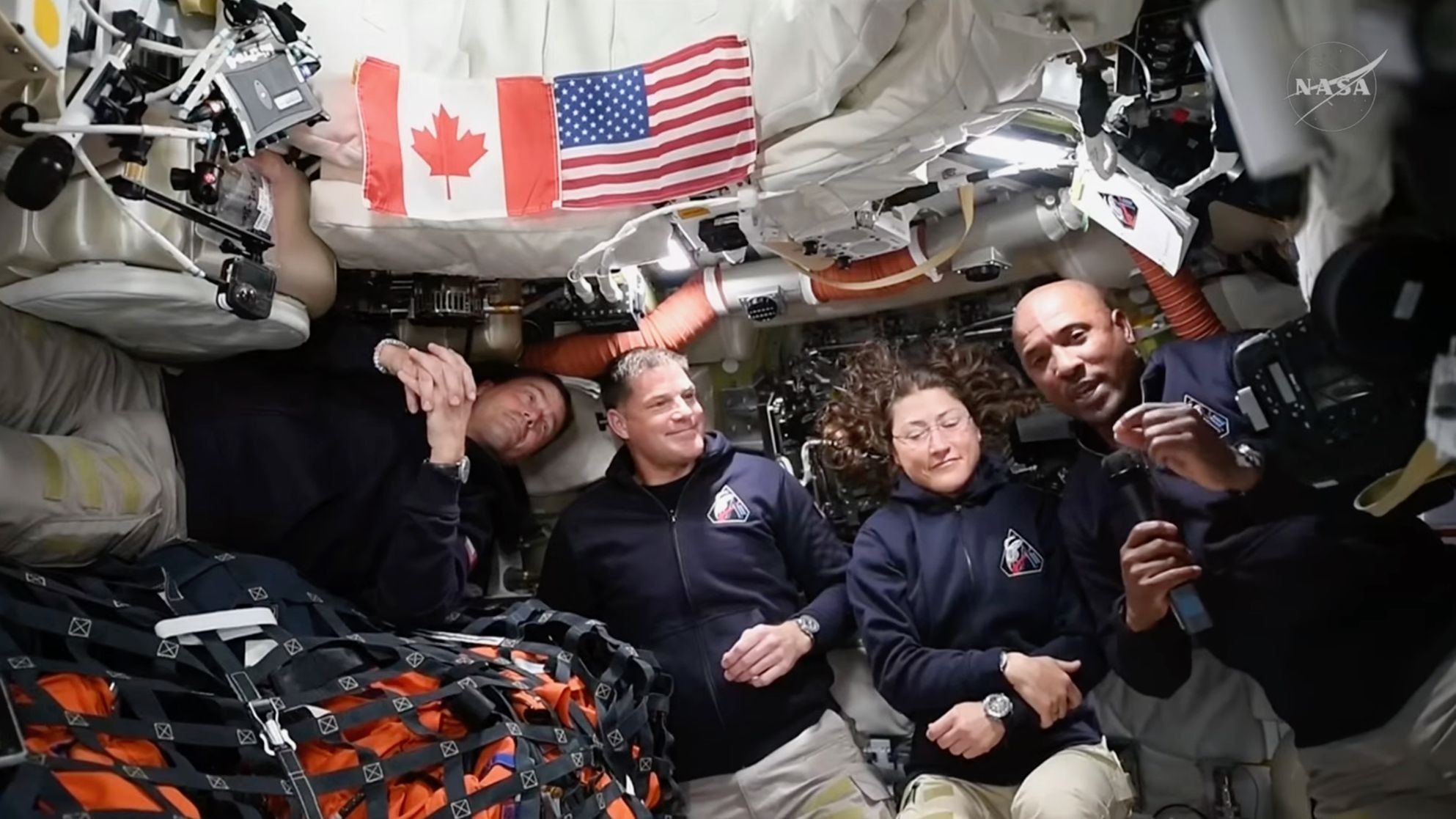
As the Artemis 2 mission progresses toward its lunar flyby, a moment of spontaneous reflection has drawn powerful parallels to one of the most iconic moments in space history. While orbiting the moon, mission pilot Victor Glover delivered an impromptu message to Earth, echoing the spiritual and philosophical weight carried by the Apollo 8 crew decades ago.
A Modern Echo of Apollo 8
The connection between these two missions is more than just chronological; it is thematic. In December 1968, the astronauts of Apollo 8 —the first humans to leave Earth’s orbit—shared a reading from the Book of Genesis with a global audience. Their Christmas message served as a moment of profound connection between a distant crew and a world watching from below.
Now, as the Artemis 2 crew travels toward the moon, Victor Glover has provided a modern counterpart. When asked for an Easter reflection during a live broadcast, Glover offered a perspective that transcended religious boundaries, focusing instead on the shared human experience.
“You guys are talking to us because we’re in a spaceship really far from Earth, but you’re on a spaceship called Earth that was created to give us a place to live in the universe… I’m trying to tell you—just trust me—you are special.”
The “Oasis” in the Void
Glover’s message focused on the fragility and uniqueness of our planet. He described the universe as a vast “emptiness” and characterized Earth as a rare, beautiful “oasis” where humanity exists together.
His remarks were designed to be inclusive, addressing people of all faiths and none. By framing the mission not just as a feat of engineering, but as a moment to recognize our collective identity, Glover emphasized a vital truth: despite the technological distance between the astronauts and those on the ground, the human connection remains unchanged.
The Mission Ahead: Seeking a New “Earthrise”
The Artemis 2 mission follows a similar flight path to its predecessor. The crew—consisting of Victor Glover, Reid Wiseman, Christina Koch, and Jeremy Hansen —will not land on the lunar surface. Instead, they will perform a lunar flyby, looping around the far side of the moon before slingshotting back toward Earth.
This trajectory brings a significant historical opportunity:
– The Mission Objective: On Monday, April 6, the Orion capsule will pass the moon, providing the crew the chance to capture images of Earth from deep space.
– The Historical Precedent: During the Apollo 8 mission, astronaut Bill Anders captured the legendary “Earthrise” photograph. That single image, showing the vibrant blue planet hanging over the desolate lunar landscape, is credited with helping ignite the modern environmental movement.
– The Goal: NASA and the Artemis crew hope to capture a new “Earthrise” that might once again remind a fractured world of its shared home and the necessity of global cooperation.
Timeline of the Return
The mission is entering its final critical phase. Following the lunar flyby on Monday, the Orion capsule is scheduled to begin its journey back to Earth, with a planned arrival on Friday, April 10.
Conclusion
By bridging the gap between the technological triumphs of the past and the exploration goals of the future, the Artemis 2 mission serves as a reminder that space exploration is as much about understanding our place in the universe as it is about reaching new frontiers.