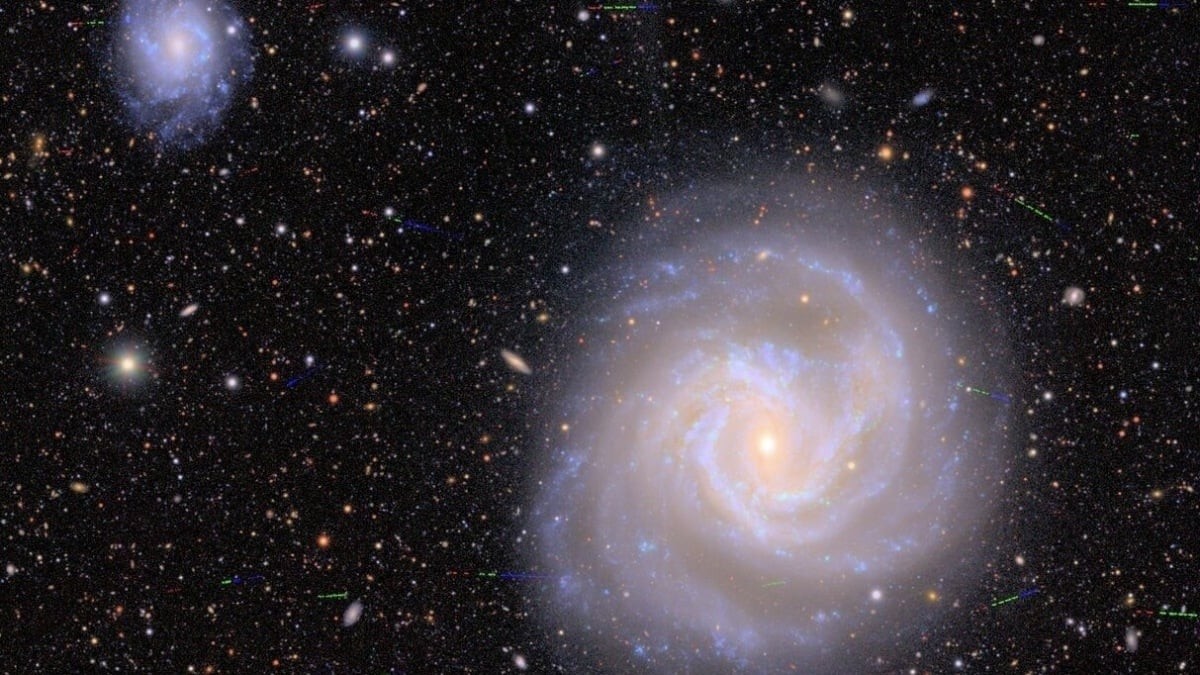
Astronomers have identified an asteroid spinning at an unprecedented rate, completing a full rotation in under two minutes. The discovery, made using the Vera C. Rubin Observatory in Chile during a test run, challenges existing theories about asteroid structure and formation. This 8-football-field-wide space rock, designated 2025 MN45, resides in the main asteroid belt between Mars and Jupiter.
Challenging Existing Theories
For decades, scientists believed asteroids larger than a few hundred yards were loosely held together by gravity, and excessive spinning would cause them to break apart. This ‘spin barrier’ suggested a minimum rotation time of around two hours. However, the Rubin Observatory’s initial observations reveal that at least nineteen newly identified asteroids defy this limit, with three, including 2025 MN45, rotating in under five minutes.
What Makes This Asteroid Unique?
To withstand such rapid spinning without disintegration, 2025 MN45 must be composed of solid rock rather than a loose pile of debris. Researchers speculate it could be a dense core fragment from a larger, now-destroyed asteroid, ripped free by a violent cosmic collision. The asteroid’s rotation speed translates to roughly 45 mph for any hypothetical observer standing on its surface.
Implications for Planetary Science
The discovery of 2025 MN45 and other fast-spinning asteroids suggests that collisions may not be the only mechanism driving extreme rotation speeds in these celestial bodies. This finding could reshape our understanding of asteroid evolution, internal composition, and the early solar system’s chaotic history. The Vera C. Rubin Observatory, once fully operational, is expected to uncover many more such anomalies.
A New Era of Asteroid Research
The Rubin Observatory’s ability to repeatedly scan the entire southern sky is revolutionizing asteroid research. Early data already indicates that the asteroid population is far more diverse than previously understood. As the survey expands, astronomers anticipate a deluge of new discoveries, potentially rewriting textbooks on planet formation and asteroid behavior.
“Determining the parent body of this fastest-rotating asteroid would be quite difficult,” said astronomer Sarah Greenstreet, “but it’s also quite possible that its parent body was catastrophically disrupted.”
The existence of such rapid rotators hints at previously unknown processes at play in the early solar system. The Rubin Observatory is just beginning to unveil the hidden complexity of these ancient building blocks of planets.