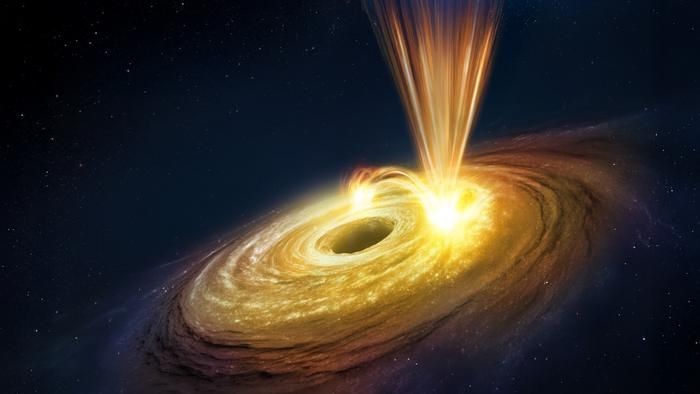
Astronomers have observed a supermassive black hole ejecting material at speeds exceeding 130 million miles per hour – a cosmic outburst unlike any previously documented. This event, detected in the galaxy NGC 3783 located 135 million light-years from Earth, provides new insight into the extreme power of active galactic nuclei (AGNs).
The Discovery of Extreme Winds
The black hole’s activity was first flagged by a massive X-ray flare. As the flare subsided, it left behind winds traveling at roughly one-fifth the speed of light (37,000 miles per second or 60,000 kilometers per second). This is significantly faster than any previously observed galactic winds, and far beyond the scale of solar flares from our own Sun.
The lead researcher, Liyi Gu of the Space Research Organisation Netherlands, described the phenomenon as unprecedented, stating, “We’ve not watched a black hole create winds this speedily before.”
Magnetic Untwisting: The Engine Behind the Blast
Scientists believe the rapid ejection was triggered by a sudden “untwisting” of the black hole’s complex magnetic field. This process is analogous to coronal mass ejections (CMEs) from the Sun, where tangled magnetic lines snap and release huge bursts of plasma. However, the scale here is vastly different. The black hole in NGC 3783 has a mass equivalent to 30 million suns, making its flares and ejections correspondingly immense.
As ESA astronomer Matteo Guainazzi put it, the event is “on a scale almost too big to imagine.” By comparison, recent solar CMEs clocked in at a mere 930 miles per second.
Collaborative Observation and Future Research
The discovery relied on data from two X-ray space telescopes: ESA’s XMM-Newton and XRISM. The team used XMM-Newton to track the initial flare and XRISM’s Resolve instrument to analyze the subsequent winds. This coordinated approach highlights the potential of combined observations in unraveling extreme cosmic events.
Researchers plan to apply this method to study other flaring AGNs, hoping to deepen our understanding of galactic evolution.
Why This Matters: Understanding Galactic History
Active galactic nuclei are among the most energetic phenomena in the universe. Studying their behavior, including the creation of these intense winds, is critical for understanding how galaxies form and change over time. The magnetism of AGNs plays a crucial role in shaping galaxies, and unraveling these processes will provide a clearer picture of the universe’s history.
“Knowing more about the magnetism of AGNs, and how they whip up winds such as these, is key to understanding the history of galaxies,” notes Camille Diez, an astrophysicist involved in the research.
This discovery emphasizes that black holes are not just cosmic vacuum cleaners, but also powerful engines driving galactic evolution.