Astronomers have tracked a powerful gamma-ray burst (GRB) – designated GRB 230906A – back to its source: a collision between two neutron stars within a small galaxy embedded in a vast stream of intergalactic gas. This discovery challenges existing theories about where such extreme events occur and may explain the unexpected presence of heavy elements like gold and silver in distant stars.
The Unexpected Location
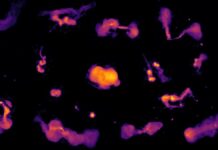
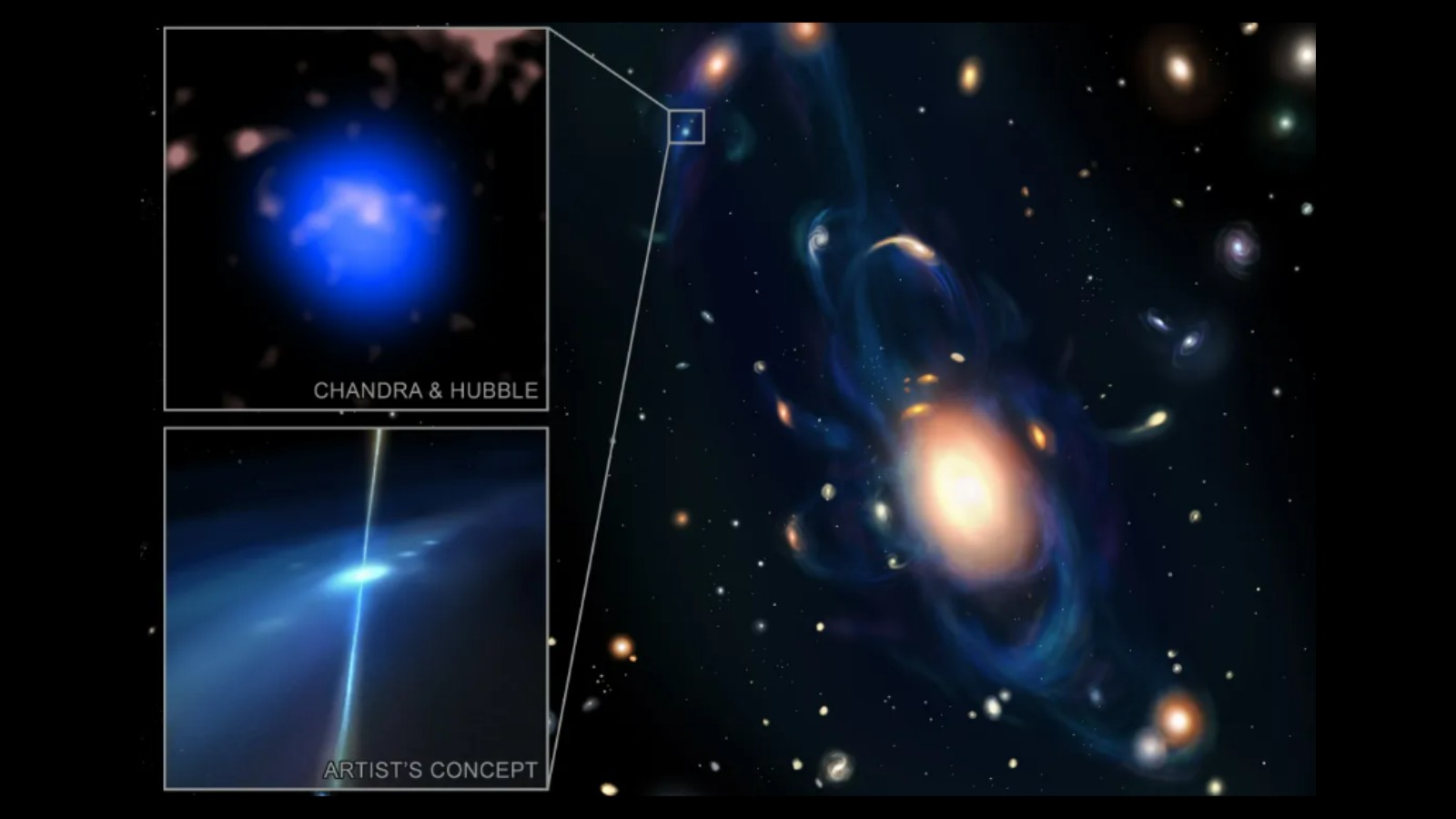
Previously, neutron star mergers – violent events capable of forging elements heavier than iron – were observed primarily in medium-to-large galaxies. This new observation, detected by NASA’s space telescopes (Chandra, Fermi, Swift, and Hubble) on September 23, 2023, reveals that these mergers can also occur in much smaller galaxies. The host galaxy is nestled within a 600,000-light-year-long gas stream, approximately six times the width of the Milky Way, formed by the aftermath of past galactic collisions.
Solving Astrophysical Puzzles
The location of this GRB is significant because it addresses two long-standing mysteries in astrophysics. First, GRBs often appear to originate from areas outside dense galactic cores, where collisions should be more frequent. This suggests that many of these events actually occur in faint, previously undetected galaxies.
Second, heavy elements like gold, silver, and platinum are found in stars far from galactic centers, which shouldn’t have been enriched with such elements yet. This discovery indicates that explosive neutron star mergers can disperse these elements across vast distances, even to the edges of galaxies.
A Collision Within a Collision
The team, led by Simone Dichiara of Penn State University, was able to pinpoint the GRB’s origin thanks to the combined power of multiple telescopes. Chandra’s precise X-ray localization allowed Hubble to identify the faint host galaxy, confirming that the merger occurred within the gas stream created by earlier galactic collisions. The team describes the event as a “collision within a collision,” where a galaxy merger triggered star formation that eventually led to the collision of the two neutron stars.
Implications for Understanding the Universe
The discovery suggests that some GRBs appear to originate from intergalactic space because their sources are simply too faint to be seen. This finding emphasizes the importance of advanced observational techniques and multi-wavelength data to reveal hidden cosmic events.
“Finding a neutron star collision where we did is game-changing,” says Dichiara. “It may be the key to unlocking not one, but two important questions in astrophysics.”
The team’s research, soon to be published in the Astrophysical Journal Letters, highlights the dynamic and violent processes shaping the universe, and the role of these extreme events in the creation of the elements we depend on.