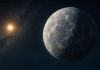
Astronomers have observed a violent collision of neutron stars – the remnants of collapsed stars – in an unusual location: a tiny, faint dwarf galaxy embedded within a massive stream of intergalactic gas. This discovery, made using NASA’s Chandra X-ray Observatory and other telescopes, sheds light on why some gamma-ray bursts (GRBs) seem to appear from empty space and how heavy elements like gold and platinum can be found far from galactic centers.
The Extreme Physics of Neutron Star Mergers
Neutron stars are among the densest objects in the universe, formed when massive stars exhaust their fuel and collapse. When two neutron stars spiral into each other, they create a catastrophic explosion that releases immense energy and forges heavy elements through rapid nuclear reactions. These collisions are key events in the cosmic production of materials heavier than iron – including gold, platinum, and other precious metals.
Why This Discovery Matters
Previously, astronomers had documented these mergers primarily within larger, more typical galaxies. The new finding shows that these events can occur in extremely small galaxies, or even in the voids between galaxies, explaining why some GRBs lack a visible host galaxy.
“Finding a neutron star collision where we did is game changing,” said Dr. Simone Dichiara, an astronomer at Penn State University. “It may be the key to unlocking not one, but two important questions in astrophysics.”
The location of this merger – approximately 4.7 billion light-years away – is embedded in a vast stream of gas stretching 600,000 light-years, likely the result of past galactic collisions. This environment suggests that neutron stars can form and collide in these chaotic, gas-rich regions between galaxies.
How the Discovery Was Made
The event, designated GRB 230906A, was first detected on September 6, 2023, by NASA’s Fermi Gamma-ray Space Telescope. Subsequent observations from Chandra, Swift, and Hubble Space Telescope pinpointed the burst’s location to the faint dwarf galaxy. The combined data revealed that the collision occurred within a region where galaxies had previously collided, triggering star formation and eventually leading to the merger of two neutron stars.
“We found a collision within a collision,” said Dr. Eleonora Troja, an astronomer at the University of Rome. “The galaxy collision triggered a wave of star formation that, over hundreds of millions of years, led to the birth and eventual collision of these neutron stars.”
Implications for Heavy Element Distribution
This discovery may explain how gold and platinum are observed in stars located far from galactic cores. Neutron star mergers can spread these heavy elements throughout the outskirts of galaxies, enriching subsequent generations of stars. While an alternative explanation suggests the burst might be behind another distant galaxy, the researchers favor the dwarf galaxy scenario.
The finding highlights the power of multi-telescope collaborations in unraveling cosmic mysteries, and emphasizes that extreme astrophysical events can occur in even the most unexpected places.
Ultimately, this discovery reinforces that the universe is far more complex than previously imagined, and that neutron star mergers may be a more common phenomenon in unusual cosmic environments than we thought.