
The sky has always been visible, but for most of human history it has also been silent. That changed when scientists realized that the universe wasn’t just shouting in light; it whispered in radio waves. A radio telescope is a device that converts these whispers into data. It is not a single object, but a system: a receiver connected to an antenna designed to intercept electromagnetic emissions with a wavelength between 10 meters and 1 millimeter. This range ranges from 30 megahertz to 300 gigahertz and captures emissions from stars, distant galaxies and quasars that optical telescopes simply cannot see.
The story begins in 1933, not with an astronomer, but with Karl Jansky, an engineer at Bell Telephone Laboratories. He didn’t search the cosmos. He was trying to find the source of static that was interfering with shortwave radio communications. To do his job, he mounted a directional antenna on a rotating turntable. He pointed it at the sky to map where the noise was coming from. The static didn’t just come from nearby thunderstorms. It also came from a steady, faint hiss from the center of the Milky Way Galaxy.
Jansky had discovered cosmic radio waves. The public was enthralled. Astronomical community? Not so much. They hardly noticed. It was dismissed as technical noise rather than a new window on the universe.
But someone was watching. Grote Reber, a radio engineer and radio amateur, took the idea seriously. In Wheaton, Illinois, he built his own dish—a 9.5-meter parabolic reflector—in his backyard. He was not affiliated with any university. He worked alone. In 1944, he created the first radio map of the sky, proving that Jansky’s discoveries were no accident.
Then came World War II. The war accelerated radar technology exponentially. When the fighting stopped, these military tools were repurposed for science. Australian and British engineers began building larger, more sophisticated dishes. The US followed. The silence of the radio sky was finally broken and the field of radio astronomy was born.
Operating principles
A radio telescope basically works on the same principle as an optical telescope, but the physics is different. Instead of glass mirrors focusing visible light, a large metal dish is used to reflect radio waves to the receiver. The size of the dish is important. A larger surface area collects more signals and allows researchers to capture fainter objects.
Wavelength is the key limitation. Because radio waves are long – from centimeters to meters – you need a large antenna to capture them accurately. For this reason, radio telescopes are often massive structures that sometimes extend hundreds of meters across.
The receiver then converts these small fluctuations in electromagnetic energy into electrical signals. Computers amplify and process these signals. What is created is not an image in the traditional sense, but rather an intensity map. Brighter points on the map correspond to stronger radio emissions.
This method reveals things that optical telescopes cannot see. Cold hydrogen gas clouds, which do not emit visible light, shine brightly in the radio frequencies range. Supernova remnants, pulsars, and the afterglow of the Big Bang itself are all visible through radio waves. The universe is full of cold, dark matter that only reveals itself when you listening and not looking.

Anatomy of listening to the cosmos
Any radio telescope, no matter how exotic in appearance, consists of two basic parts. First, there is the dish. Second is the receiver.
It’s that simple. Or it should be. The reality is much more technical.
The dish is a big radio antenna. Its job is to pick up signals that have traveled through the universe for millions, sometimes billions of years. These signals are weak. Incredibly weak. In the noise of the universe, they are barely a whisper. The antenna acts as a funnel. It collects these weak radio waves and transmits them to the next component.
The next component is the radiometer. Sometimes called a radio receiver. This is the brain of the operation. It takes raw, chaotic energy that the dish collects and amplifies. It detects the signal. It converts invisible radio waves into data that scientists can actually look at.
Why size matters for sensitivity
You might think that a small dish would be suitable for a large signal. It does. But cosmic radio sources are rarely large or bright. They are weak. You need sensitivity to measure them.
Sensitivity depends on two things working together. Antenna surface area and its efficiency. A larger dish captures more signals. An efficient dish wastes less of it. But size alone is not enough. You also need a sensitive receiver. If the receiver is loud, it drowns out the faint cosmic whispers.
In terms of broadband continuous radiation – i.e. signals that are spread over different wavelengths – the bandwidth of the receiver is also important. More bandwidth captures more data. This allows the telescope to see a larger part of the radio spectrum at once. This is crucial to understanding the bigger picture of what is going on there.
Because the sources are so faint, radio telescopes tend to be huge. We are talking about structures with a diameter of hundreds of meters. They use the most sensitive radio receivers available. Period. There is no shortcut.
The fight against noise
There is another problem. It’s not just that the universe is quiet. It’s because Earth is loud.
Human technology causes radio interference. From cars to cell phones to WiFi routers. These terrestrial emissions can mask weak cosmic signals. A faint galaxy can shout at us on radio waves, but a nearby microwave can drown it out.
Therefore, great efforts are made to protect radio telescopes. Engineers build them in remote valleys. They protect them from man-made emissions. They create radio silent zones. Without this protection, the data would be useless. It would just be noise.
How radio telescopes capture the unseen
The key to understanding how radio telescopes capture the unseen is their ability to filter out the noise of human activity. By placing these instruments in isolated locations and using advanced shielding, researchers can isolate weak signals from space. This process is crucial for detecting distant galaxies, pulsars, and other celestial phenomena that emit radio waves.
The sensitivity of a radio telescope does not depend only on its large dish; it’s about a clean signal. The receiver must be able to distinguish between the hum of human civilization and the true sound of the universe. This difference allows astronomers to map the sky in radio waves, revealing structures and events that cannot be seen by optical telescopes.
The role of receiver sensitivity in modern astronomy
Receiver sensitivity plays a key role in modern astronomy. It determines how deep
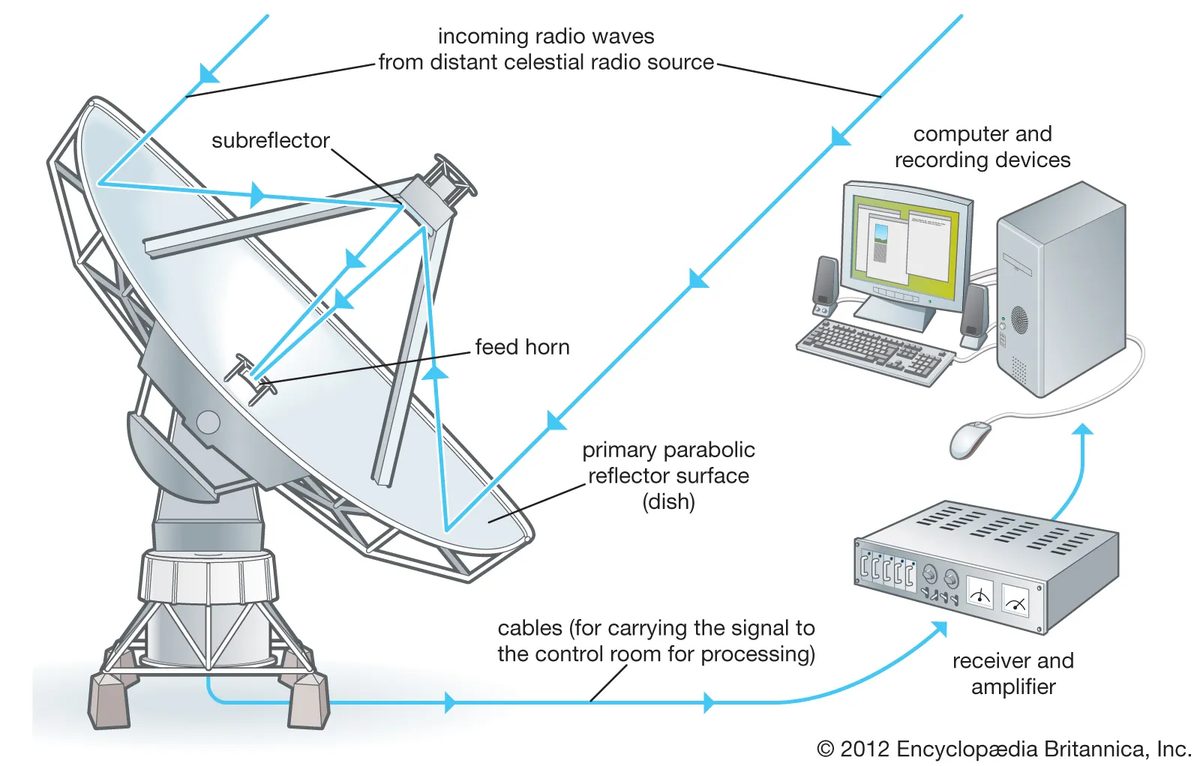

An ordinary radio telescope looks like a giant white dish, but beneath its familiar silhouette lies a complex technical puzzle. It basically works the same way as a satellite dish on your roof. A parabolic antenna captures the faint cosmic radiation and focuses them into a small component called the feed. This term dates back to the radar era, but the physics remains the same. The input is usually via a waveguide horn, which is a special antenna that picks up the signal and transmits it to a sensitive radio receiver.
If you want to hear the whispers of distant galaxies, you have to silence the noise. This means using solid state amplifiers that are cooled to near absolute zero. These cryogenic systems reduce internal electrical noise and allow the telescope to receive signals that would otherwise be lost in the static.
Tracking the sky without a single axis
How to track a moving object in the sky? Early designs tried to mimic the motion of the stars by mounting a massive dish on the equatorial axis. One side of the mount is aligned with the Earth’s axis of rotation, allowing the telescope to turn on a single track to track celestial bodies. It sounds elegant. In practice, it’s a nightmare. Building a structure stable enough for high-frequency radio waves while maintaining precise equatorial alignment is incredibly difficult and expensive.
Modern observatories have ditched that complexity. Instead, the digital computer now controls the telescope on two axes: azimuth and elevation. By moving back and forth along these two planes, the computer can direct the dish to precisely track any radio source in the sky.
The problem with hanging receivers
There is an easy way to connect a radio telescope. You place the receiver directly at the focal point where the dish focuses the signal. A cable runs from the support arm to the ground, where engineers can record and analyze the data. It’s straightforward. It’s also impractical.
Try hanging a heavy, sensitive amplifier several hundred feet in the air and then ask how you’re going to fix it if it breaks. Weight restrictions limit the size of the equipment that can be installed there. Access to maintenance work is a logistical obstacle. This is why most modern dishes use a secondary mirror.
This secondary reflector completely changes the geometry. In the Cassegrain Focus model, the secondary mirror is in front of the focal point and directs the signal back through the hole in the main dish. With gregorian focus it is located behind the focal point and reflects the signal forward to the vertex. In both ways, the reception point is moved to the center or base of the telescope.
Why bother? Because the vertex is a more stable and easily accessible place. You can install mulvertexle feeds and receivers there without having to worry about balancing a massive load on a tall dish. You can also shape both the primary and secondary surfaces to improve gain. This optical fine-tuning gets more sensitivity out of the system than a simple parabolic shape ever could.
The result is a telescope that is not just a wave collector, but a fine-tuned instrument that can dissect the radio universe in real time. But as we strive for larger arrays and clearer images, the fundamental challenge remains: how much noise can we remove before the universe is the only signal left?

Breaking the stagnation of traditional design
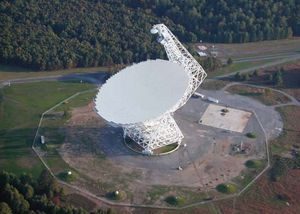
Old school radio telescopes relied on symmetrical tripods or quadropods to hold the feed or secondary reflector in place. It sounded logical. This kept the hardware centralized. But blind spots also appeared. These outriggers blocked incoming radiation. Worse, they reflected the signals back to the receiver and distorted the data.
Newer models get around this problem entirely. By placing the feed or secondary reflector off the center axis, engineers ensure that the incoming signal hits the dish unimpeded. This off-axis radio telescope configuration offers greater sensitivity. It ignores the noise that interfered with the feed. The result is cleaner data. Less noise. A clearer view of the cosmos.
Accuracy paradox
The performance of a radio telescope does not depend only on size. It’s all about perfection. And perfection is expensive.
Due to manufacturing errors, the reflective surface rarely conforms to the ideal shape. The wind is pushing against it. Heat changes its shape. As the antenna travels through the sky, gravity pulls on it, causing deflections. These are not just minor disruptions. When the deviation from the perfect parabolic surface reaches only a few percent of the operating wavelength, the image quality deteriorates.
This creates a strict hierarchy of scales. Small structures can be built very precisely. Radio telescopes designed for millimeter wavelengths are therefore typically only tens of meters in diameter. You need that tight tolerance.
However, centimeter wave telescopes have more breathing space. Their diameter can be up to 300 meters. And for meter wavelengths? The rules are completely changing. The surface accuracy should only be a few centimeters. This is loose enough to use “chicken wire” fencing or parallel rows of wire. They can build massive, fixed structures that would be impossible with solid metal.
Fighting gravity with math
Traditionally, engineers fought gravity with brute force. The moving structure was made as rigid as possible so that it would not sagging under the influence of its own weight. It worked. However, this required heavy and expensive materials.
A smarter approach uses the principle of homology. Instead of resisting gravity, the design embraces it. The cross-section and weight of each element are specially chosen so that gravitational forces transform the reflective structure into a new paraboloid. It’s a slightly different shape with a slightly different focus.
Does it interfere with the signal? No. You just move the feed or secondary reflector to fit the new shape. It ensures optimal performance without the need for incredibly stiff steel.
This technique was impossible until recently. It is based on computer-aided structural simulations. Especially the finite element method. Only with these tools were engineers able to predict how the dish would shape under load and design accordingly.
The sky is still out. The dish moves. But now it moves exactly where it should.
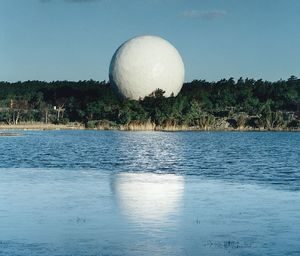

Building a radio telescope operating at very short wavelengths is a technical nightmare. The wind shakes the dish. Fluctuations in temperature distort the metal. To keep the signal from getting messed up, engineers often put a protective cover over the whole thing. These are called radomes. They block the wind and keep the temperature stable. But they come at a high price.
The materials needed for these shells must allow radio waves to pass through them without absorbing or reflecting them. It’s hard to do. It’s even harder to do it cheaply. Placing a massive antenna in an air-conditioned radome can cost almost as much as the antenna itself.
Aim the beam without destroying the bowl
A full dome is not always necessary. If the bowl is huge, it will be expensive to transport the whole thing. So engineers attach a large reflector to the ground. You only need to move the feeder or the secondary mirror to focus the beam. It saves money.
But there is a catch. With parabolic mirrors, you can only steer so far before everything gets blurry. Moving too much will cause deviation. The signal strength decreases. You will lose data. It’s a trade-off between cost and accuracy.
From slow scans to instant data
Radio telescopes look for two things. Broadband continuous radiation. And narrowband signals from atomic or molecular lines in space. In the early days, astronomers had to tune their receivers step by step over a huge frequency range. The spectrometer only looked at a small part of the spectrum at a time.
It was slow. Painfully slow. That limited what they could detect. Today, modern telescopes can see everything at once. They split the signal into thousands of separate channels. They simultaneously cover a bandwidth of tens or even hundreds of megahertz.
The mathematics behind the noise
How do they do it? The simplest spectrometer uses a series of filters. Each filter processes one frequency. Each has its own indicator. They combine the signals into a multi-channel receiver.
Alternatively, the system converts the broadband signal into digital data. Autocorrelation and Fourier transforms are then performed. That’s the hard work. It extracts the pattern from the noise.
Signals from space are weak. So weak that the heat radiation from the receiver drowns it out. To solve this, the receiver output is averaged. Sometimes for hours. It smooths out the noise. It reveals the cosmos.
Radio interferometry and aperture synthesis
This leads to the next technological leap. If a dish is limited by its size and price, what if you use several?

電波望遠鏡は根本的な物理的限界に直面しています。 細部を識別する能力 (角度分解能) は、観察波長と望遠鏡の物理的サイズの比率に依存します。 電波は可視光よりもはるかに長いため、標準的な光学望遠鏡の鮮明さに匹敵するように電波望遠鏡を大きくする必要があります。 最大の単一皿でも、数秒角の壁を突破するのは困難です。 これは、地上の光学望遠鏡が達成できるものよりも約 10 倍ぼやけます。
しかし、電波天文学者はこの制限を回避しています。
光の波長では、地球の大気が入ってくる光を妨害し、画像がぼやけます。 電波は最小限の歪みで大気中を通過します。 これは、電波望遠鏡の理論上の分解能が実際に達成可能であることを意味します。 さらに、電波信号は完全性を失うことなく長距離伝送できます。 これにより、科学者たちは大陸ごとに離れたアンテナを接続して、地球そのものと同じサイズの機器を作成することができました。
電波天文学の歴史は本質的に、この問題をめぐる工学の歴史です。 目標は常に高解像度です。
Aperture synthesis and Fourier components
The secret lies in the interferometer. Astronomers synthesize large effective apertures by combining signals from multiple antennas. A simple installation of two antennas changes shape as the Earth rotates. This rotation changes the path length from the wireless source to each antenna.
If the signals arrive at the same time, they interfere strongly. Achieving an out-of-phase can cause destructive interference. This creates interference similar to optical physics. If the source is a point, the pattern is clean. If the source size is finite, the path difference varies with the source size. The resulting stripes encode the detailed brightness distribution of the sky.
Each pair of antennas measures one “Fourier component” of this brightness map.
Sir Martin Ryle and his team showed in the 1950s and 1960s that a moving antenna combined with the Earth’s rotation could sample enough Fourier components to reconstruct high-resolution images. This is a daunting computational task. It requires a fast computer and a mathematical algorithm specifically designed for these discrete transformations: the Fast Fourier Transform (FFT).
Ryle’s work on Fourier synthesis (also known as aperture synthesis or earth rotation synthesis) was groundbreaking. He won the Nobel Prize in Physics in 1974.
Clear the signal
The raw data from the interferometer is messy. Separate distances between antennas can lead to false responses that cause artifacts in the final image. In the 1960s, Swedish physicist Jan Hogbom developed a method called CLEAN to eliminate these errors. Repeatedly subtract point light sources from the data to make the image sharper.
Self-calibration increases progress. This method was proposed by British researchers Roger Jennison and Francis Graham Smith in the early 1950s and uses the observed source itself as a calibrator. Fix errors in individual antenna responses and small atmospheric disturbances.
These techniques allow radio telescopes to achieve image quality and angular resolution unmatched by any other wavelength band.
Very long baseline interferometer
Traditional interferometers rely on a physical link (coaxial cable, waveguide, or optical fiber) to transmit a common local oscillator signal and correlate the data. This applies to groups within a radius of tens of kilometers. In addition to this, the costs become prohibitive. High-frequency radio links can cover larger gaps, but require too many relay stations to operate over hundreds of kilometers, making them impractical.
The solution is very long baseline interferometry (VLBI).
VLBI eliminates the need for a physical connection. Each antenna stores its own data independently. Earlier systems used broadband video tape. Modern systems use large computer disks. The discs are then transferred to a central correlation center, where the data is replicated and combined to form interference fringes.
The technical requirements are very high. Recordings must be synchronized within a millionth of a second. Local oscillator standards must maintain stability at least parts per trillion.
A few hours of observation can produce about a trillion bits of information. This is roughly equivalent to the entire book collection of an average library. To control this timing precision, the VLBI team uses the hydrogen maser frequency standard. These devices offer timing accuracy in billionths of a second and frequency stability in one part in a million billion.
雷达技术
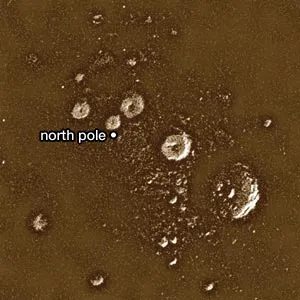

It may sound like science fiction, but astronomers mainly reflect radio waves from planets. The technology mirrors that found in military defense systems or civil air traffic control. By analyzing the time it takes for a signal to return and the way its frequency changes, scientists can create high-resolution maps of worlds hundreds of millions of kilometers away.
This method, known as radar astronomy, offers a unique advantage over passive observation. When a radio telescope sends strong signals to a planet or asteroid, the reflected echo contains certain information. Flight time shows distances with amazing accuracy. The Doppler shift of the spectrum helps to derive rotation rates. Even more impressively, researchers can use it to map topographic features with a linear resolution of up to 1 km.
How radar signals map planetary surfaces
The process is based on high-power radar transmitters. Why? This is because the radio signals reflected from the surfaces of the planets are incredibly weak. As the echo travels back to Earth through the solar system, it is barely detectable above the cosmic background noise. Without massive transmitters, the signal would disappear into nothingness.
The delay in returning the signal emphasizes the enormous size of our solar system. Consider Venus. Even closest to Earth, it is not right next to it. The radar pulse’s journey to Venus and back takes about five minutes. Now look at Saturn. It’s much further away. The round trip of the signal to Saturn and back takes more than two hours.
“By measuring the spectrum and travel time of the signals reflected from the surfaces of the planets, it is possible to study topographic features with a linear resolution of up to 1 km.”
This technique is not only about knowing the position of the planet. It’s about understanding its physical nature. Radar can penetrate cloud cover that blocks visible light. This is especially useful for Venus, whose thick atmosphere hides its surface from optical telescopes. Radar waves bounce off the ground and show mountains, valleys and impact craters.
Why this is important for space exploration
The accuracy of distance measurement is crucial for navigation. Knowing the exact location of the planet helps astronomers refine their models of solar system dynamics. It also helps plan spacecraft missions. When launching a probe at an asteroid, knowing … is not optional its rotation speed and surface shape. It is a matter of survival for the mission.
Radar astronomy provides the necessary information to understand these small bodies. It helps determine whether an asteroid is a single rock or a pile of debris. It shows how fast it spins. These details affect how we might deflect an asteroid if it were on a collision course with Earth.
Technology is developing. The more powerful the transmitters and the more sensitive the receivers, the better the resolution. We no longer look only at points of light. We create detailed 3D models of distant worlds. This moves our understanding from abstract numbers to concrete landscapes.
The next time you see a news report about a new crater on Mercury or an unexpected shape of an asteroid, think about the radio waves that made it possible. They traveled for minutes or hours, bouncing off a rock in the dark and returning with a map. We listen to the echoes of the solar system.

Decoding the Cosmos Through Radio Waves
Radio telescopes do more than just listen to the void. They capture the electromagnetic whisperings of the universe, revealing objects that optical eyes would never see. The sources are varied. Some emit thermal radiation simply because they are warm, like the solid surfaces of planets. Others glow due to bremsstrahlung, a German term for “braking radiation” emitted by hot gas in the interstellar medium. Then there is synchrotron radiation, produced when electrons zip near the speed of light through weak magnetic fields.
But the most intriguing signals come from specific atomic or molecular transitions, creating spectral lines in gaseous envelopes around stars. And then there are the pulsars. These are neutron stars spinning rapidly, surrounded by intense magnetic fields and energetic electrons, sending out rhythmic bursts of pulsed radiation that tick through the galaxy like cosmic lighthouses.
Mapping the Solar System
Before radar, we knew very little about Mercury. It was thought to be tidally locked, keeping the same face toward the Sun forever. Radar measurements shattered that assumption. They revealed the planet’s actual rotation, proving it does not sit still.
Radar also peeled back the mystery of Venus. Its surface is completely obscured by heavy, permanent cloud cover. Visible light cannot penetrate this shroud. But radio waves can. By bouncing signals off Venus, astronomers mapped its surface features for the first time.
This technique did something even more profound. It helped test Einstein’s general theory of relativity. Scientists measured the travel time of radar signals reflected from Venus when it was on the far side of the Sun. The signals took longer to return than expected. Why? Because radio waves passing close to the Sun’s massive gravity well actually slow down. It was an independent confirmation of how gravity warps spacetime.
The Pulsar Revolution
The discovery of pulsating radio stars, or pulsars, in 1967 changed astronomy forever. It revealed that rapidly rotating neutron stars exist throughout the Milky Way. This discovery was not just about finding new objects. It led to the first observation of gravitational radiation effects.
Beyond these extreme objects, broadband continuum emission fills the radio-frequency spectrum. It comes from binary stars, X-ray sources, and supernova remnants. It traces the magnetic fields and relativistic electrons drifting through the interstellar medium, painting a picture of energy in motion across galactic scales.
The Chemistry of Space
With sensitive spectrometers, radio astronomers have identified about 150 separate molecules in space. These are not simple atoms. They are complex compounds. Water. Formaldehyde. Ammonia. Methanol. Ethyl alcohol. Carbon dioxide. The interstellar medium is a chemical factory.
One signal stands out above all others: the spectral line of atomic hydrogen at 1,421.405 MHz. This corresponds to a wavelength of 21 centimeters. This line is the key to mapping our galaxy.
By measuring the Doppler shift in this wavelength, astronomers can determine the motion of hydrogen clouds in the Milky Way and other galaxies. The data shows something strange. The rotational velocities of these clouds do not drop off as expected with distance from the galactic center. They remain high, even in the outer reaches.
The Dark Matter Evidence
This velocity data allows scientists to estimate the mass of spiral galaxies. And the numbers do not add up. The amount of starlight visible in these galaxies is insufficient to account for the gravitational pull required to keep those fast-moving hydrogen clouds in orbit.
Radio telescopes provide the evidence for dark matter. They show that there is much more mass out there than meets the eye. The visible matter is just the tip of the iceberg. The rest is hidden, detected only through its gravitational influence on the gas and stars we can see.
It is a ghost in the machine of the galaxy. Present in every spiral. Measured by the spin of hydrogen. But never seen directly.
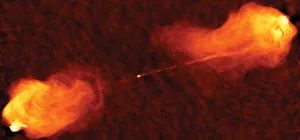

Radio telescopes can be used to see beyond the Milky Way, revealing powerful radio galaxies and quasars that lurk in the dark night. These are not just distant points of light. These are massive structures with powerful clouds of radio radiation that extend hundreds of thousands of light-years away from the central engine. That engine? An active galactic nucleus or quasar. The high-resolution array captured something even more dramatic: a highly relativistic jet shooting toward a radio lobes far from the core. It is an intense and energetic dance on such a scale that human history seems to flash by in the blink of an eye.
But the radio sky offers more than just active monsters. In 1965, Arno Penzias and Robert Wilson were troubleshooting experimental communications antennas at Bell Laboratories in Holmdel, New Jersey. They weren’t looking for cosmology. They encountered the cosmic microwave background radiation while measuring a signal with a wavelength of 3 centimeters. The antenna received a faint hiss from all directions in the sky, at a temperature of only 3 Kelvin. This is not a hardware error. This is the afterglow of the Big Bang.
The primordial explosion that set the universe in motion 13.7 billion years ago is said to have left a thermal legacy. Since then, satellites and ground-based radio telescopes have mapped small deviations of the background radiation from isotropy. These small variations were the seeds of everything today. By analyzing them, astronomers can more precisely determine the size, shape and age of the universe.
Filled-aperture telescopes
When it comes to intercepting these weak signals, size matters. The largest single radio telescope on Earth is a 500-meter spherical telescope known as FAST. The place is a natural karst depression located in the Guizhou province of China, where the landscape practically begs for a dish. Completed in 2016, FAST is a technological marvel. Designed to observe targets from a zenith of 40 degrees, its giant 500-meter eye looks up and scans the sky for whatever the universe throws at it.
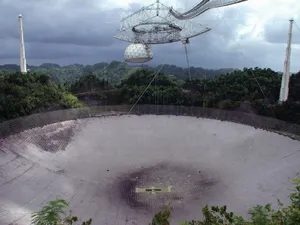
How #FAST became the world’s largest radio telescope
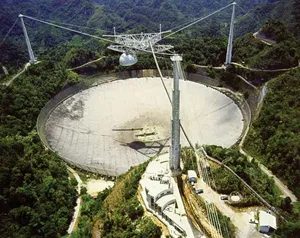
A new leader has emerged in the competition for the biggest disc in the sky. FAST, a 500-meter spherical radio telescope, has officially surpassed Arecibo’s previous record. The Puerto Rican giant, 305 meters (1,000 feet) in diameter, tragically collapsed in 2020. The Chinese-made FAST telescope currently holds the title of the world’s largest fixed spherical reflector.
Arecibo is not just big. This is historic. Located near the city of Arecibo, it was a cornerstone for planetary radar astronomy. Scientists used it to study pulsars, map asteroids, and detect galactic and extragalactic phenomena. The scientific community lost a legendary instrument when its central platform collapsed. But FAST doesn’t just replace it. It expands the boundaries of possibilities.
Russian competitor: RATAN-600
Although FAST dominates the spherical category, Russia’s RATAN-600 remains a strong player in large-scale radio astronomy. Located in the Caucasus Mountains near Zelenchukskaya, this telescope uses a different approach. Instead of a single bowl, it uses ring of 895 reflecting panels.
Each panel is 7.4 meters (24.3 ft) high. Together they form a circle with a diameter of 576 meters (1,890 ft). It is almost 600 meters wide. Researchers can tailor the shape using long parabolic cylinders, standing reflectors, or dipole elements. This flexibility allows the RATAN-600 to be aimed at specific areas of the sky with great precision.
Global efforts to develop large antennas
It’s not just FAST and RATAN-600. Expanding the collection area is a global effort. Teams from Australia, France, India, Italy, Russia and Ukraine all contributed to the construction of the antennas with massive surface areas. These structures are designed to intercept weak radio signals from the edge of space.
The competition is not just about size. It’s about sensitivity and resolution. Bigger discs mean bigger cosmic ears. This allows astronomers to detect weaker signals and resolve finer details. As technology advances, these telescopes continue to reach deeper into space. They listen to whispers from distant galaxies.
“The largest fixed spherical reflector is now FAST, surpassing Arecibo’s 305-meter legacy.”
The fall of Arecibo marked the end of an era. FAST marks the beginning of a new one. It is no longer a question of who is the greatest. It is what we will find with these massive ears turned toward the stars. The sky is full of noise. Finally, we learn to listen.
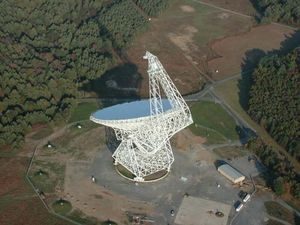
Design that supports GBT accuracy
Green Bank, West Virginia is home to the Robert C. Byrd Green Bank Telescope (GBT), the planet’s largest fully steerable radio telescope. Completed in 2000, this off-axis megastructure measures 110 m x 100 m. It operates at short wavelengths of a few millimeters.
The weight of the movable structure is 7.3 million kilograms. That’s 16 million pounds. It points to any direction in the sky with an accuracy of just a few seconds of arc. The secondary reflector is supported by an off-axis support structure. This minimizes radiation from the ground. It also prevents unwanted reflections from support legs.
The paraboloid consists of 2004 panels. Each is held in place by a computer-controlled actuator. These keep the surface with an accuracy of a few tenths of a millimeter.
GBT is located in the National Radio Quiet Zone. This provides unique protection for radio telescopes. It protects them from local sources of man-made interference.
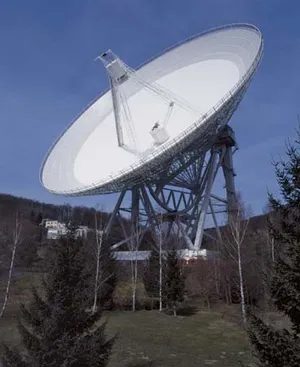

The green monolith isn’t the only giant watching the sky. Other large, fully steerable filled-aperture radio telescopes play equally critical roles in mapping the universe. Their contributions vary by location and size, but their collective mission remains constant.
The Global Network of Giants
In Germany, the Max Planck Institute for Radio Astronomy operates a 100-meter (330-foot) diameter antenna near Effelsberg. It stands tall among its peers, designed for precision and range.
Down under, Australia’s Commonwealth Scientific and Industrial Research Organization (CSIRO) manages the Parkes radio telescope. This 64-meter (210-foot) dish has become a staple in radio astronomy, handling everything from pulsar detection to satellite tracking.
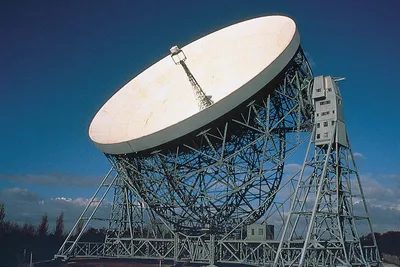
England hosts the Lovell Telescope at Jodrell Bank. Measuring 76 meters (250 feet), it is one of the most iconic instruments in radio astronomy, capable of turning to track objects with remarkable agility.
Why These Telescopes Matter
These filled-aperture radio telescopes are not just collecting data; they are decoding the cosmos. Their primary use lies in atomic and molecular spectroscopy across a wide frequency range. By analyzing the radio waves emitted by atoms and molecules, scientists can determine the composition of distant gas clouds.
This capability extends beyond simple identification. It enables detailed studies of both galactic and extragalactic phenomena. Researchers use these instruments to trace the structure of our own Milky Way and peer into the distant reaches of other galaxies.
The data gathered helps answer fundamental questions about star formation, the distribution of matter in the universe, and the physical conditions of interstellar space. Each telescope, with its unique size and location, adds a piece to this vast puzzle.
The Bigger Picture
Steerable dishes like these offer flexibility that fixed arrays cannot match. They can track specific targets for extended periods, allowing for deep observations of faint signals. This mobility is essential for monitoring transient events and studying objects that move across the sky.
Together, these instruments form a global network of eyes pointed outward. They do not just listen; they interpret. The radio waves they catch tell stories of cold gas, distant stars, and the invisible structures that hold galaxies together.
The universe is noisy. These telescopes help us make sense of the static.
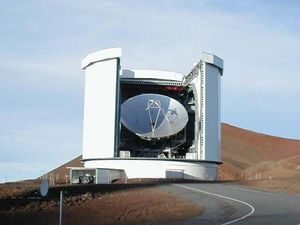
To obtain clear data at millimeter wavelengths, one problem must be solved: water vapor. The solution is simple in theory, but very difficult in practice, because the Earth’s atmosphere absorbs and distorts these high-frequency signals. You go up.
To escape the thick lower atmosphere, several small, high-precision radio telescopes have been installed on mountain tops and high plains. The goal is to minimize signal loss and reduce distortion.
Let’s take Japan’s Nobeyama Radio Astronomy Observatory as an example. It has a 45 meter (148 ft) long antenna designed to capture wavelengths down to 3 millimeters (0.12 in). This is the workhorse of millimeter wave astronomy, designed for maximum clarity.
Next is the Franco-Spanish Institute for Radio Astronomy (IRAM). The company’s 30-meter (100-foot) antenna is located at Pico Veleta in the Sierra Nevada Mountains of Spain. Elevation is 2,850 m (9,350 ft). This height allows observations at wavelengths down to 1 millimeter (0.04 in), making most ground-based observations into the submillimetre range nearly impossible elsewhere.
Hawaii and Arizona have higher terrain.
Several submillimeter telescopes are located at 4,000 meters (13,000 ft) near the summit of Mauna Kea in Hawaii. The air is thin, cool and dry, ideal conditions. The James Clerk Maxwell Telescope (JCMT) is the largest of these, with a dish of 15 meters (49 ft). It’s a key player of the Mauna Kea Observatory.
Another location is Mount Graham near Tucson, Arizona. It is equipped with instruments operating in the submillimeter wave spectrum and benefits from high altitude and stable atmospheric conditions.
Every dish is powerful. But they are just the beginning.
Radio telescope arrays
下一次飞跃isn’t about building a bigger single dish. It’s about linking many smaller ones together. This is where radio telescope arrays come into play.
通过结合来自多个望远镜的信号,天文学家可以simulate a dish as large as the distance between the farthest units. 这种技术称为interferometry,可dramatically improves resolution. 您不需要一公里宽的碟形天线来观察精细的细节。 您只需要正确的几何形状和精确的计时。
围绕这些高海拔地点建立的阵列使科学家能够更深入地观察恒星诞生的寒冷、稠密的云层。 它们捕获了单个碟形天线根本无法解析的结构。 数据很复杂,需要复杂的相关技术,但结果是对宇宙隐藏机制的更清晰的了解。
为什么这很重要? 因为细节决定故事。 解决单个原恒星喷流或分子云内的混沌运动改变了我们理解恒星形成的方式。 它将我们从一般理论转向具体的、可观察的机制。
The transition from single dishes to arrays标志着规模的转变。 我们不再只是收集光子。 我们正在构建一个足够大以匹配天空本身的虚拟眼睛。 硬件是模块化的。 科学是累积的。 而且视野也越来越清晰。


New Mexico Giants
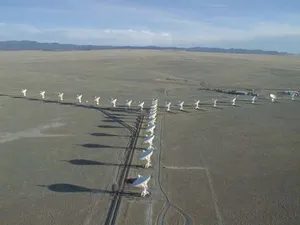
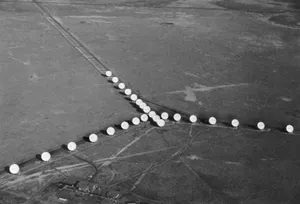
The Very Large Array (VLA) holds its place as the world’s most powerful radio telescope. It dominates the field because it combines sensitivity, resolution and versatility that no other product can match. Not found in town. It is located on the San Agustin Plains near Socorro, New Mexico. It’s smooth, quiet and deliberately free of radio interference.
The hardware is amazing. You now have 27 parabolic antennas. The diameter of each plate is 25 meters. It is about 82 feet. If the collecting areas of all 27 antennas were arranged, it would be a huge antenna with a width of 130 meters. But the real magic happens in the spacing. VLA’s angular resolution is comparable to the angular resolution of a single dish with a diameter of 36 kilometers. You can see the details just like the Hubble Space Telescope can see in visible light.
The mobile giant
These are not fixed monuments. they are movable. Each antenna is located in the transport unit. They run along a Y-shaped railroad track. This structure allows astronomers to change the layout. The arms of the Y can expand or contract. The distance between the elements varies from 600 meters to 21 km. Why bother? Changing the settings changes the resolution. Shorter baselines look at broad structures. Longer baselines zoom in on tight details.
The receiver in each dish also serves multiple purposes. They work with eight different bands. That spans from 7 millimeters up to 4 meters. When the array is fully expanded and tuned to the shortest wavelength, the resolution reaches 1/10 arcsecond. It is very sharp.
Who uses this tool? The VLA is operated by the National Radio Astronomy Observatory. This is an institution of the National Science Foundation. About 1,500 astronomers use it each year. They study everything from our solar system to distant quasars. They created maps of atomic and molecular gases in the Milky Way and other galaxies. They track pulsars. They even recorded the radio afterglow of gamma-ray bursts.
European and Australian eyes
VLA is not the only player. Look west to Europe. The Netherlands Astronomical Research Foundation uses the Westerbork Synthesis Radio Telescope. They are arranged in an east-west direction. Fourteen antennas line up over 2.7 kilometers. Each dish is 25 meters wide. You can enjoy different views to the north and the equatorial sky.
In the Southern Hemisphere, the Australian Telescope Compact Array leads the way. The Commonwealth Scientific and Industrial Research Organization manages the facility near Narrabri in New South Wales. It has 6 elements. It focuses on the southern skies. This includes the Magellanic Clouds, which are satellite galaxies orbiting the Milky Way.
Innovations in India
India has added an important piece to the puzzle with the Giant Metrewave Radio Telescope (GMRT). It is located near Pune. The group contains 30 antennas. They stretch out in a circle about 25 kilometers in diameter. Each dish is 45 meters wide. That is larger than the VLA’s individual dishes.
The architecture here is different. The engineers used a new and inexpensive wire trusses. This is an alternative to traditional steel beam support structures. It made building a huge array more affordable. GMRT works with relatively long wavelengths. It works between 20 centimeters and 6 meters. This covers the frequency coverage between VLA and Westerbork.
Together, these telescopes form a global network. They listen to the cold, dark universe. It captures signals that cannot be seen with optical telescopes. VLA is uniquely adaptable because the antenna can be moved. The GMRT’s large dishes and wire-truss design show how cost-effective design can extend our coverage. Westerbork and the Australian Compact Array ensure that no part of the sky is left unmonitored.
What happens when they look at the same object at the same time? Improved resolution. Sensitivity has increased. We now have a clearer understanding of the universe. The next step is to link them
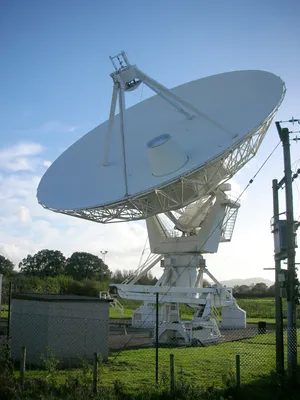

Connecting seven antennas spread across the south of England with fiber optic cables instead of microwave links is a major upgrade to the Multi-Element Radio Linked Interferometer Network (MERLIN). The facility, run by the Nuffield Radio Astronomy Laboratories at Jodrell Bank, allows signals to be transmitted with minimal loss between dishes 217 kilometers (135 mi) apart. The goal is clarity. More specifically, MERLIN targets small radio sources associated with quasars, active galactic nuclei (AGN) and cosmic masers. The resolution? A few hundredths of an arc second. That is tight.
The VLBA’s Distributed Precision
Across the Atlantic, the Very Long Baseline Array (VLBA) uses a different distance approach. It has 10 25-meter (82 ft) dishes and is located from the Virgin Islands to the east and Hawaii to the west. They cover wavelengths ranging from 3 millimeters to 1 meter. The result is a resolution of 0.0001 arc seconds. For context, it’s more than 100 times clearer than the Hubble Space Telescope.
The hardware is simple. The dishes have no direct connection to each other. Instead, they record signals onto high-density computer disk drives. The drives are then physically shipped to a processing center in New Mexico. There, the data is replayed and analyzed to construct images.
Timing is everything. Without precise synchronization, the data is useless. Each antenna slot is equipped with a hydrogen maser atomic clock, which enables full alignment of the elements. The control center for this large operation is located in central New Mexico and is co-located with the Very Large Array (VLA) operations center. Sometimes these two instruments are used together. Combining those data can potentially improve sensitivity and angular resolution.
Breaking the Ground Barrier
In 1997, Japanese astronomers attempted to break the limits of ground-based geometry. They sent an 8-meter (26-foot) dish into Earth orbit. The program, known as the VLBI Space Observatory Program (VSOP) or HALCA (Highly Advanced Laboratory for Communication and Astronomy), works together with the VLBA and other ground-based telescopes.
The math was staggering. By placing the dish in space, they created an interferometer baseline of 33,000 kilometers (21,000 miles). The potential was immense. In 2003, reality hit. The satellite lost its ability to point accurately. The program ended.
Chasing the Millimeter Wave
Interferometry isn’t just for long radio waves. Matrices are also used in the millimeter and submillimeter fields. Why? To study how stars and galaxies form. A simple full-aperture antenna cannot achieve the resolution achieved by these arrays, but the trade-off is brutal.
Operating at these short wavelengths is difficult. Water vapor in the atmosphere distorts the phase of the signal. To minimize this, the devices should be placed in a high, dry place.
In such a harsh environment, there are several noteworthy spaces.
– The Combined Array for Research in Millimeter-wave Astronomy (CARMA) near Big Pine, California.
– IRAM Plateau de Bure plant in France.
– Nobeyama Radio Astronomical Observatory, Japan.
In 2003, the Harvard-Smithsonian Center for Astrophysics and Taiwan’s Academia Sinica jointly completed the Submillimeter Array (SMA) system. It is located near the summit of Mauna Kea in Hawaii, at an elevation of 4,080 meters (13,385 ft). The array consists of eight 6 m (20 ft) parabolic antennas designed to operate at wavelengths down to 0.3 millimeters (0.01 in).
Atacama Leap
The next big step took place in 2013. A new international facility managed by the United States, Canada, Europe and Japan has been completed in the Atacama desert of northern Chile. The location is very extreme. More than 5,000 meters (16,000 feet) above sea level.
This is the Atacama Large Millimeter Array (ALMA). It consists of 50 12 meter (39 ft) parabolic antennas. It also includes a more compact configuration consisting of four 12 m (40 ft) panels and sixteen 7 m (23 ft) panels. Like SMA, ALMA operates at wavelengths down to 0.3 millimeters (0.01 in). The dry air of the Atacama offers a clarity that terrestrial instruments cannot match anywhere else.
地球轨道射电望远镜

大气过滤器
大多数无线电波几乎毫无波澜地穿过我们的大气层。 这种透明度正是我们可以在地面建造大型天线的原因。 如果空气对所有频率都完全透明,那么对于射电天文学家来说,太空将是一个昂贵且不必要的步骤。
但尚不清楚。 不是到处都有。
在特定的频率范围内,大气就像一堵墙。 它扭曲了。 它吸收。 它妨碍了。
需要空间的异常
那为什么要去太空呢? 三个主要原因迫使天线转向恒星。
首先,长波长无线电波。 这些信号被地球电离层抛掷。 高层大气中的带电粒子会弯曲并散射它们,使地面观测变得混乱且不可靠。
第二,短波长观测。 这里的问题是低层大气中的水蒸气和氧气。 它们像海绵一样吸收信号。 如果你想聆听高频的宇宙低语,潮湿的空气会把它们淹没。
第三,热噪声。 即使频率很好,地面本身也会发出热量。 这种热辐射会干扰所有波长的精确观测。 太空很冷。 很安静。 它很干净。
Try it first
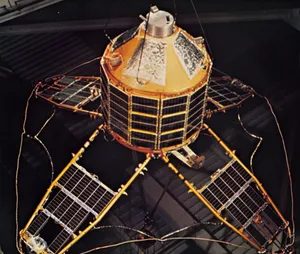
I didn’t have to wait long to test this out. The first radio astronomy satellite was born from joint research between the United States and the United Kingdom: Ariel 2.
It was launched in 1964 with a simple but important mission. Investigate long-wavelength radio noise. Not only from deep space, but especially from the Earth’s own ionosphere and the Milky Way. Turns out the concept works.
Ariel 2 is not an isolated experiment. Later, two more Ariel series satellites were launched. The United States also participated and launched Radio Astronomy Explorer 1 and 2 in 1968 and 1973.
they are not perfect. They are prototypes. But they created a model. When the atmosphere is calm, listen to the story from above.
Technology is constantly developing. The demands on sensitivity are getting higher and higher. But the basic logic remains the same. If heaven and earth are noisy, go higher.
What if you need a higher resolution? The next step requires a larger group. Or a bigger lens. Or both. Hardware changes. The problem remains the same. This atmosphere still exists.

Measuring the echoes of the initial explosion
Terrestrial radio astronomy faced difficulties. The atmosphere blocks or distorts many of the signals that astronomers want to capture. This is why space missions have become so important.
As an example, the Submillimeter Wave Astronomical Satellite (SWAS). Released in the US in 1998. Then there’s Odin. The joint project of Sweden, Canada, France and Finland started in 2001. These satellites operate in very short submillimetre ranges. Finding a signal from Earth is almost impossible.
But the real game changer is the mission to map the oldest light in the universe.
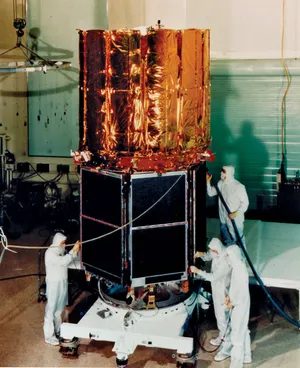
The Cosmic Background Explorer (COBE) was launched in 1989. This is the first detector to clearly read the cosmic microwave background radiation. This is the heat left over after the Big Bang. This is a baby picture of the universe.
Then in 2001 the Wilkinson Microwave Anisotropy Probe (WMAP) was introduced. This was followed in 2009 by the launch of the European Planck satellite.
These three tasks deal with more than just background noise. They found the seeds.
Small variations in radiation. The temperature difference is so small that it is almost imperceptible. But these small changes are important. They correspond to original structures that eventually collapse under the influence of gravity. That’s where galaxies form. Without these first waves, the universe would be a homogeneous, bland soup of gas.
These satellites map these variations so precisely that the calculations can finally be done. We can calculate the age of the universe. Its composition can be determined. dark matter. dark energy. It’s normal.
The numbers rise to the center. No more guessing. Measurement in progress.
Why space-based observations are winning
You might wonder why we can’t build better telescopes on the ground. The answer is in the air itself.
Water vapor in the atmosphere absorbs submillimetre waves. If nothing blocks your view, you will be surrounded by living landscapes. SWAS and Odin avoid that overlay entirely. They sit in orbit and gaze into space unencumbered by weather.
But in the case of the cosmic microwave background, the story comes from sensitivity.
COBE, WMAP and Planck are very accurate thermometers. They measured the temperature from the sky, and the changes were only a few millionths of a degree. Devices on the ground cannot achieve this stability or sensitivity. Earth’s own heat, radio noise, and atmosphere dampen the signal.
In space, it is cold. It is very quiet.
Especially for Planck, the resolution is a step ahead of WMAP. This provides a clearer map of these original structures. This complements the numbers we’ve come to rely on.
This isn’t just about satisfying your curiosity. Understanding the age and composition of the universe changes the way we think about our place in it. It will tell you when the first star lights up. It tells us how much of the universe is invisible to the eye. It tells us why galaxies exist in today’s star clusters.
The data from these satellites is still being analyzed. New insights emerge from old maps. But these specific missions lay the groundwork. They turned the faint echoes of the Big Bang into detailed history books.
But the universe keeps throwing curve balls. There are still deviations in the data that do not fit the standard model