


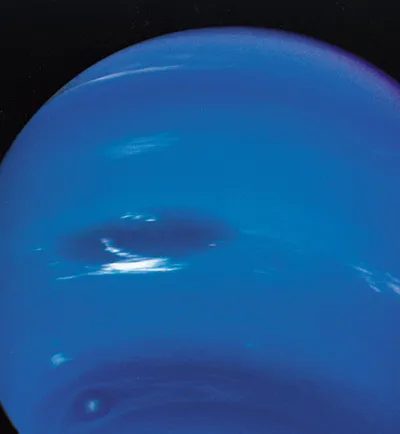
Located at the edge of the solar system, Neptune is an eighth planet that cannot be ignored. It is the third most massive world in the solar system, but it is still invisible to the naked eye. You need a telescope to see it. Still, it’s just a small, pale blue-green disc. Astronomers mark it with the symbol ♆.
But this distant ice giant is more than just a dot in the sky. This is an extreme place. Its winds are the fastest in the solar system. The heat is felt from the inside. The discovery was a combination of difficult physics and wild guesswork.
Here’s what we know about the last big planet.
Information behind the blue marble
Neptune is far away. It’s really far. The average distance from the sun is about 4.5 billion kilometers. This is 30.1 astronomical units (AU). AU is the distance from the Earth to the Sun. Therefore, it takes several hours for light from the Sun to reach Neptune.
Because of this distance, its orbit appears almost perfectly circular. The eccentricity is only 0.0086. This means that its distance from the Sun changes very little over the course of a long year. One Neptune year lasts 164.79 Earth years. That is a long time to be cold and dark.
The planet is tilted 28.3 degrees around its axis. This corresponds to the Earth’s tilt of 23.5 degrees. This means that Neptune has seasons. Long ones. Each season lasts more than 40 years on Earth.
The planet’s magnetic field is strange. It is tilted 46.8 degrees from the axis of rotation. It is also about half a radius from the center of the planet. This causes the magnetic field to be disturbed. It doesn’t look like Earth’s well-ordered north-south dipole.
How was Neptune discovered?
The discovery of Neptune was no accident. It was discovered through mathematics.
In 1846, astronomers noticed that Uranus was not moving as expected. Its orbit wobbled. They suspected another planet was pulling on it. They used Newtonian physics to calculate the location of the hidden planet.
This calculation was based on a numerological scheme that later proved to be unfounded. However, the prediction was correct. Johann Gottfried Galle pointed his telescope at the predicted location. There was Neptune.
It is the first planet discovered through mathematical prediction. It is also the second planet discovered by the telescope. Uranus was the first.
This discovery is a triumph of science. This shows that the solar system is predictable. It shows that mathematics can find the invisible.
Size, Mass, and Composition
Neptune is huge. The radius of the equator is 24,764 kilometers. Its polar radius is 24,340 kilometers. It is about four times the size of Earth. However, it is smaller than Uranus. Uranus has a large diameter.
However, Neptune is denser. The average density is 1.64 g/cm3. Uranus is 1.27 g/cm³. Neptune is more massive. Its mass is 17 times the mass of Earth. Uranus has 14.5.
What is Neptune made of? It is not a gas giant like Jupiter. It’s an ice giant. It has a rocky core. It is surrounded by a thick layer of water, ammonia and methane ice. Above it is an atmosphere of hydrogen and helium.
There is no solid surface. If you try to land on Neptune, you would sink. The pressure would crush you. The temperature would freeze you.
The main component of the atmosphere is hydrogen. Helium makes up only a small part. Methane gives Neptune its blue color. Methane absorbs red light. Reflects blue light. This is why Neptune looks blue.
Heat source
Neptune is very far from the sun. It receives almost no sunlight. Less than half as much as Uranus. It is expected to be colder than Uranus.
it is not.
Neptune is slightly warmer than Uranus. Why?
It has an internal heat source. The planet radiates more heat than they receive from the sun. The heat comes from within. Maybe it’s because of the slow collapse of the planet. Maybe from the differentiation of materials. It is probably caused by the decay of radioactive elements.
We do not know for sure. But heat is important. It drives the weather.
The wind
Neptune has the fastest winds in the solar system. Its wind speed is over 2000 km/h. It is five times faster than the strongest hurricanes on Earth.
The winds are caused
The Hidden Power of #Neptune: Why the Blue Giant Betrays the Sun
We like to think we understand the outer reaches of our solar system. We’ve mapped the gas giant, studied its moons, and even sent probes to study its atmosphere. But Neptune is different. This is a planet where secrets are kept and revealed only in bits and pieces.
Before the Voyager 2 flyby in 1989, we knew next to nothing. Only two moons had been spotted from Earth. The rings? Unconfirmed ghosts. This short flyby produced a spin period, a magnetic field, and a magnetosphere. Since then, Earth’s technology has caught up and filled the gap. But what are the key facts? They continue to emerge from that brief encounter.
The geometry of a long year
Neptune’s orbit is a slow and deliberate crawl. It takes 164.79 years to orbit the sun. it has completed just one lap in September 1846. This means that astronomers will continue to refine mathematical calculations of the size and shape of its orbit well into the 21st century. This is a work in progress that will likely continue for decades.
Voyager 2 raised the estimated distance from the Sun slightly higher. Currently, the distance is believed to be about 4.5 billion kilometers (2.8 billion miles). It’s so far away. However, its orbit is very circular. It has an eccentricity of 0.0086, making it the second roundest of all the planets. Only Venus can beat it.
This roundness is important. This means that Neptune’s seasons are stable and not chaotic. Its axis is tilted 29.6 degrees, steeper than Earth’s 23.4 degrees. This tilt determines the seasons, but because its orbit is circular, it doesn’t punish us for winter when it moves away from the sun. Each season lasts about 41 years. Equal. Predictable. Unyielding.
The mystery of size, density and mass
Neptune’s rotation period? 16.11 hours. We didn’t see it spin. we heard it. Voyager 2 received radio pulses associated with magnetic fields. Because the magnetic field is embedded inside, the radio pulses tell us how fast the core is spinning.
The planet is big, but not as big as you’d think. At a pressure level of 1 bar (Earth’s sea level pressure), it has a diameter of 49,528 kilometers (30,775 miles). It is only 3% smaller than Uranus. However, Neptune was crushed. Flatten the rod with a quick twist. The poles are 848 kilometers (527 miles) shorter in diameter than the equator.
Its size suggests that Uranus is larger. Mass says otherwise. Neptune is even denser. 1.64 g/cm3 compared to 1.3 g/cm3 for Uranus. The extra density increases Neptune’s mass by 18%. It’s a more compact, heavier world inside a similar shell.
Chemical properties of the color blue
Let’s look at Neptune through a telescope. It is bright and clear blue. Uranus is light blue-green. Why the difference? Both atmospheres are dominated by hydrogen and helium, 98% at 1 bar level. rest? methane.
Hydrogen and helium are invisible. Methane is a light eater. It eats red wavelengths. Sunlight bounces off Neptune’s clouds and loses its red color spectrum. Only blue remains. simple physics.
But why is Neptune blue bright? Uranus also has methane, but it looks darker. A promising theory? Unknown atmospheric gas. Something in the nebula of Neptune scatters the light in different ways. I don’t know what it is yet.
Warm from cold darkness
This is where Neptune gets weird. The temperature distribution of the atmosphere is contradictory.
At a pressure level of 0.1 bar, the temperature is a cold 50 Kelvin (-370 °F / -223 °C). But come up. Let go of the pressure. The temperature rises quickly. 2000 kilometers above the 1 bar level and at 1/10 billionth of a bar, the temperature reaches 750 K (890 °F / 480 °C). It’s still hot there. Uniform. Stable.
Go down? It gets hotter. It’s hotter. Near the center, the pressure reaches 5 megabars.
Temperatures rise to 7,000 K (12,000 °F / 6,700 °C).
However, the real problem is energy balance.
Neptune is more than 50% further from the Sun than Uranus.
Less than half the amount of sunlight. However, its effective temperature (the temperature of a nonreflective sphere radiating the same energy) is 59.3 K (-353 °F / -214 °C), about the same as Uranus.
They reflect the same amount of sunlight. Therefore, it absorbs the same amount. So why does Neptune give off more heat?
Because it makes its own.
Neptune emits more than twice as much energy as it receives. The heat comes from within. Uranus? Almost no leakage. Why? I don’t understand. This is a process we do not fully understand. It remains a buried mystery.
The wind that breaks the rules
The temperature is also not uniform in the horizontal plane. At the one-bar level, the average temperature is 74 K (-326 °F / -199 °C). The equator and polar regions are several degrees warmer than mid-latitudes. This indicates vertical movement. Air rises in mid-latitudes and descends at the poles and equatorial regions. This flow can spread into the atmosphere.
It is horizontal near the top of the cloud. Zonal flow. The wind blows from east to west along the latitudes. Time stays the same. Predictable.
But this is not the case.
Neptune’s wind speed is very fast. At latitude 70 south, the speed of the east wind (direct, rotating) is 100 meters/s (360 km/h). But what about 20 degrees south latitude? Westerly winds (rear, opposite) blow at 700 meters per second (2,520 km/h).
This is faster than any other wind in the solar system. Supersonic speed.
Why so violent? Internal heat makes it work. Uranus is cold, quiet and winds slowly. Neptune is hot and restless, and storms sweep the land.
The information is self-explanatory. This planet is very active. Full of energy. Uranus has a different lifestyle. But what about the mechanics? It is still hidden.
There are numbers. diameter. temperature. The wind speeds. We know how long the seasons are. We know how heavy the core is. However, it is not known why the heat is trapped. We don’t know what makes the blue so bright. We don’t know what’s driving the engine.
Voyager 2 gave us the map. But the territory? Still unmapped.
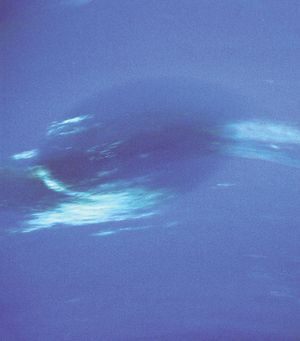

Neptune’s Vanishing Storm
Neptune’s atmosphere is a violent place. Strong winds and a large amount of internal heat escaping may be the driving force behind the turbulence seen in Voyager 2’s flyby. In the southern hemisphere, two large black ovals dominate the view.
The largest is called the Great Dark Spot. It looks like the shadow of Jupiter’s Great Red Spot. They are similar in latitude and shape. It is also roughly the same size as Earth. It’s not just a pretty sight. Here, scientists measure the highest wind speeds in the solar system.
Jupiter’s Red Spot has been visible from Earth for over 150 years. Scientists believe that Neptune’s dark spots will also remain. They were wrong.
By 1991, two years after Voyager’s approach, the Hubble Space Telescope found it gone. The spot had vanished. Then in 1994, a new dark spot appeared in the northern hemisphere. It is about the same size as the first one. Storms here do not stay still. They move. They change. They disappear.
The bright clouds in the Voyager images are more short-lived. These could be methane ice clouds. Strong updrafts pushed pockets of methane gas higher into the atmosphere. There, the air is colder. The gas condenses into ice crystals. They formed clouds that lasted only as long as the wind held them up.
Neptune’s storms don’t last long. It does not have the long-term stability characteristic of Jupiter.
This raises questions about the stability of the planet. Why do storms last for centuries in one world, while another sheds them in years? The answer lies in energy. Neptune radiates heat internally. That heat fuels the winds. The winds tear the atmosphere apart. Storms are temporary. The planet is not.
The Great Dark Spot is gone. The northern spot may fade too. We see them. We track them. They are already different. The atmosphere is changing. Ice crystals fall. The wind continues to blow.
Neptune’s clouds do something no other giant planet has ever done. They create shadows.
High, sparse clouds float above thicker, continuous clouds. The upper cap may be made of methane ice crystals floating 50 to 60 miles above the main cloud layer. The lower layer may contain ammonia and hydrogen sulfide ice. At depths where the pressure exceeds 100 bar, water ice clouds can form. But Voyager 2 could not see them. We can only guess what is there based on the sulfur and nitrogen compounds.
Why is Neptune’s magnetic field broken
Neptune’s magnetic field is strange. It is internally produced, Voyager 2 discovered in 1989, and is essentially broken compared to what we might expect from a planet.
Most planets have dipole fields like bar magnets. This is how the Earth works. The same goes for Jupiter and Saturn. Their magnetic field is centered and less than 12 degrees from the axis of rotation. A compass on Earth points north.
Neptune’s compass points south.
Reverse polarity. But what’s really shocking is tilt. Neptune’s magnetic field is tilted 47 degrees from its axis of rotation. Uranus is even worse, at 59 degrees. And neither magnetic field is in the planet’s core.
Neptune’s magnetic center is offset by 55 percent of the planet’s radius. This means that the source of the field is closer to the top of the cloud than to the center of the planet. Scientists believe this means that a magnetic field is not generated in an Earth-like core based on a liquid iron core. It probably formed in the upper layers of the planet’s interior.
This creates an apple-shaped magnetosphere that flattens on the sunward side and is stretched into a long tail by the solar wind away from the Sun. The solar wind is a stream of charged particles emitted by the sun. It distorts Neptune’s magnetic bubble.
The result? An almost empty magnetosphere.
The magnetic field is so skewed that the charged particles pass through Neptune’s moons, causing them to ring repeatedly. The moons and rings absorb most of the protons and electrons. Neptune’s magnetosphere contains fewer charged particles per unit volume than any other giant planet.
When the particles slip close to the magnetic pole, it crash into the atmosphere. They collide with the gas and fluoresce. This causes the aurora. They are real. They are classical. They are also weak.
What is inside the giant planet?
Neptune is the densest of the giant planets. Its average density is slightly less than 30% that of Earth, but it is the highest among the gas giants. This suggests that Neptune’s interior has a higher proportion of molten ice and molten rock.
But how are that rock distributed?
Data from Voyager 2 suggest that a layered model is not appropriate. If Neptune had a distinct rocky core surrounded by an outer core of molten methane, ammonia and water, Neptune would spin faster. The measured rotation was 16.11 hours. This is about an hour slower than predicted in the layered model.
Therefore, the heavier compounds are might not centered. They might be spread uniformly distributed throughout the interior.
In this respect, Neptune is more like Uranus than Jupiter or Saturn. Both ice giants appear to have mixed interiors rather than separate layers.
Why is Uranus cold and Neptune Warm
Neptune radiates more heat from within than it receives from the Sun. Uranus does not.
Does this mean Neptune’s center is hotter? Perhaps. But it may just be insulation.
The deep atmosphere of Uranus may have multiple stratified layers. These layers trap internal heat and prevent it from escaping. Neptune’s heat escapes easily.
As Uranus approaches its equinox, images from Earth show its atmosphere becoming increasingly active. The sun begins to illuminate the equatorial regions directly. This suggests that the atmospheric activity of Uranus and Neptune is driven more by solar radiation rather than internal heat.
Internal heat is not as important as external light.
The interior remains a mystery. It has density. We have the rotation. We have magnetic chaos. However, the distribution of rock and ice is still a matter of speculation. the heat trap remain a theory.
We know what the clouds do. We know how the magnetic field twists. We don’t know how the planet holds itself together.
The standard story of the formation of our solar system is known as “the Nice Model,” named after the French town where astronomers first sketched the solar system. It paints a very different picture of the early solar system than what we see today.
At that time, four gas giant planets were clustered close to the sun: Jupiter, Saturn, Uranus and Neptune. They orbited between 5 and 17 astronomical units (AU). In context, 1 AU is simply the average distance between the Earth and the Sun, which is about 150 million kilometers.
They don’t just hang out. They are fixed in precise orbital resonance.
Think of it like how a clock works. If Neptune and Uranus were in 3:4 resonance, Uranus would make four revolutions for every revolution Neptune makes around the Sun. It is a steady rhythmic dance.
But they danced on a floor made of rubble.
The planets orbit in the disks of giant planetesimals, which are tiny rocky remnants of the birth of the solar system. There are hundreds of these objects, some as large as Pluto. Gravity is an annoying neighbor. These planetesimals pull the planet and knocking them out of resonance.
The track gets weird. They become unstable. And they become unstable.
This instability led to large-scale migration. Saturn, Uranus and Neptune drifted outwards, reaching their present distant positions. In some computer simulations, Uranus and Neptune even switch places completely. At the same time, Jupiter also moves slightly inwards.
The consequences would be catastrophic for the inner solar system. The chaotic spreading of the planet disk sent shower of rocks inward. This led to the Late Heavy Bombardment, a violent impact on the rocky planet about 4 billion years ago.
Most of the disk was swept away. Small pieces of debris fell into the Kuiper belt. Some planetesimals were captured by Neptune’s gravity and became Trojan asteroids.
Neptune’s rings and moons
Today, Neptune is a world with at least 16 moons and six narrow rings.
These rings are not solid bands. They are made up of countless tiny particles, each of which is like a tiny moon in itself.
The four innermost moons orbit inside this ring system. They are more than just passengers. They interact with the ring particles through gravity. Without these, the rings would spread out and disappear. They act as herders, keeping the material confined and visible.
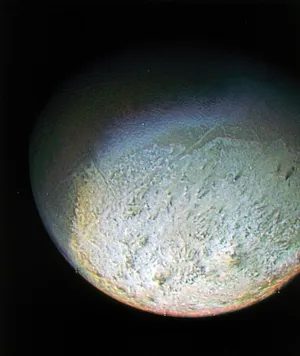

Before the Voyager 2 flyby in 1989, maps of the Neptune system were very sparse. We know two names: Triton and Nereid. Discovered in 1846, Triton is a gigantic creature about the size of the moon. It dominates the scene and is more than six times larger than the second largest moon, Proteus. A hundred years later, Nereid, found on photographic plates in 1949 looked ghostly in comparison.
The naming practice is a standard Greek mythology, often associated with Proteus and the waters. But the physics here defy standard expectations. Triton is the only large satellite in the solar system that orbits in a retrograde orbit. While most large satellites are tilted within 5 degrees of the equator, Triton’s orbit is flipped and tilted more than 157 degrees. Nereids are equally eccentric. Its orbit is very long, and its farthest point is nearly seven times farther to Neptune than its closest point. Even at its closest point, Nereid is four times as far out as Triton is.
Internal groups
Voyager 2 changed everything. Its approach revealed six previously unknown moons. They are not outcasts. They are ordinary satellites. They follow a prograde, nearly circular path near Neptune’s equatorial plane. All but one orbit closer than Triton does.
Then, in 2002 and 2003, telescopes on Earth captured five more tiny guests. These are irregular satellites. They are small, with an estimated radius of 15–30 kilometers (9–18 mi). Their orbits are highly eccentric and have steep angles to the equator. Three of them can also orbit backward. They remain in the cold darkness, 15 to 48 million kilometers from Neptune, far beyond Triton’s range.
Then there’s Hippocamp. The radius of the satellite, which was discovered in 2013 with the images of the Hubble Space Telescope, is small, only about 9 kilometers. This was not a new find in spirit. Astronomers tracked its signature in archived Hubble data back in 2004. It slipped between Larissa and Proteus, two moons cataloged by Voyager.
The characteristics of these satellites are very precise, but they are all different. Naiad, Thalassa, Despina, Galatea and Larissa grab Neptune. Their orbital radius varies from 48,200 kilometers to 73,500 kilometers. They rotate very quickly, in less than a day. Hippocamp has a slightly extended inner group, is located at an altitude of 105,300 km and has an orbital period of 0.95 days. Proteus, the largest of the inner group, at a distance of 117,600 km.
Triton is an anomaly. The track height is 354,800 kilometers. The cycle is 5.877 days, but the “R” stands for retrograde. The angle of inclination is 157.3 degrees. Nereid breaks the scale entirely, orbiting at an altitude of 5,513,900 kilometers. The cycle lasts more than a year. The slope is a gentle 5.1 degrees, but the eccentricity is 0.751. The outer irregulars Halimede, Sao, S/2002 N 5, Laomedeia, Psamathe, Neso and S/2021 N 1 are found over millions of kilometers spanning decades and on high inclinations.
Shape and surface
Voyager 2 does more than just count. it looked. Five of the six inner moons discovered have such tight orbits that Neptune rotates faster than they circle it. For an observer atop Neptune’s clouds, the five moons rise in the west and set in the east. This is a rare perspective in the solar system.
Voyager got close enough to Proteus and Larissa to see the details. Both are irregular. They are not balls. They look like lumpy stones with holes in the surface. The other four inner satellites are too small to determine their shape directly. This estimate depends on the brightness, assuming it reflects light like Proteus and Larissa, with a reflectivity of about 7%.
Proteus is the heavyweight of this inner group. The average radius is about 208 kilometers. It is slightly bigger than Nereid and has a radius of about 170 kilometers. The rest are small, with an average radius of less than 100 kilometers.
No one has ever visited the Nereid up close. Voyager data show it to be roughly spherical. This means that the brightness does not flicker during rotation and the surface is relatively uniform. The rotation period cannot be determined, but due to its highly elliptical orbit, synchronous rotation (where the moon keeps one face to the planet) is unlikely.
Triton is synchronized. Its rotation coincides with its orbit. The inner moons can also be synchronized or nearly synchronized. Hippocamp adapts to this pattern and can even be synchronized. The outer irregulars don’t bother with synchronization. Its chaotic orbit allows it to spin independently, untethered from the planet’s rhythm.
Save the results
Triton not only resembles Pluto; It has the same density, size and icy surface structure as Pluto. But how does it move? This is a dead giveaway. Its orbit is strongly tilted compared to Neptune’s orbit and moves backward. From a planetary perspective, this is a sign of capture. Triton did not form together with Neptune. It may have started as a rogue asteroid in the Kuiper belt that drifted on its own until captured by Neptune’s gravity.
This makes things confusing.
The original orbit would have been highly eccentric. Over time, tidal forces (a rhythmic attraction that stretches and compresses two objects) pulled Triton into a circular path. However, circularization has its price. The energy released during the capture and orbital collapse would tear apart the existing satellite system formed from Neptune’s protoplanetary disk.
Enter Nereid. Its elliptical orbit is probably a scar from chaos. Some researchers believe that Nereid could also be a captured object, but its current path matches the outline of a survivor.
Internal systems take a bigger hit. A satellite orbiting between Proteus and Nereid has no chance. Many of them have been ejected from the solar system entirely. Others fell to Neptune. The molten and heated surface of newly settled moon Triton swallowed some. Even those who survived closer to Neptune did not remain unscathed.
Now Naiad’s trajectory through Proteus looks completely different from its original trajectory. They are likely fragments of the violence caused by Triton’s arrival. Debris from Neptune’s orbit and meteorite impacts from interplanetary space abraded the surface and changed its orbit. Let’s take the Hippocamp as an example. The current model suggests that it did not originate with the other models. It was probably created by a massive impact that almost crushed Proteus and ejected material that merged into the small moon we see today.
The silent guardian
While the inner moons tell tales of destruction, Neptune’s outer edges hold something more stable. A group of Trojan asteroids share Neptune’s orbit, sitting quietly at the Lagrangian points. These are the gravitational points where the Sun’s and Neptune’s forces balance, pinning objects at a 60-degree angle in front (L4) and behind (L5) of the planet.
These are not theoretical constructs. The first Neptune Trojan was identified in 2001 and named 2001 QR322. Since then, astronomers have identified 35 of them. An uneven distribution. Twenty-eight cluster is located at point L4 in front of Neptune. Seven hang back at L5. They remained there, trapped in a cosmic dance that lasted long after Neptune’s inner realm was violently reformed.
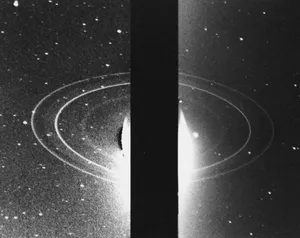

Adams Ring and the mystery of the ark
The idea that Neptune has rings did not come from telescope images. It is due to a glitch in the data. In the mid-1980s, astronomers noticed something strange while observing the stars that passed behind Neptune. Its light flickers and dims before and after the planet blocks the star. But the dips is erratic. They appear in some studies but not in others, and they never appear in clean, symmetrical form on either side of the planet. If Neptune had a perfect continuous ring like Saturn, the light would be equally dimmed on both sides. This asymmetry suggests something else: a partial ring. Or technically called a ring arc.
Voyager 2 later proved this wrong. If anything, it complicates things. The probe revealed six rings surrounding the planet. These “arcs” are just bright spots of the outer ring (called the Adams ring).
These arcs are characteristic of the ring. Other giant planets have rings, but none as clumpy as this one. The Adams ring contains five different bright areas called Courage, Freedom, Equality 1, Equality 2 and Fraternité. They cover an arc of 45 degrees and their length varies from 1,000 kilometers to more than 10,000 kilometers.
So why don’t they spread out? Ring particles are constantly colliding. Over time, these collisions spread the material into a uniform donut. The fact that they are still clustered together suggests that the event that created them happened recently. Perhaps the small moon broke up thousands of years ago. It was truly a geological blink of an eye.
The moon Galatea orbits inside the Adams ring. This gravitational force can trap particles within these arcs. But gravity alone is not enough to stop the spread permanently. The arcs persist because they are young.
Inner Ring System
The other five rings (Galle, Le Verrier, Lassell, Arago and Galatea) are more uniform. They didn’t have the dramatic clumping of Adams.
Le Verrier is about 110 kilometers wide. It is very similar to the non-arc part of Adams. Inside it orbits a moon called Despina, which acts as a shepherd. repels particles and keeps the inner edge of the ring sharp.
Galle is the innermost ring. It is wide and faint. Its edges are soft and fuzzy because there is no moon nearby to shepherd it.
The Lassell is a faint plateau of material extending from Le Verrier to Adams.
The Arago is a narrow, bright band on the outer edge of the Lassell.
Galatea is a faint ring of dust scattered around the orbit of the moon Galatea.
This is how the rings are divided based on their distance from the center of Neptune.
| Tyre Name | Distance (km) | Width (km) | Main features |
|---|---|---|---|
| Objective | 41,900 | 41,900 2,000 | Slim Edge |
| Le Verrier | 53,200 | 110 | |
| Lassell | 55,200 | 55,200 4,000 | Weak plateau between Le Verrier and Aragon |
| Arago | 57,200 | 57 200 <100 | Lassell Bright Outer Rim |
| Galatea | 61,950 | 61,950 <100 | Shared orbit with moon Galatea. |
| Adams | 62,930 | 62 930 15 | 15 Bright arc. inner edge held by moon Galatea |
Dust, Dark Ice, and a Young System
Voyager 2 attempted to detect these rings using radio waves. The signal passes through the ring without scattering. This means that there are no particles larger than 1 centimeter. If there were, they would have bounced the signal back.
The rings are mostly dust. They are brightest when backlit by the sun, as the tiny particles scatter light forward toward the viewer. They are dark, and may be covered by radiation-darker methane ice.
This brings us back to the era of institutions. Adams’ version is still very young. The other rings are very narrow. It is difficult to limit them. No known moon can completely prevent the natural spread of ring material. Therefore, the enring ring system may be a new addition to Neptune. Probably not even a million years ago.
A million years is nothing in a planetarium. The rings we see today could have been completely different at the geological blink of an eye. Next A visiting spacecraft may encounter systems that have evolved beyond recognition.
Observation from the ground
Sky Ghost
Neptune does not exaggerate. It is the only giant planet that cannot be found without a telescope. It has an apparent magnitude of 7.8, making it about five times fainter than the naked star visible to the naked eye. This difference in brightness means that ancient astronomers may have missed it.
Galileo first pointed his telescope at the sky in 1609. But he missed this too. A sketch of December 28, 1612 shows that he actually saw Neptune as it drifted close to Jupiter. He saved it as a star.
The solar system seemed perfect until William Herschel discovered Uranus in 1781. six planets. Earth, Mercury, Venus, Mars, Jupiter, Saturn. that’s it. Philosophers and scientists agree on this. The discovery of the seventh celestial body shattered this popular belief. This raises the lingering question: is there something else out there?
There is also a mathematical lust. Bode’s Law. Or Titius Bode’s law. Johann Daniel Titius discovered the pattern in 1766. The known planets form a neat order according to their distance from the Sun. This is not random. It follows a simple equation measured in astronomical units (AU) – the average distance of the Earth from the Sun.
The size of Mercury is about 0.4 AU.
Venus, Earth, Mars, Jupiter and Saturn follow the formula 0.4 + (0.3 × 2^n).
Here n is 0, 1, 2, 4, 5.
Did you notice it jumps from 2 to 4? Number 3 is missing. Johann Elert Bode published this article in 1772. He thought the gap was not a mistake. This is a sign. There should be a planet between Mars and Jupiter.
Nobody cares. Until Uranus appeared.
Uranus is 19.2 AU. Bode’s law predicts 19.6 AU when n = 6. Close enough to make astronomers sit up. Then in 1801 Ceres and other asteroids appeared in that missing n = 3 point between Mars and Jupiter. The law seems justified.
Self-confidence is at its peak. Some astronomers are getting bolder. They named the hypothetical eighth planet “Ophion”. Bode’s law sets n = 7 at 38.8 AU. This is speculation disguised as science.
However, something is wrong with Uranus.
It did not follow the path predicted by Newton’s laws. It would not work with the Sun or other known planets. In addition, there are more than 20 old sightings from 1690. The calculated locations do not match the sightings. Something is pulling Uranus. invisible gravity. hidden neighbors.
Data processing competition
In 1843, John Couch Adams began crunching numbers. British mathematicians were trying to find the hidden mass. He sent the results to George B. Airy, the Astronomer Royal at Greenwich. Airy was not impressed. He argued that the data lacked the precision required for targeted searches. So he put it on hold.
At the same time in France, Urbain-Jean-Joseph Le Verrier made the same calculations. He didn’t know Adams. He works in isolation.
By the middle of 1846 the atmosphere had changed. John Herschel, the son of the discoverer of Uranus, considered these calculations serious. Airy finally listened. He ordered James Challis of Cambridge to hunt using Adams’ coordinates.
Challis tried. But he was blindfolded. He did not have a detailed star chart of that part of the sky. His method was slow torture. He can draw stars. Come back in a few nights. Compare the drawings. Look for movement. This is ineffective.
Le Verrier has a similar friction. The French astronomer thought his proposed search distance was a waste of the telescope’s time. He pressed anyway.
On September 23, 1846, he sent his final calculations to Johann Gottfried Galle at the Berlin Observatory.
Galle looked. He and his assistant Heinrich Louis d’Arrest had detailed star charts. They are made to hunt asteroids. Accuracy is important.
Galle looked towards where Le Verrier was pointing. He saw a dot.
It’s not on the map.
She checked again the next night. He checked again the next night.
The dots moved relative to the background stars.
It’s Neptune.
Who owns Discovery?
Its first witnesses were Galle and d’Arrest. But soon the credit war started.
Le Verrier claimed it was his only discovery. He wanted the planet to be named after him. The French media agreed. But the rest of the world hesitated. There are two reasons for that.
First, Adams did the math. He couldn’t get his boss to look.
Second, it seems wrong to name the major planets after living people. Arrogant even.
In the end, both Adams and Le Verrier were honored. However, modern history suggests that Adams’ contribution was not as clear-cut as early reports claimed. His calculations were good, but not as accurate as Le Verrier’s final prediction.
In the end, tradition wins. The name of this planet comes from the ancient world. Neptune. Roman god of the sea. A world ripe for discovery through gravity and human curiosity.
The sky is wide. we are small but we can count what we can’t see.
The discovery of Neptune was the nail in the coffin of Bode’s law. It wasn’t just a failure. It collapses from its own inaccuracies. Astronomers predict that the new planet will be about 38.8 AU from the Sun. This number comes directly from a formula, a neat arithmetic sequence that promises to act as a ruler for mapping the solar system.
In contrast, Neptune is found at 30.1 AU.
This is a big gap. Almost 9AU off. It’s not a rounding error. There is not the slightest deviation. Fundamental disagreement. This physical difference, combined with the apparent lack of a theoretical reason why the law “works” (no gravitational logic or orbital mechanics to back it up), means that the scientific community can no longer act as if this is a law. This is a coincidence. A lucky guess about physics.
And then Pluto arrived.
In 1930, Clyde Tombaugh discovered a faint spot that had been classified as a planet for decades. If Bode’s Law had any lingering credibility, Pluto may save it. This formula predicts that the next interval in the sequence will be 77.2 AU, n = 8. Pluto is 39.5 AU away.
It is still well below 77.2.
But here’s where things get messy. Pluto’s mean distance is surprisingly close to the predicted value of 38.8 AU for n = 7, the slot Neptune was supposed to occupy. Some might argue for a moment that Pluto fits this model better than Neptune. Maybe the pattern is correct and Neptune is an anomaly?
No
The prediction that Pluto approaches n = 7 does not restore this law. It highlights how random this act is. If you don’t believe in the underlying mechanism, you can pick any planet, any distance, and reverse the calculations to suit. Pluto didn’t validate Bode’s law. This shows that if you have enough planets and enough room to change, you can always find a number that looks vaguely right.
The formula died not with a bang, but with a shrug. There are no deep truths hidden in the gaps between the orbits. It’s just that the geometry, chance, and messy reality of our solar system refuse to follow a simple set of integers.
Neptune seen from Earth
Observing Neptune from Earth has always been difficult. The average distance to the planet is 30.1 AU. This distance means that the brightness of sunlight reaching the atmosphere is only 0.1% of the brightness here. Before Voyager 2 arrived, telescopes showed little detail. Even under perfect conditions, the Earth’s atmosphere covers a terrain less than one-tenth the diameter of the Earth.
Astronomers have spent decades speculating. They calculated its size, mass, density and orbit. They are looking for satellites. But they couldn’t really see the planet.
Then came the 1980s. High resolution infrared CCD cameras are a game changer. For the first time, astronomers were able to find visual features at the cloud tops that were consistent enough to measure their rotation periods. The spectrum confirmed hydrogen and methane. Based on what we know about other giants, helium is thought to be present. The infrared data also revealed the surprising fact that Neptune generates its own internal heat. It doesn’t just reflect sunlight.
By the mid-1990s, the Hubble Space Telescope took over. It is outside the filter that distorts Earth’s air. Images taken by the Hubble and Spitzer space telescopes show Neptune with a clarity that ground-based telescopes in the 1980s could only dream of.
But astronomy on Earth didn’t stay in the dust. Researchers are developing adaptive optics. This technique uses real-time data from infrared star images to instantly adjust the telescope’s mirrors. Removes atmospheric blur. Today, large telescopes using adaptive optics often have better resolution than Hubble. We are now able to study Neptune in detail with close-up observations made by the Voyager spacecraft.
Unique visitors
Voyager 2 is the only spacecraft to visit Neptune. It was launched alongside its twin Voyager 1 in 1977. The original plan was simpler. Visit Jupiter. Visit Saturn. Stop.
But timing is important. Voyager 2’s launch window allowed Voyager 2 to head toward Uranus with the help of Saturn’s gravity. And even further, to Neptune.
It flew by on August 24 and 25, 1989, and has observed the system continuously since June. Measure the radius. Check internal rotation. As a result, a magnetic field was found that was strongly tilted from the axis of rotation. It confirmed the rings. Found 6 new moons.
The data disproved the hypothesis. Scientists think Neptune is too cold for active weather. Voyager proved them wrong. These images show the fastest winds in the solar system. A great storm broke out. The storm is roughly the size of Earth.
Mission scientists took this risk. They brought Voyager closer to Neptune than any other planet on its journey. The spacecraft passed within 5,000 kilometers of the North Pole. A few hours later, it flew within 40,000 kilometers of Triton at breakneck speed.
This flyby enabled high-resolution imaging of Triton’s varied surface. You can accurately measure the moon’s radius and temperature.
No other missions are planned. We have one set of close-up eyes at the outermost giant. After that, all that was left was us, our telescopes and the long dark.


