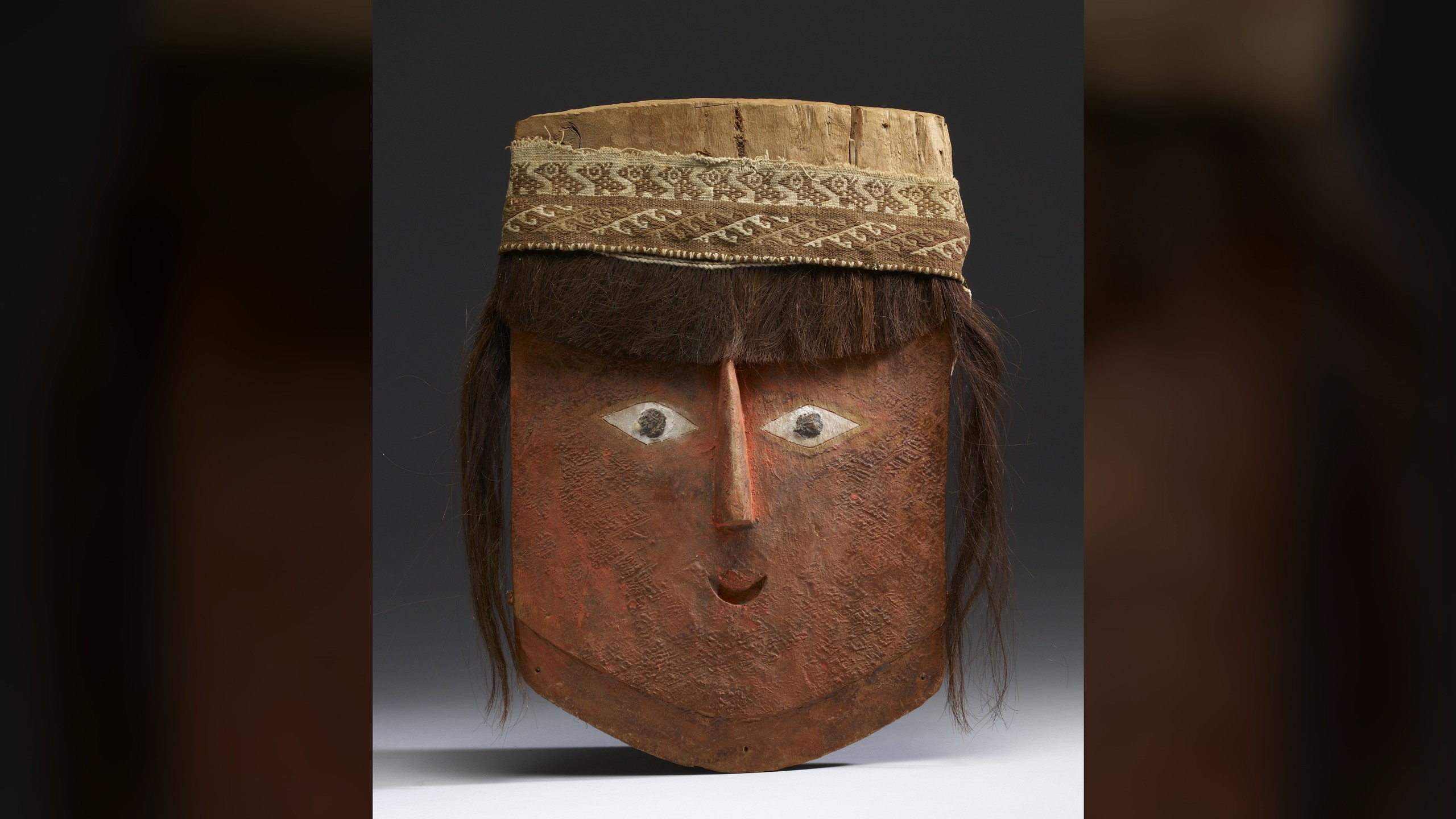
It sits in Baltimore now. Quiet. Cold. But a millennium ago, it had a job.
The Walters Art Museum holds a wooden face that isn’t quite a face. It’s a mummy mask with wig —a “false head” crafted for the Chancay people. These pre-Inca folk lived along Peru’s central coast between 1000 and 1450 AD. They didn’t just bury their dead. They dressed them. Layers of textiles. Vegetal fibers. Animal skins. They wound the corpses into tight, fetal-shaped bundles.
But here is the problem. When you wrap a body that tightly, you lose the geography of the corpse. The head vanishes.
So, the Chancay made one.
This specific artifact measures 12 by 8 inches. Roughly life-size. But don’t expect photorealism. Chancay artists weren’t trying to trick the eye. They used simplified geometry. A triangular nose. Diamond-shaped eyes. A tiny, U-shaped smile. It’s stylized. Abstract. Deliberate.
“False heads” made from textiles or wood were sometimes tied onto Chancay funerary bundles to act a focal point for venerating the ancestor
Why did they bother with such effort? To create a focal point. A place for grief to land. The mask anchors the ancestor. It makes the dead present in the world of the living.
Then there’s the material. The mask is wood, painted with cinnabar. That’s mercury sulfide. Brick-red. Toxic. If you handle this without gloves, you’re inviting heavy metal poisoning into your system. Back in the 11th century, that red pigment wasn’t just paint. It was symbolic. It signaled purification. Commemoration. Ritual importance.
But the mask tells a darker, more intimate story upon closer inspection. A microscopic analysis in 2017 confirmed something shocking about the hair on the head. The wig was made from real human hair.
Not wool. Not alpaca fiber. Human strands.
Who did those hairs belong to? We don’t know. But it implies a personal connection. Someone cut their hair. Or someone else’s. It’s an intimate object.
Here’s where it gets weird. You’d think such a striking, toxic red mask would be the outermost layer of the burial bundle. You’d want people to see it. To honor it. The Walters Art Museum suggests otherwise.
The cinnabar on this mask bears a patterned impression. Textile marks. The mask wasn’t on the outside. It was wrapped inside. Buried under more textiles, hidden away. Was it meant for the spirits? Or for the dirt? The purpose of the false head might have been purely ritualistic during the wrapping process, a spiritual scaffold that disappeared once the ancestor was settled.
The Chancay aren’t the Incas. They don’t get the headlines. But recent research into their ceramics and the tattoos on their mummies suggests a highly complex society. Artists with serious skill. A culture that cared deeply about how you looked when you left this one.
We spend so much time looking at gold and jade. We forget about the wood. The hair. The mercury.
The mask is small. Fragile. A fragment of a tradition we can’t fully reconstruct. You can stare at the diamond eyes and try to find a ghost. But you won’t find one. Just red paint. And old, dried human hair.