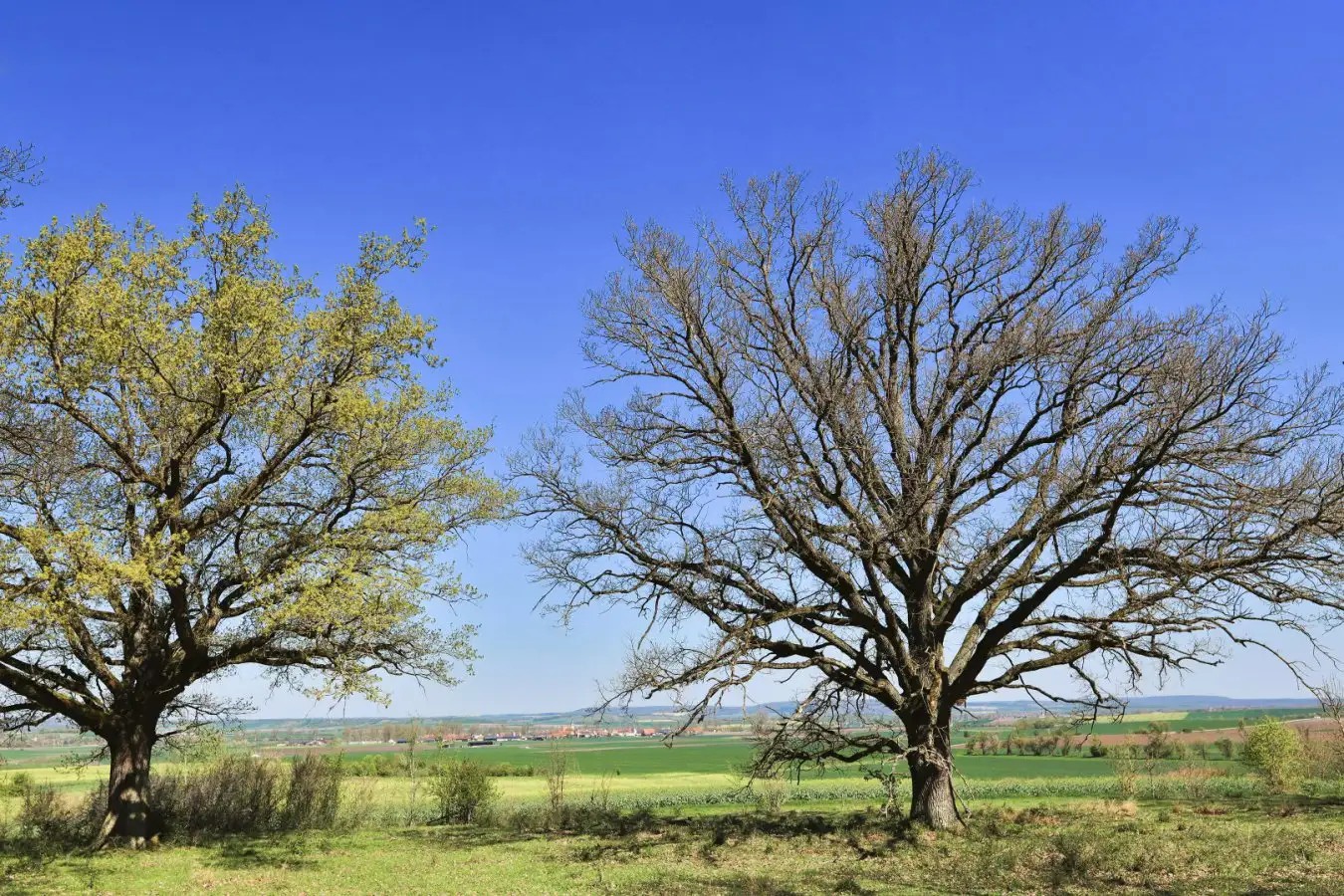
Oak trees possess a sophisticated survival strategy: they can intentionally delay the emergence of their leaves in the spring to starve out hungry caterpillars. When faced with severe defoliation in one year, these trees push their bud opening back by approximately three days the following season. This seemingly minor shift disrupts the synchronized life cycle of pests, causing many caterpillars to hatch without food and significantly reducing damage to the forest.
A Disruptive Delay
In spring, rising temperatures and longer days typically signal trees to unfurl new leaves. Many insect species, particularly caterpillars, have evolved to hatch precisely when these young leaves are soft and nutritious. This synchronization ensures a reliable food source for the larvae but leaves trees vulnerable to massive outbreaks.
Researchers at the University of Würzburg, led by Soumen Mallick, discovered that oak trees can break this cycle. By analyzing satellite radar data from the Sentinel-1 mission, the team monitored a 2,400-square-kilometer area in northern Bavaria, Germany, between 2017 and 2021. The study focused on two dominant oak species: the pedunculate oak (Quercus robur ) and the sessile oak (Quercus petraea ).
The data revealed a clear pattern following the 2019 outbreak of gypsy moths (Lymantria dispar ). Oak trees that had been heavily stripped of leaves that year delayed their spring bud opening by three days compared to less affected neighbors. This delay proved highly effective:
* Reduced Damage: The lag cut leaf loss by 55% compared to the previous year.
* Starvation Strategy: Caterpillars hatched at their usual time, only to find bare branches instead of a feast. Many perished due to lack of food.
Adaptation or Constraint?
The findings suggest that oaks employ multiple defense mechanisms, including producing tougher leaves or aromatic compounds that attract predators. However, the researchers argue that delaying bud opening is more efficient than these chemical or physical defenses.
Mallick posits that this behavior is an evolutionary adaptation rather than a simple physiological reaction to stress. While resource depletion after heavy feeding could theoretically slow growth, the delay was observed across dozens of tree populations and was most pronounced in areas where it offered the greatest survival advantage. This consistency points toward a strategic response honed by natural selection.
However, the scientific community urges caution. James Cahill of the University of Alberta notes that while the correlation is strong, causality has not been definitively proven. The delay could simply be a sign of weakened plant vigor rather than an active defense. More research involving multiple outbreaks is needed to confirm whether this is an intentional adaptation or a side effect of stress.
Implications for Climate Modeling
This study has broader implications for our understanding of forest ecology and climate change. Current computer models often predict spring green-up based solely on temperature data. These models frequently fail to account for biological interactions, such as pest pressures, leading to inaccurate predictions of when forests will turn green.
As James Blande of the University of Eastern Finland observes, the mechanisms behind this delay are “intriguing” and require further investigation. Understanding that plants respond to biological pressures as well as climatic ones is crucial for improving ecological models. As James Cahill emphasizes, recognizing that plant behavior is driven by more than just temperature is a vital step in accurately predicting forest health in a warming world.
“The mechanisms are intriguing and are a key aspect requiring further research.” — James Blande, University of Eastern Finland
Conclusion
Oak trees appear to use a three-day delay in spring growth as a strategic defense against caterpillar outbreaks, significantly reducing damage by disrupting pest feeding cycles. While further research is needed to confirm if this is an active adaptation or a stress response, the findings highlight the complex biological interactions that current climate models often overlook.