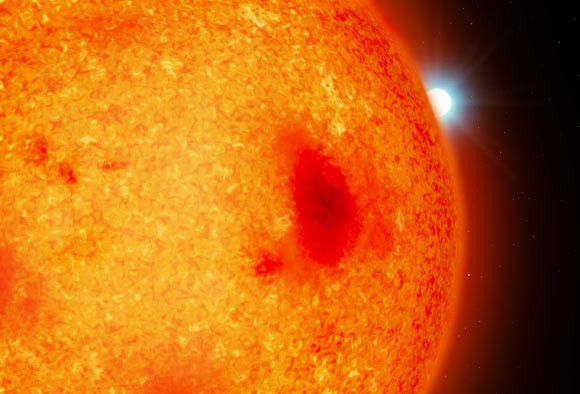
Close-in.
Right next door.
For decades, astronomers have scoured the sky for dead stars lurking near living ones. They’ve missed four. Specifically, four white dwarfs hugging red dwarf stars within 20 parsecs of us. That is roughly 65 light-years out.
The find uses data from Hubble’s Space Telescope Imaging Spectrograph.
They weren’t easy targets. Nearby isolated white dwarfs? Easy to spot. But these four were hiding. Their red dwarf partners are bright in visible light, effectively drowning out the fainter glow of their dying companions. You can’t see what you’re blinded to.
“Nearby isolated white dwarfs are usual easy to find, but we couldn’t see these four stars directly in visible waves.” — Mairi O’Brian
So they looked in the near-ultraviolet.
That’s where white dwarfs shine. Or try to. Red dwarfs are messy neighbors. They flare. Those flares can look a lot like a white dwarf signature in UV data. It’s a lot of noise.
The team built custom calibration tools. They had to tease the signal apart from the static. When it worked, the wobble showed up. A substantial radial wobble. The red dwarf moves back and forth. Something heavy is tugging on it.
The systems are G 203-48, GJ 207-1, LHS 1817 and Wolf 1138.
Wait, why the wobble matter? Because it proves mass. It proves a companion is there.
One system is particularly strange.
G 203-88. It sits just 25 light-years away. People saw its wobble 27 years ago. No one found the companion until now. It is the ninth closest white dwarf to Earth.
And its mechanics make no sense.
The red dwarf spins once every 10 days. It orbits the white dwarf every 1.9 days. Gravity should have synchronized them by now. Like the Moon. Always showing the same face to Earth. Tidal locking.
But G 208-87 doesn’t do that.
“It shouldn’t be rotating this slowly.”
Dr. David Wilson calls it fascinating. Wrong, even. If this pair formed like most of them, they should be locked in step.
The implication? Their pasts are different.
Some binary systems go through violent, messy early chapters. Prolonged interactions that force them into sync. Others? G 233-1? No.
This one. It had a gentler birth. Brief encounters. Nothing traumatic enough to lock the rotation. The slow spin is a ghost of its youth.
Why does it matter?
Census taking.
Models said we should have found about four to five pairs in this radius. The survey found four. The math holds up.
“We think there could be 9 or 1 additional systems.”
Only 33% of the local red dwarfs have been properly checked. That means we have only seen a fraction of what’s out there. Professor Tremblay says we could easily double the count with better focus.
The paper drops in MNRAS.
O’Brien et al., 262.
We looked. We looked wrong for a while. Then we looked right.
Four stars found. Nine more?
Maybe.
We won’t know until we point the telescope at the next quiet red dwarf.