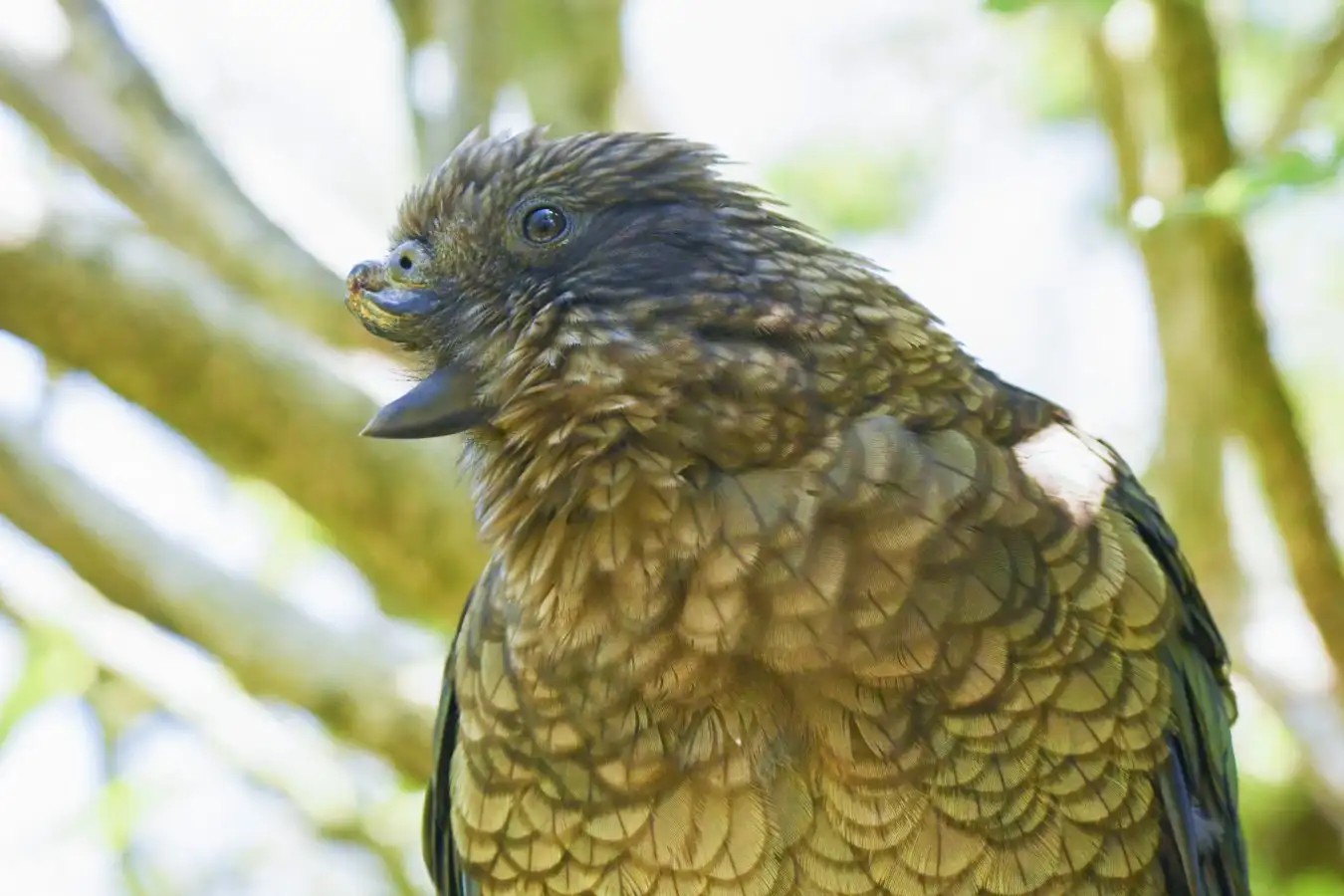
In the wild, physical perfection is often a prerequisite for survival and social dominance. However, a remarkable case study involving a New Zealand kea has challenged this assumption, proving that behavioral innovation can sometimes outweigh physical advantages.
From Near-Death to Social Dominance
The story began in 2013 in Arthur’s Pass, New Zealand, when a malnourished and undersized kea (Nestor notabilis ) was discovered struggling to survive. The bird had suffered severe trauma, resulting in the loss of the entire upper portion of its beak. Given the kea’s status as an endangered species, researchers from the University of Canterbury intervened, bringing the bird into captivity at the Willowbank Wildlife Reserve.
Initially misidentified as a female due to his diminished size and missing upper mandible, a DNA test revealed the bird was actually male. Renamed Bruce, he entered a social group consisting of nine other males and three females. Despite being significantly smaller than his peers—weighing only 800 grams compared to many others who exceed a kilogram—Bruce did not just survive; he rose to the top of the hierarchy.
The Power of Behavioral Innovation
In a typical kea “circus” (the collective term for a group), dominance is often established through size and the sheer force of a large, hooked beak. Bruce, however, lacked the traditional tools for combat. Instead, he developed a unique tactical advantage through behavioral innovation.
Because Bruce lacks an upper mandible, his lower beak is fully exposed. This allows him to utilize his bottom beak as a specialized weapon:
- The Jousting Technique: While other males have upper mandibles that shield their lower beaks, Bruce uses his sharp, straight lower beak to deliver precise, forceful jabs.
- Momentum over Mass: Rather than relying on brute strength, Bruce uses rapid forward momentum to “topple” into opponents.
- The Tactical Advantage: When other males attempt to headbutt, they strike with the blunt, rounded curve of their upper beaks. Bruce, conversely, strikes with a sharp point, a tactic so effective that his rivals frequently recoil in retreat.
The effectiveness of this strategy is backed by data. During a four-week observation period, researchers recorded 162 aggressive interactions among the males. Bruce won every single one of his 36 encounters, establishing himself as the undisputed alpha.
The Benefits of a Secure Hierarchy
Bruce’s dominance extends beyond physical combat; he has successfully monopolized the group’s resources and social structure. He maintains absolute priority over the enclosure’s four feeding stations and has even established a “grooming” hierarchy, where lower-status birds assist in cleaning and preening his beak.
Perhaps most surprisingly, Bruce’s status has resulted in lower physiological stress. Researchers found that his stress hormone levels were the lowest in the group. Because his position as alpha is so secure, he rarely needs to engage in high-energy, aggressive displays to maintain his rank, whereas the other males must constantly compete to defend their standing.
Why This Matters
This case is scientifically significant because Bruce represents the first documented instance of a severely injured animal achieving and maintaining alpha status through behavioral innovation alone.
In the natural world, injuries are often seen as a death sentence or a permanent slide down the social ladder. Bruce demonstrates that “difference” is not always a disadvantage; if an animal can adapt its behavior to turn a physical deficit into a unique functional strength, it can redefine its place in the ecosystem.
Bruce proves that survival is not just about having the strongest tools, but about knowing how to use what you have left in ways your competitors never expect.
Conclusion
Bruce’s rise to dominance highlights the incredible plasticity of animal behavior, proving that even a significant physical handicap can be transformed into a strategic advantage through innovation.