For nearly two centuries, evolutionary biologists have operated on a compelling hypothesis: the ancestors of modern mammals once laid eggs. While the theory was widely accepted, the “smoking gun”—a fossilized egg or a specimen preserved within one—remonged elusive.
That changed with new high-tech imaging of a prehistoric creature called Lystrosaurus, providing the first tangible evidence that egg-laying was a critical survival mechanism for our distant ancestors.
The Survivor of the “Great Dying”
Around 250 million years ago, Earth underwent its most catastrophic biological crisis, known as the Great Dying. This period was defined by molten landscapes, acid rain, and poisoned oceans that wiped out much of life on the planet.
Amidst this chaos, a tusked, pig-like creature called Lystrosaurus did something remarkable: it flourished. While more dominant and ferocious species perished, Lystrosaurus became a dominant figure in the post-extinction world. New research suggests its success wasn’t just due to its adaptability, but specifically because of how it reproduced.
Advanced Technology Unlocks Ancient Secrets
The breakthrough came not from a new discovery in the field, but from a leap in imaging technology. In 2008, paleontologist John Nyaphuli discovered fossilized specimens in South Africa’s Karoo region. However, the delicate details remained hidden within stone for years.
Using synchrotron tomography —a non-destructive X-ray technique at the European Synchrotron Radiation Facility—scientists were able to peer inside the fossils in 3D without damaging them.
The results were transformative:
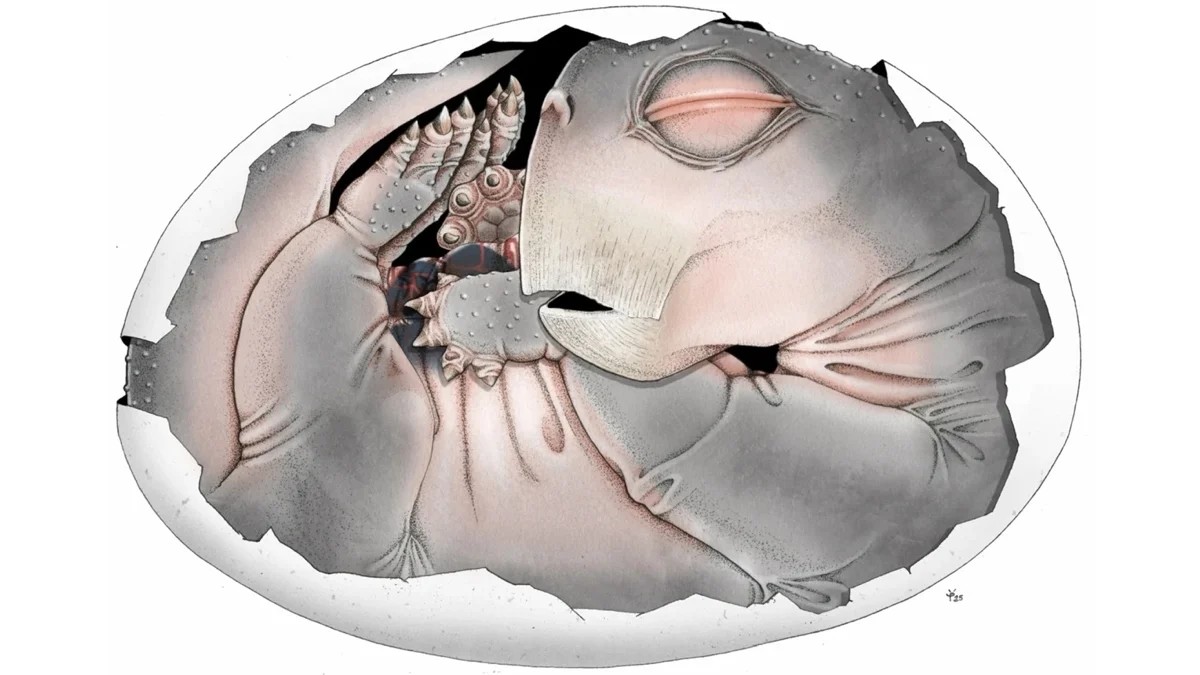
– A “frozen” moment in time: One specimen was revealed to be a perfectly curled-up hatchling that had died inside its egg.
– Biological clues: The hatchling’s lower jaw was not yet fused, a trait seen in modern birds and turtles before they hatch.
– Physical development: The specimen’s bones and cartilage were too weak to support its weight, confirming it had never emerged from its shell.
While the eggshells themselves did not survive, the shape of the fossilized nodule and the curled posture of the baby strongly suggest an ovoid egg structure. Researchers believe these eggs were likely soft and leathery, similar to those of modern reptiles, rather than the hard-shelled eggs typical of dinosaurs.
The Evolutionary Advantage of the Egg
The ability to lay eggs provided Lystrosaurus with several distinct advantages during a period of extreme environmental instability:
- Resistance to Drought: The study suggests Lystrosaurus laid eggs that were large relative to its body size. Larger eggs are more resistant to drying out, a vital trait in the drought-stricken environments of the Permian-Triassic transition.
- Rapid Development: Larger eggs typically produce “precocial” offspring—young that are relatively large and capable of feeding and defending themselves almost immediately after hatching.
- Nutritional Independence: The size of the eggs implies that the young were well-nourished by large yolks, meaning they did not initially require milk to survive.
Redefining the Origins of Lactation
Perhaps the most provocative implication of this study concerns the origin of lactation, a defining characteristic of modern mammals.
If Lystrosaurus provided all necessary nutrition via the egg yolk, why did mammals eventually evolve to produce milk? The researchers propose a fascinating evolutionary pivot: lactation may not have started as a way to feed young. Instead, it may have begun as skin secretions used to:
* Moisturize the eggs;
* Provide nutrients to the embryo;
* Protect the eggs from fungi and bacterial infections;
* Facilitate hormonal signaling through the egg membrane.
“Lystrosaurus occupies a pivotal position for understanding how reproductive strategies shaped survival during this extinction,” the researchers concluded.
Conclusion
By leveraging advanced X-ray technology, scientists have confirmed that egg-laying was a cornerstone of Lystrosaurus survival, allowing this ancestral mammal to outlast the Great Dying by producing hardy, independent offspring. This discovery not only fills a 180-year-old fossil gap but also offers a new perspective on how the very foundations of mammalian life—such as nursing—may have first emerged.