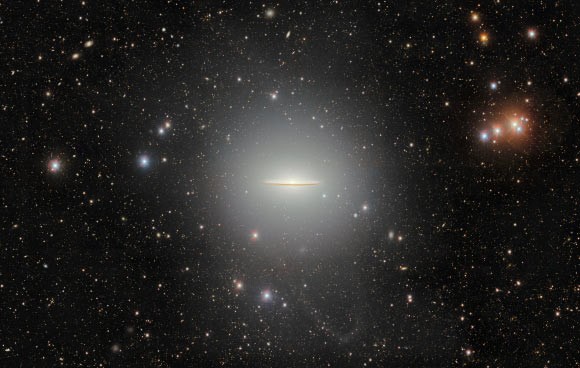
A powerful new image of the Sombrero Galaxy (M104) has been released, captured by the 570-megapixel Dark Energy Camera (DECam) mounted on the Víctor M. Blanco 4-m telescope in Chile. This high-resolution view provides astronomers with more than just a beautiful picture; it offers a detailed map of a galaxy with a complex and potentially violent history.
A Galactic Hybrid
Located approximately 28 million light-years away in the constellation Virgo, the Sombrero Galaxy is an astronomical anomaly. While most galaxies fall into distinct categories, M104 acts as a hybrid :
- Spiral Characteristics: It possesses a prominent disk and spiral arms.
- Elliptical Characteristics: It features an unusually large, bright central bulge.
Because we view the galaxy nearly “edge-on” (at an angle of just 6 degrees), its most striking feature is the dark, thick lane of dust that encircles its bright core, giving it the appearance of a wide-brimmed hat.
New Discoveries in the Details
The sensitivity of the DECam instrument has allowed researchers to see features that were previously obscured or lacked sufficient detail. The new imagery highlights three critical components:
- The Central Nucleus and Clusters: At the heart of the galaxy lies an intensely bright nucleus, surrounded by a massive swarm of approximately 2,000 globular star clusters.
- The Dust Lane: A thin, dark band of cold dust and hydrogen gas traces the disk’s perimeter, marking the primary site of active star formation.
- The Massive Halo: Perhaps most significantly, the image reveals an enormous glowing halo that extends over three times the width of the galaxy itself. This level of detail in capturing the halo’s scale is a significant achievement for astronomers.
Evidence of a Turbulent Past
The most compelling aspect of this new data is not just what is visible, but what it implies about the galaxy’s evolution. The DECam captured a sweeping stellar stream extending from the southern side of the galaxy.
This stream, along with the vast halo, is composed of stars that appear to have been “torn” from their original homes. For astronomers, this is a “smoking gun” for galactic mergers. It suggests that the Sombrero Galaxy grew by consuming smaller satellite galaxies, a process that reshaped its structure and contributed to its unique hybrid appearance.
“The halo and the stellar stream are populated with stars that have been torn from their home galaxies, hinting at a past galactic merger,” noted astronomers from NOIRLab.
Why This Matters
Understanding the Sombrero Galaxy helps scientists piece together the lifecycle of galaxies. By studying the stellar streams and the distribution of globular clusters, researchers can better understand how galaxies grow through mergers and how supermassive black holes—like the one residing at M104’s center—influence their surroundings.
Conclusion
The new high-resolution imagery of the Sombrero Galaxy provides a rare, detailed look at its massive halo and stellar streams, offering vital evidence that this iconic hybrid galaxy was shaped by the violent consumption of smaller neighbor galaxies.